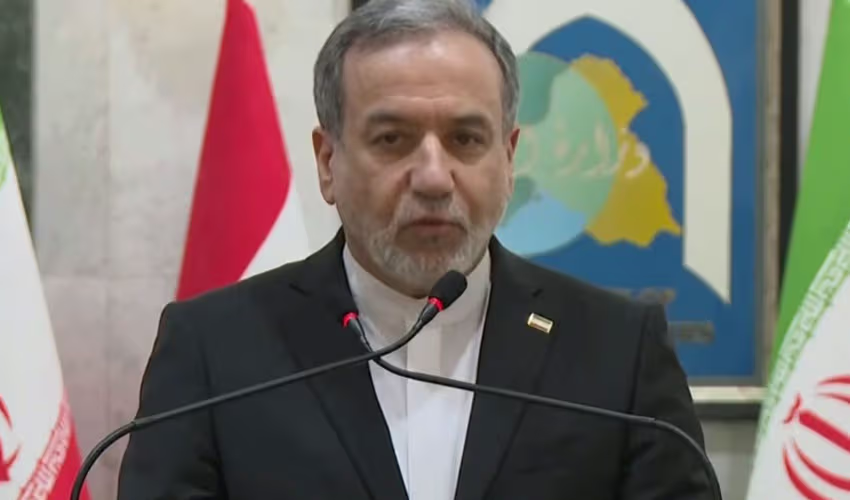
Iranian Foreign Minister Abbas Araghchi has said Tehran is prepared to reopen the Strait of Hormuz under a seven-day plan if the United States is serious about reaching an agreement.
In an interview with US media, Araghchi said Washington could take the required measures within five days, with the strategic waterway reopening on the sixth day and negotiations on a final agreement resuming on the seventh.
Araghchi said Iran had proposed a specific sequence of steps to create a path back to negotiations.
“We want the US to take certain specific measures; it can do so within five days. On the sixth day, the Strait of Hormuz would open, and on the seventh day, negotiations for a final agreement would resume,” he said.
The foreign minister added that the possibility of an agreement remained if Washington was genuinely prepared to reach a deal on reopening the Strait of Hormuz.
Araghchi says war can’t resolve dispute
Araghchi stressed that military action was not a solution to the issues between Iran and the United States.
“War is not the solution to any problem,” he said, adding that the dispute could be resolved through negotiations and dialogue.
He said Tehran was continuing to pursue diplomacy despite its experience with previous agreements and negotiations with Washington. He also rejected claims that Iran had violated the Nuclear Non-Proliferation Treaty (NPT).
“We have not violated the Nuclear Non-Proliferation Treaty,” he said, while arguing that Iran had faced attacks during negotiations in both 2025 and 2026.
According to Araghchi, the attacks occurred while diplomatic efforts were underway, undermining confidence in the negotiation process.
Collapse of previous agreement
The Iranian foreign minister said it took the United States only two weeks to abandon an agreement that had already been signed.
“They attacked us during the negotiations in 2025 and 2026,” Araghchi said, adding that Washington took only two weeks to break the agreement it had signed.
He questioned why Iran should return to diplomacy after those experiences, saying there was “no reason” for Tehran to resume negotiations under such circumstances.
Diplomacy remains worth pursuing
Despite his criticism of the previous process, Araghchi said Iran was still giving diplomacy an opportunity.
“There is no reason for us to return to diplomacy,” he said, before stressing that he was nevertheless continuing to pursue a diplomatic solution.
“I believe we should not squander any opportunity for peace,” Araghchi added.
His comments indicate that Tehran continues to leave the door open to negotiations, with the reopening of the Strait of Hormuz and a return to broader talks tied to specific measures that Iran wants Washington to take.