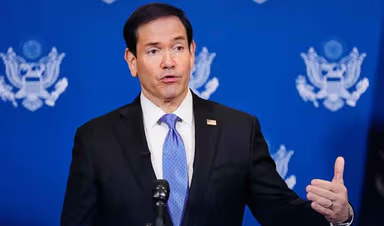
US Secretary of State Marco Rubio said on Wednesday that Washington would honour its defense commitments to Saudi Arabia amid escalating regional tensions and a series of Houthi attacks on the Kingdom.
Rubio described the US-Saudi defense agreement as “very strong” and said Washington was already fulfilling its commitments, while stressing that President Donald Trump had multiple options available in response to the attacks.
Speaking to reporters in New York, Rubio said the United States had made firm commitments to Saudi Arabia and would continue to uphold them.
“We have a very strong defense agreement with Saudi Arabia, and we will live up to our commitments in that agreement,” Rubio said when asked whether Trump was prepared to take further action against the Houthis.
Rubio declined to provide details about potential military options but said Saudi Arabia remained a strategic defense partner of the United States. He added that Trump had “many options available” to him.
US closely monitoring attacks on Saudi Arabia
Rubio said Washington was closely reviewing the latest attacks on Saudi Arabia, describing the situation as “very disturbing.”
The comments came amid security concerns in the Kingdom following missile and drone attacks by Houthi forces in recent weeks. Reuters has reported that Houthi attacks have expanded to several Saudi cities and affected energy infrastructure.
Rubio also said Saudi Arabia had faced attacks from groups beyond the Houthis, pointing to what he described as Iranian-backed militias in Iraq.
“The Iranian regime actively supports organizations in the Middle East who target infrastructure, energy infrastructure and civilians,” Rubio said.
Rubio links attacks to Iran-backed groups
The secretary of state accused Iran of supporting and arming groups that have targeted energy and civilian infrastructure across the region. He said militias in Iraq backed by Tehran were likely involved in recent attacks on energy infrastructure, while also referring to strikes against Saudi Arabia launched from Yemen.
Rubio said the United States was concerned about attacks on regional energy infrastructure and their wider implications for security and trade. He welcomed the restart of a Saudi oil pipeline that had been temporarily shut down following attacks earlier this month.
He described the infrastructure as important not only for the Saudi economy but also for global trade, highlighting the broader economic implications of disruptions to energy infrastructure in the region.
Rubio addresses US-Iran diplomatic contacts
Rubio also discussed indirect diplomatic contacts between Washington and Tehran that took place on the sidelines of the United Nations General Assembly.
He said the United States understood the concerns surrounding the Strait of Hormuz and would continue efforts to defend and keep strategic waterways open. Rubio added that Trump had a number of options available, including military options.
Rubio said any agreement with Iran would require “hard work over a period of time,” while reiterating that the US president retained military options.
US-Iran talks remain unresolved
Rubio described Tuesday’s discussions involving US and Iranian officials as largely an exchange of ideas and messages. The contacts involved US special envoys Steve Witkoff and Jared Kushner, who met with mediators over a possible agreement to end the Iran conflict.
Trump said Tuesday that US officials had held a “very good” three-hour meeting with the Iranian delegation and indicated that Washington and Tehran were moving toward a settlement.
Iranian officials, however, said Tehran was reviewing the US response to its proposal to end hostilities while significant differences remained between the two sides. Reuters reported that reopening the Strait of Hormuz and lifting the US naval blockade of Iran were among the issues discussed during the indirect talks.
An Iranian official also said Tehran could reopen the Strait of Hormuz within days if Washington eased military pressure and lifted its blockade on Iranian ports.
US-Saudi defense partnership
Saudi Arabia and the United States signed a strategic defense agreement during Crown Prince Mohammed bin Salman’s visit to Washington in November 2025, according to the report.
The agreement was presented by the White House at the time as a means of strengthening deterrence in the Middle East and deepening military cooperation between Washington and Riyadh. Trump also designated Saudi Arabia as a major non-NATO ally during the visit.
Rubio’s latest comments come as Saudi Arabia faces increased security pressures linked to the wider regional conflict and Houthi military activity.
The United States has also continued to emphasize the importance of protecting strategic waterways, including the Strait of Hormuz, amid disruptions to regional shipping and energy flows.