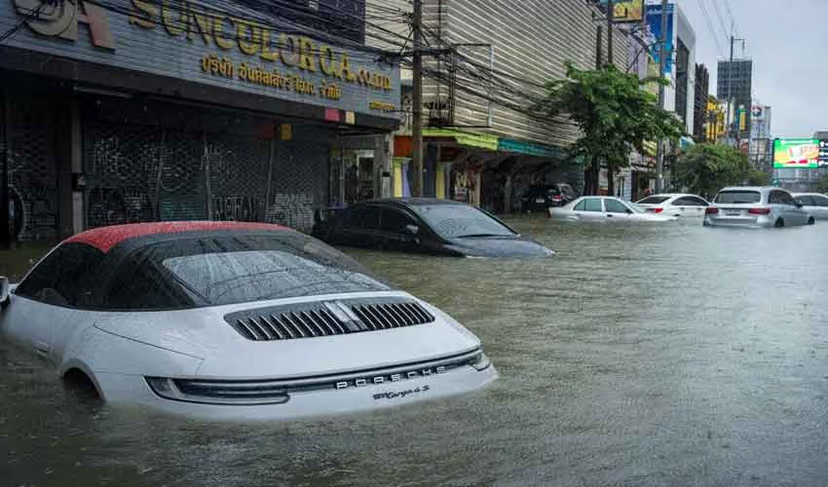
Thousands of residents have taken shelter in evacuation centres across Thailand as flooding continues in Bangkok following intense weekend rainfall, while authorities in the eastern province of Rayong have ordered further evacuations after reservoirs exceeded capacity.
More than 80,000 people living in flooded areas are currently unable to leave their homes, prompting officials to deploy boats and mobile kitchens to provide emergency assistance.
Bangkok was hit by 320 millimetres (12.6 inches) of rain over two or three days last week, nearly matching the amount the low-lying capital normally receives throughout the entire month of September.
The intense rainfall overwhelmed the city’s drainage system and inundated entire neighbourhoods. Although rainfall eased in the capital on Sunday, flooding persisted in several low-lying areas, with intermittent showers continuing on Monday.
Interior Ministry Permanent Secretary Unsit Sampuntharat said more than 80,000 residents in flooded areas were unable to leave their homes. Mobile kitchens and boats were being mobilised to support affected communities.
“The goal is to provide three meals a day to all residents throughout the flooding period and for at least another seven after waters recede,” he said.
Thousands move to evacuation centres
At least 5,901 people in Bangkok had moved to 234 evacuation centres, according to a city administration official. Earlier, the city had established more than 200 temporary shelters, with about 3,000 people staying in them as of Sunday.
At least 31 roads remained affected by floodwaters, while several low-lying suburban areas were still submerged. Bangkok Governor Chadchart Sittipunt said officials were working to drain the water as quickly as possible.
Chadchart said rainfall in Bangkok had decreased but warned that water levels in the city’s main canals remained high, with some still rising as water continued to flow in from surrounding areas.
8 killed as floods hit 41 provinces
Bangkok is among 41 provinces affected by flooding since September 16. The Interior Ministry said at least eight people have died, while more than 580,000 homes have been affected nationwide.
Separately, Thailand’s Department of Disaster Prevention and Mitigation said more than 545,000 people in 25 other provinces had been impacted by flooding as of Sunday, particularly in central and eastern regions.
Prime Minister Anutin Charnvirakul said incessant rainfall had overwhelmed drainage capacity in many areas. He ordered relevant authorities to take immediate measures to ease flooding and provide assistance to affected residents.
Rayong orders evacuations as reservoirs overflow
In the eastern coastal province of Rayong, authorities ordered evacuations on Monday after floodwaters caused two reservoirs to exceed their capacity.
Rayong lies next to a major industrial belt, raising concerns about the impact of flooding on businesses and economic activity in the region.
Bangkok and eastern Thailand are expected to bear much of the economic impact, particularly among wholesale and retail businesses, while industry and agriculture in other areas could also suffer.
Flood-hit Bangkok sees floating market
In the hard-hit Bang Kapi neighbourhood, residents waded through waist-deep water to purchase essential supplies three days after relentless rainfall triggered flooding.
Some vendors adapted to the conditions by setting up makeshift stalls using floating plastic boxes and drums, creating an improvised market amid the floodwaters.
Bangkok’s location on a river delta, its soft clay ground and its elevation of only around 1.5 metres (5 feet) above sea level leave the capital particularly vulnerable to flooding. The city, home to more than 8.4 million people, also faces regular flooding during its six-month rainy season and is sinking by several millimetres each year.
Floods threaten Thailand’s economic growth
Economist Aat Pisanwanich of Rangsit University’s economics department estimated that the flooding could cause at least 11 billion baht ($327 million) in economic damage nationwide, with losses potentially increasing if conditions do not improve.
He said the flooding could reduce Thailand’s economic growth this year by 0.3 percentage points to 2.1%, while third-quarter growth could be cut by around 0.5 percentage points to 1.7%.
Thailand’s economy, Southeast Asia’s second-largest, grew 1.9% year-on-year in the second quarter. That was significantly lower than the 2.8% growth recorded in the previous quarter and comes as the country continues to lag behind several regional economies following the COVID-19 pandemic.
The flooding has also disrupted transportation and businesses across the country. Several long-distance train and bus services were suspended, while airports continued operating, although passengers experienced some delays.
The widespread flooding has affected traffic in Bangkok, with businesses also facing significant disruption as accumulated rainfall exceeded 300 millimetres (11.8 inches) in many areas.
Weather conditions remain concern
Thailand’s Meteorological Department warned that moderate to heavy rain was expected in several parts of the country on Sunday, although conditions were expected to improve by Monday.
On Sunday, September 27, thunderstorms were forecast across 80% of Bangkok and surrounding provinces. Over the following 24 hours, many areas in the western part of the Central region were expected to receive heavy rain, with some areas facing very heavy downpours.
Rainfall was beginning to ease in Bangkok, surrounding provinces and the eastern region, but authorities warned that heavy showers could continue.
Residents were advised to remain alert for heavy to very heavy rain and accumulated rainfall, which could trigger flash floods, rising floodwater and overflowing rivers. Forest runoff and landslides were also possible, particularly on foothill slopes near waterways and in low-lying areas.
Authorities urged people to avoid routes that are prone to recurring flooding, particularly low-lying roads where temporary waterlogging could develop.
Monsoon conditions driving heavy rainfall
The weather conditions are being driven by a low-pressure area over the western part of Thailand’s Central region, combined with a fairly strong southwesterly monsoon over the Andaman Sea, southern Thailand and the Gulf of Thailand.
The upper Andaman Sea and upper Gulf of Thailand are experiencing fairly strong winds, with waves reaching 2 to 3 metres and rising above 3 metres during thunderstorms.
The Meteorological Department advised mariners in the Andaman Sea and Gulf of Thailand to navigate carefully and avoid areas affected by thunderstorms.
Small boats in the upper Andaman Sea and upper Gulf of Thailand were advised to remain ashore until Monday, September 28.
The latest flooding comes less than a year after catastrophic floods in southern Thailand killed at least 145 people.
Those floods were triggered by 630 millimetres (25 inches) of rain over three days, inundating more than 33,000 homes and damaging critical infrastructure, including schools, hospitals and highways.