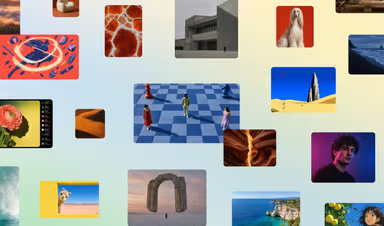
Design platform Canva has launched its first in-house image generation model, Canva Craft, as it expands its artificial intelligence capabilities to compete with image-generation technologies developed by Google, OpenAI, ByteDance and Meta.
Developed by Canva’s research team, the model is designed to produce images with accurate object details, readable text and layouts suited to different digital platforms.
According to the company, Canva Craft uses a two-stage process. First, it interprets a user’s prompt and develops a plan covering spatial relationships, relative sizes, visual hierarchy and text generation. It then generates an image at resolutions of up to 2K across as many as 30 aspect ratios.
Canva said the approach also allows users to make precise changes to an image without altering other elements.
Model trained on design templates
Unlike image-generation models primarily trained on photographs, Canva said Craft was trained using designs from its library of human-created templates.
These include posters, social media graphics, presentations, infographics, menus and typography-heavy layouts.
The company said this design-focused training could make generated images easier to transform into editable, layered compositions using Canva Magic, its image-to-design tool.
Canva previously introduced its own design-focused AI model to better understand design elements and layers, expanding its efforts to integrate AI into creative workflows.
Canva Craft expands AI access
Canva Craft is available through the Dream Lab tab on the company’s platform, according to Canva. The company also plans to make the model available through its application programming interface (API).
It intends to support image generation through third-party chatbots, including ChatGPT and Gemini, using Canva’s Model Context Protocol (MCP) integration.
Canva already uses multiple image-generation models across its platform. The introduction of an in-house model could help the company manage API expenses while gaining greater control over image quality and generation speed.
The company is also developing two lower-cost versions, called Craftfast and Craft-ultrafast, which it says will be released later.
Leonardo.ai researchers contributed to model
Canva acquired generative media platform Leonardo.ai in 2024 as part of its broader investment in AI-powered creative tools.
The company said researchers from Leonardo contributed to the development of Canva Craft.
The launch comes as Canva continues to expand its AI offerings while navigating the costs of developing and deploying generative AI technology.