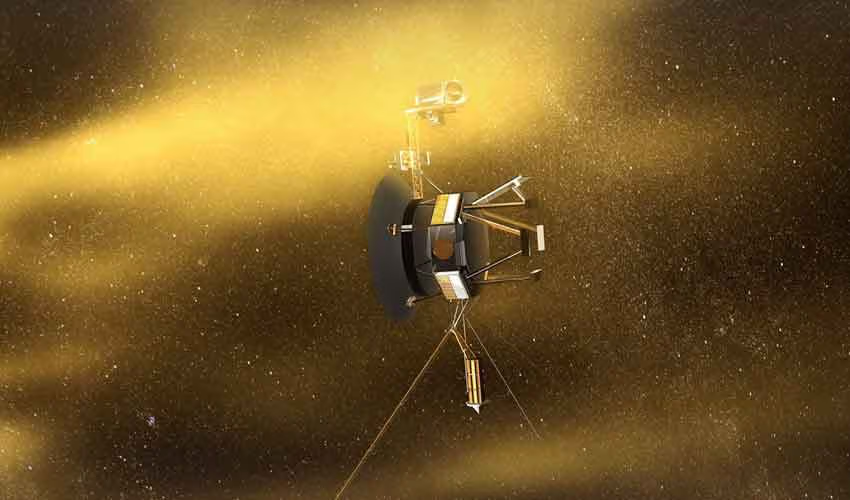
NASA’s Voyager 1, humanity’s most distant spacecraft, has crossed the one-light-day distance from Earth after nearly 49 years of travelling through space, marking an unprecedented achievement in space exploration.
The spacecraft reached the milestone on Wednesday, November 18, at 5:16 am EST (10:16 GMT), travelling approximately 16.1 billion miles (25.9 billion kilometres) from Earth.
NASA confirmed the achievement after receiving Voyager 1’s radio signal through its Deep Space Network antennas in Madrid, Spain, early Thursday, nearly 24 hours after the spacecraft reached the milestone.
The delay reflects the time it takes for a radio signal travelling at the speed of light to cover the distance between Voyager 1 and Earth.
NASA engineer Nshan Kazaryan announced the confirmation at the agency’s Jet Propulsion Laboratory (JPL) in California, saying, “After 16 billion miles of exploration, Voyager 1 continues its journey into the unknown.”
NASA officials and mission leaders celebrated the milestone, even as they acknowledged the challenges of keeping the ageing spacecraft operational.
“This is such an amazing day,” NASA’s head of science, Nicola Fox, said at a JPL event, praising the team that continues to keep Voyager 1 travelling farther into space.
What is a light-day?
A light-day is the distance light travels in 24 hours, approximately 16 billion miles (26 billion kilometres). Scientists use the speed of light to measure enormous distances across the universe.
Light travels at approximately 186,000 miles (299,000 kilometres) per second in a vacuum. A ray of sunlight takes about 1.3 seconds to reach the Moon, around four hours to reach Neptune and approximately 20 hours to reach Voyager 1.
A light-year, another commonly used astronomical measurement, represents the distance light travels in a year, approximately 5.9 trillion miles (9.5 trillion kilometres).
NASA’s Heliophysics Division director Joe Westlake said Voyager’s achievement was much more than simply travelling farther from Earth.
“Traveling a light-day is a singular feat for a spacecraft, but Voyager is so much more than a distant traveler,” he said, adding that the mission’s Grand Tour of the outer planets transformed planetary science before the spacecraft became a central part of NASA’s heliophysics missions.
Voyager 1 continues exploring interstellar space
Voyager 1 crossed the outer boundary of the heliosphere, the protective bubble of particles and magnetic fields generated by the Sun, in 2012, entering interstellar space.
The spacecraft is currently travelling at nearly 38,000 miles per hour (61,000 kilometres per hour) and heading towards the star Gliese 445, which is approximately 17 light-years from Earth.
If it maintains its current trajectory, Voyager 1 is expected to pass within about 1.7 light-years of the star in roughly 40,000 years.
Before entering interstellar space, Voyager 1 explored Jupiter and Saturn, two of the largest planets in the solar system. The mission provided scientists with groundbreaking observations and high-resolution images of the planets and their moons.
Its twin, Voyager 2, was launched in 1977, several weeks before Voyager 1, and entered interstellar space in 2018.
NASA investigates Voyager 1’s technical problems
Despite reaching the historic milestone, Voyager 1 is experiencing technical difficulties as its systems continue to age.
The spacecraft stopped transmitting science and engineering data on November 14, although it has remained in contact with Earth through a carrier signal, which typically carries the data collected by its instruments.
NASA engineers have used the carrier signal and trajectory calculations to confirm the spacecraft’s distance from Earth while continuing to investigate the technical issue affecting its science and engineering transmissions.
Voyager project manager Suzanne Dodd expressed confidence that the spacecraft would resume transmitting data.
“The anomalies have become normal for us,” Voyager mission manager Kareem Badaruddin said, acknowledging the challenges of maintaining the nearly five-decade-old spacecraft.
“We’re having to work with today’s technology to interface with aging technology — aged technology — and just solving problems that way,” Badaruddin added.
Voyager spacecraft running out of power
The spacecraft are gradually losing power generated by their plutonium-based radioisotope power systems, forcing NASA to switch off instruments and other systems to extend their operational lives.
NASA has implemented power-saving measures that could allow both Voyager probes to remain in communication with Earth for another three to four years, according to a JPL representative.
Voyager project scientist Linda Spilker said Voyager 1 currently has two scientific instruments operating, while Voyager 2 has three.
Voyager 1 continues collecting information about the effects of the Sun, including solar storms, shock waves and pressure fronts that extend into interstellar space, as well as fast-moving energetic particles known as galactic cosmic rays.
“We’re one light-day, but we are definitely not done yet,” Dodd said.
Voyager 2, which is considered to be in very healthy condition, is expected to reach the one-light-day distance from Earth in November 2035.
Voyager mission to continue beyond communications
NASA officials said the Voyager mission will continue to hold scientific value even after the spacecraft eventually lose the ability to communicate with Earth.
“When’s the mission going to end? It’s never going to end, even when we can no longer talk to Voyager,” Fox said, describing the spacecraft’s journey through the near-vacuum of interstellar space.
She also highlighted the possibility of developing nuclear-powered spacecraft for future missions to explore interstellar environments, stressing the importance of having sufficient power for extended space exploration.
“What you want is a lot of power,” Fox said.
Fox added that Voyager’s scientific observations remain particularly valuable because the spacecraft are exploring regions of space humanity has never directly studied before.
“They’re in an area of space that we’ve never been to, so every single bit of data that comes back is precious,” she said.
JPL director Dave Gallagher described Voyager 1’s crossing of the light-day threshold as another historic achievement in an extraordinary mission, praising the scientists and engineers who have kept the spacecraft connected to Earth across vast distances.
He said the milestone reflects the dedication of generations of teams who built, programmed and continue to operate the spacecraft, adding that Voyager’s achievements inspire NASA to pursue new frontiers in robotic and human exploration.
Voyager’s Golden Record carries message from Earth
Beyond its scientific instruments, Voyager 1 carries the Golden Record, a gold-plated copper phonograph containing images and sounds from Earth intended as a message to any advanced civilisation that might eventually encounter the spacecraft.
Nearly half a century after its launch, the Voyager mission continues to represent the ambition and curiosity that drive humanity’s exploration of the universe.
Caltech president Ray Jayawardhana said the mission reflects the vision of Ed Stone, the physicist and former JPL director who guided Voyager for decades, alongside generations of scientists and engineers who continued his work.
“Beyond its immense contributions to science, Voyager also captures something profound about the human spirit,” Jayawardhana said.
“We may never know where its journey will ultimately lead, but it will venture on, an enduring affirmation that humanity was here and we yearned to explore.”
Voyager deputy project scientist Jamie Rankin also reflected on the mission’s persistence, saying its journey should remind people not to give up despite limitations or difficult circumstances.
He said humanity should “never stop shining and never stop reaching for the stars — for we never know how far we will go.”