

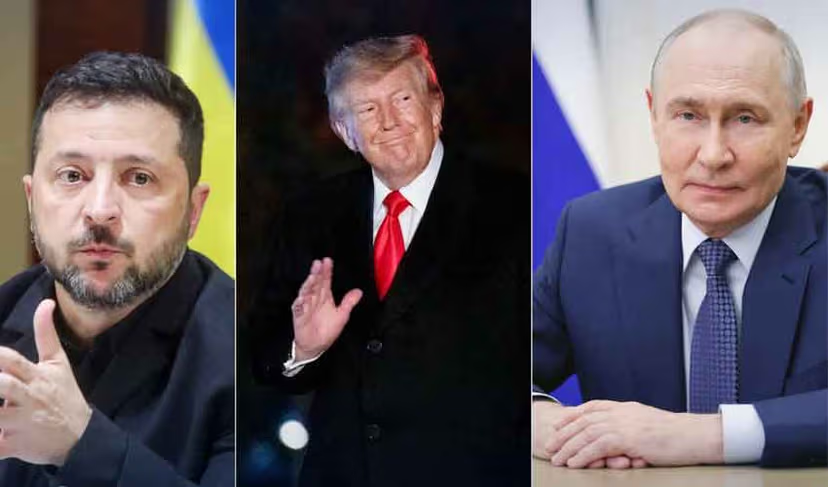
US President Donald Trump has suggested that Ukrainian President Volodymyr Zelensky should consider appointing someone else to negotiate an end to the war with Russia, while discussing Iran’s military capabilities, oil prices, nuclear disarmament and a proposed meeting with Chinese President Xi Jinping and Russian President Vladimir Putin.
Speaking to reporters at the White House on Monday, Trump questioned Zelensky’s role in negotiations and said Russia had been relatively inactive in the conflict. He also confirmed that the United States continued to share intelligence with Ukraine and said he would consider extending temporary protected status for Ukrainians in the US until the war ends.
Trump said it might be time for Ukraine to appoint another representative to negotiate on its behalf as efforts continue to end the war with Russia.
“Maybe it’s time for Zelenskiy to get somebody else to negotiate,” Trump said, reiterating a position he had also expressed on October 10, when he called for Ukraine to replace its president.
The US president described Russia’s recent actions in Ukraine as relatively limited, saying Moscow had been “fine” in this regard and adding that Russian forces “haven’t been doing much”.
Despite his criticism of Zelensky, Trump said Washington continued to share intelligence with Kyiv. He also said he would consider allowing Ukrainians to remain in the United States under temporary protected status until the war comes to an end.
Russia’s role in Iran conflict
Trump said the United States was holding discussions with Russia about Iran, offering differing assessments of Moscow’s involvement in the conflict.
At one point, he said Russia had done nothing in Iran and described that as a positive development. He also said Russian President Vladimir Putin was keeping his distance from Tehran, calling that the news.
However, Trump separately claimed that Russia was providing significant assistance to Iran.
The US president said Washington was inflicting severe economic and military blows on Iran and insisted that Tehran must change its behaviour regardless of the circumstances.
He also claimed that Iran’s leadership had requested a halt to attacks and said any cessation of hostilities would require the country to abandon its pursuit of nuclear weapons.
Iran’s leadership and air defences weakened
Trump said Iran had lost much of its senior leadership, claiming that the country’s first and second tiers of leaders had been eliminated. He added that Iran had lost several commanders and alleged that those who survived had sought assurances that they would not suffer the same fate as their predecessors.
The US president also claimed that Iran’s radar and air defence systems had been destroyed, presenting the developments as evidence of the severity of the military campaign.
However, Trump said he did not know precisely whom the United States was negotiating with in Iran, despite his claim that Iranian leaders had sought an end to the attacks.
Trilateral summit with China and Russia
Trump said he was prepared to hold a trilateral meeting with Chinese President Xi Jinping and Russian President Vladimir Putin, describing the proposed summit as a potentially positive development for the world.
He acknowledged that no agreement to hold the meeting had been reached but said he was ready to proceed and expected the summit to take place.
Trump said the meeting would not primarily focus on the war in Ukraine. Instead, he indicated that nuclear weapons and disarmament would be central topics, alongside other matters, including trade.
The US president also discussed the balance of nuclear capabilities among the three countries, saying China would need another five years to reach parity with the United States and Russia in terms of nuclear weapons.
He expressed confidence that the discussions would extend beyond nuclear issues to include trade and other areas of mutual interest.
Trump predicts further decline in oil prices
Trump said oil prices would fall further because of abundant supplies in the global market. He predicted a significant drop in prices once the conflict ends, linking the outlook for energy markets to the conclusion of hostilities.
His remarks came alongside his claims that the United States was applying substantial economic and military pressure on Iran and that Tehran had sought a halt to attacks.
Turning to domestic economic issues, Trump announced an $8 billion financial assistance programme for American farmers. He said a new relief initiative would be launched to support the agricultural sector, reiterating that farmers would receive $8 billion in financial assistance.
Trump also said the United States and Mexico were close to reaching a major agreement, although he did not provide further details about its scope or the issues it would cover.
During the White House interaction, Trump also criticised immigration in France, claiming that migrants had held the country “hostage” for years.
He further predicted that Paris would soon become a Muslim-majority city, without providing supporting evidence for the assertion.
Nuclear diplomacy and Ukraine remain key issues
Trump’s comments highlighted several issues facing his administration, including the search for an end to Russia’s war against Ukraine, the conflict involving Iran and the possibility of renewed discussions on nuclear disarmament.
His suggestion that Zelensky should hand negotiations to another representative could add to tensions surrounding Washington’s approach to Kyiv, even as the US continues to share intelligence with Ukraine.
Meanwhile, Trump’s willingness to consider a meeting with Xi and Putin signals an interest in discussing nuclear weapons and trade directly with the leaders of the world’s other two major nuclear powers.