The fire broke out at around 4pm local time on Saturday at Canadian Forces Base Wainwright, approximately 210 kilometres east of Edmonton, Alberta’s capital. Authorities said the blaze is now contained, although emergency crews remain at the scene to guard against possible flare-ups.
The deceased soldiers were identified as Sergeant Morgan Wong, Private Shaun Farrell, Private Aidan Goulding and Private Hayden Lykkemark.
According to Alberta Premier Danielle Smith, 39 people were receiving hospital treatment following the incident, with at least 19 in critical condition. Smith warned that many of the injured would require weeks or even months of specialised and intensive medical care.
The injured included reservists and members of the Princess Patricia’s Canadian Light Infantry. Officials said those affected had come from military bases across Canada.
Addressing the nation from Ottawa on Sunday, Carney expressed condolences to the families and colleagues of the deceased.
“The nation is in mourning for those brave members of our armed forces who we have lost,” he said, adding that he had ordered flags on federal buildings across Canada to be lowered to half-staff in honour of the victims.
Carney also praised military personnel and civilian emergency workers who battled the flames throughout the night under what he described as “some of the worst conditions imaginable”.
Strong winds caused fire to spread rapidly
Military officials said the blaze began as a smouldering grass fire in the prairie landscape surrounding the base’s training facilities. The fire ignited approximately one kilometre from an attack range before spreading towards the area where soldiers were conducting exercises.
Major General Wade Rutland, commander of the 1st Canadian Division based in Edmonton, said the cause of the fire remained under investigation.
He explained that winds reaching speeds of up to 96 kilometres per hour, or 60 miles per hour, fuelled the flames. Wind speeds had been below 50 kilometres per hour before the fire started, making the sudden change particularly dangerous.
Rutland described the incident as an “uncommon, rapid” event, saying the flames advanced approximately one kilometre in just 30 to 60 seconds.
“I’ve certainly never seen anything like it,” he said.
The fire’s rapid spread and shifting direction pushed it towards the administrative area of the attack range, complicating efforts to contain the blaze and protect personnel.
Wainwright Mayor Bruce Pugh told the BBC that cannon fire had been heard coming from the base on Saturday before it suddenly stopped. He noted that hearing cannons was not unusual in the area, but emergency services were subsequently mobilised for what was described as an “all hands on deck” situation.
Soldiers conducting live-fire combat training
At the time of the fire, soldiers were carrying out high-intensity combat training involving live ammunition at the base’s grenade and attack ranges.
Rutland said 85 soldiers from the 3rd Battalion of the Princess Patricia’s Canadian Light Infantry were participating in the exercises. The training included the use of grenade launchers, grenades, small arms and ammunition.
The attack range was designed to simulate combat scenarios, with groups of approximately 10 soldiers practising assaults against a simulated enemy.
Officials said the soldiers were preparing for deployment to Latvia, where Canadian forces currently maintain their largest international military operation.
The presence of multiple training activities and live munitions across the area added to the complexity of the emergency, although officials have not established a connection between the training exercises and the initial ignition of the grass fire.
No evidence of terrorism, outside interference
The Canadian Armed Forces said in a statement early Sunday that the incident remained under investigation, but there were no indications that it had resulted from terrorist activity.
Rutland also ruled out outside interference and said officials did not believe the fire was connected to the region’s extensive oil and gas infrastructure.
Investigators have not yet determined what caused the grass fire, and military officials have declined to speculate while inquiries continue.
Hospitals emergency response expands
The scale of the incident placed considerable pressure on healthcare facilities in and around Wainwright.
Warren Thirsk, an emergency department doctor at Edmonton’s Royal Alexandra Hospital, told CBC that the number of patients involved had “completely overwhelmed” healthcare facilities in Wainwright.
The Royal Alexandra Hospital initially declared a code orange, a disaster-response protocol used to coordinate care during a mass-casualty incident. The alert was later stood down.
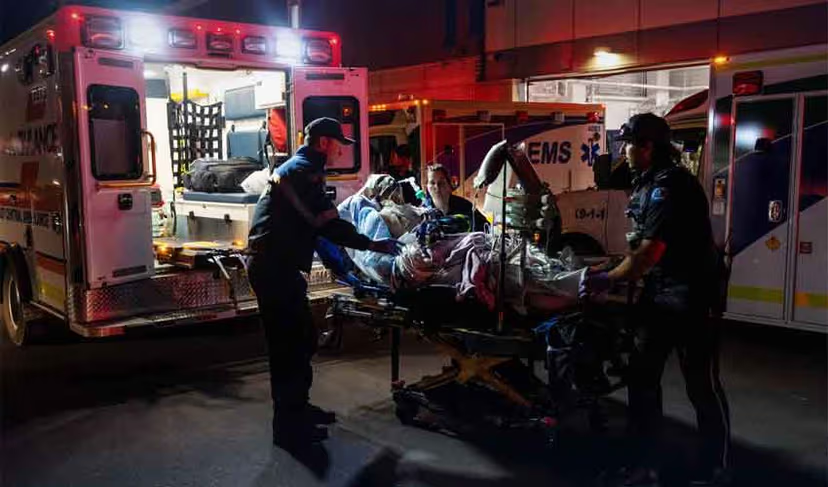
Smith said 22 ground ambulances and eight air ambulances responded to the emergency. Patients were transferred to hospitals in Edmonton, Wainwright, Calgary and Red Deer.
Military search-and-rescue technicians also parachuted into the site as part of the response, Rutland said.
Carney said military and civilian firefighters continued working through the night in exceptionally difficult conditions as emergency teams dealt with the aftermath of the fire.
Fire contained at major Canadian training base
Canadian Forces Base Wainwright is one of the country’s principal facilities for live-fire military training. It houses the Canadian Manoeuvre Training Centre, which conducts training scenarios and exercises for the Canadian Army, and accommodates troops from Canada and allied countries.
The base typically has around 690 military personnel and 300 civilian workers on site on an ordinary day. Census data recorded 1,310 military and civilian personnel stationed there in 2021.
The nearby town of Wainwright has a population of approximately 6,600 and lies just north of the military installation.
The municipality said on social media that the fire had crossed the base’s perimeter fence into a neighbouring district, although no evacuation orders had been issued. In a subsequent update on Sunday, local authorities said the fire was not expected to spread beyond its existing boundaries.
Fire and rescue teams remain at the scene to monitor conditions and prevent potential flare-ups as investigators work to establish how the blaze began.
The deaths and injuries have cast a shadow over the Canadian military community, with authorities continuing to coordinate medical care for survivors and support for those affected by one of the country’s most serious peacetime military incidents.