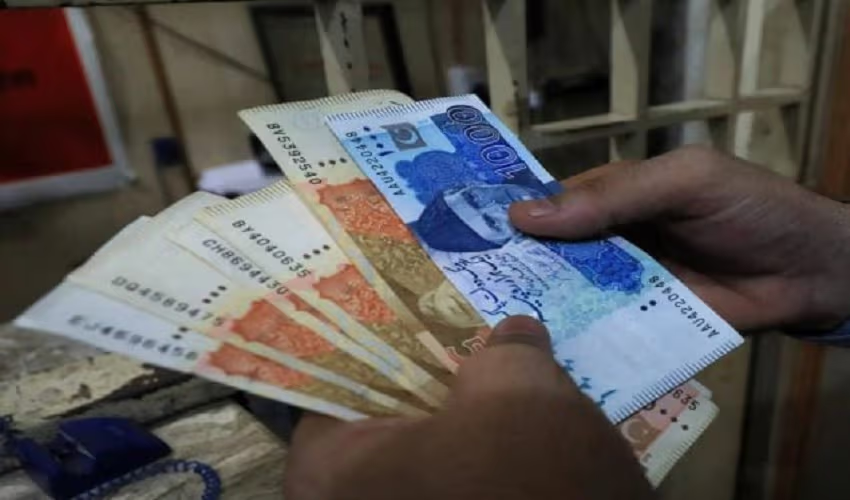
The federal government has planned to borrow Rs7,020 billion during the current fiscal year to finance the budget deficit, with most of the funding expected to come from domestic sources.
The government has also unveiled a three-year debt strategy for 2026–2028, prioritising long-term fixed-rate borrowing while seeking to reduce dependence on short-term loans.
Under the borrowing plan, the government expects to raise Rs6,046 billion from domestic sources, while another Rs813 billion is projected to come through external financing.
The government has also estimated Rs161 billion in revenue from privatisation during the current fiscal year, adding another source of financing for its fiscal requirements.
The domestic borrowing plan includes raising around Rs4,580 billion through Pakistan Investment Bonds (PIBs) and Rs3,785 billion through Sukuk and other Islamic financing instruments.
The plan also estimates a net repayment of Rs2,592 billion through T-bills, as the government manages its short-term debt obligations.
External borrowing and bond targets
According to a Ministry of Finance report, total external debt is projected at $13.378 billion during the fiscal year, while repayments are expected to reach $10.574 billion.
After accounting for these repayments, external financing is expected to generate a net inflow of $2.804 billion.
The government has set a target of issuing $2 billion worth of bonds during the current fiscal year. It has already raised $3 billion through a Eurobond.
Three-year debt strategy unveiled
The federal government has finalised its debt management strategy for 2026 to 2028, with a stated shift towards longer-term financing.
The strategy gives priority to long-term fixed-rate and zero-coupon bonds, while seeking to keep short-term and floating-rate borrowing limited.
The government also plans to prioritise long-term loans secured on favourable terms, Sharia-compliant bonds and financing that brings investors from outside the banking sector into the debt market.
Focus on reducing short-term borrowing
The debt strategy seeks to minimise reliance on short-term loans and reduce exposure to the risks associated with floating-rate debt.
The government plans to focus instead on longer-maturity instruments that can provide greater predictability in debt servicing while expanding the range of financing sources available to the country.
A key part of the strategy is also to re-enter international markets through Panda Bonds and Eurobonds, subject to market conditions.
The Ministry of Finance said implementation of the debt plan will depend on global economic conditions, the geopolitical situation and fiscal discipline.
The borrowing programme comes as the government seeks to meet its budget financing requirements while managing a substantial debt burden and balancing domestic and external financing needs.
The plan effectively puts fresh borrowing at the centre of the government’s strategy to finance the fiscal deficit, with domestic debt expected to account for the bulk of the required funds.