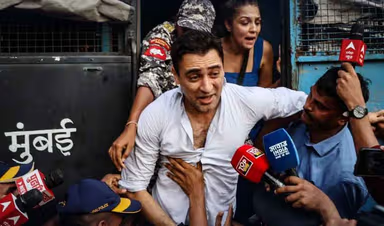
Indian authorities have asked Bollywood actor Imran Khan to leave the country by October 28, alleging that he violated immigration rules by participating in a political demonstration in Mumbai.
The notice followed his detention during a rally against Election Commission chief Gyanesh Kumar and a complaint filed by a Bharatiya Janata Party (BJP) leader.
The Foreigners Regional Registration Office (FRRO), a federal agency responsible for monitoring foreign nationals in India, issued a Leave India Notice (LIN) directing Khan to leave the country by October 28, according to reports by The Indian Express, The Times of India and other Indian media outlets.
Mumbai Police said the notice was issued after a complaint alleged that Khan had breached the Foreigners Act by participating in a political protest despite not being an Indian citizen. The complaint was filed at Gamdevi police station and forwarded to the FRRO for further action.
According to The Indian Express, the complaint prompted the FRRO to issue the notice on the grounds of an alleged violation of immigration and visa rules. Police also said Khan had been charged under the applicable provisions of the Foreigners and Immigration Act, 2025, according to an NDTV report.
Khan, 43, is a US citizen and holds an OCI card, which allows people of Indian origin to live in India under a special immigration arrangement but does not confer Indian citizenship.
Imran Khan detained during Mumbai protest
Khan participated in a rally organised by the satirical political movement Cockroach Janta Party (CJP) at Mumbai’s August Kranti Maidan on October 10. Protesters demanded the resignation of Chief Election Commissioner Gyanesh Kumar over revisions to voter lists that opposition parties and critics claim could benefit Prime Minister Narendra Modi’s ruling Bharatiya Janata Party.
Police detained Khan during the demonstration. His girlfriend Lekha Washington and relative Zayne Marie Khan also attended the protest and were reportedly detained by police.
Before his detention, Khan said he was attending the rally as a resident of Mumbai concerned about restrictions on freedom of movement and the suppression of public voices. He said he was not making demands of anyone and was not part of any organisation, describing himself as a representative of ordinary citizens.
Following his detention, Khan questioned restrictions on freedom of movement and what he described as the silencing of people’s voices. Videos of his detention quickly circulated online, drawing widespread attention.
On the day of the protest, the actor also posted a picture on Instagram showing him making a victory sign from the back of what appeared to be a police van, accompanied by the caption, “Apparently I’m going for a drive.” The post reportedly received more than two million likes.
BJP leader Kirit Somaiya filed complaint
BJP leader Kirit Somaiya filed the complaint that led to the authorities’ action against Khan. Somaiya had called for action against the actor, alleging that his participation in the protest violated OCI provisions and visa conditions.
Police said the complaint alleged that Khan had breached the law by taking part in the demonstration despite being a foreign national. The matter was subsequently referred to the FRRO, which issued the notice requiring him to leave India by October 28.
Khan did not immediately respond to a request for comment from Reuters.
What are rules for OCI cardholders in India?
OCI cardholders are foreign nationals of Indian origin who receive lifelong visa privileges under a scheme introduced in 2005. However, the status does not grant Indian citizenship and does not allow holders to vote or contest elections.
OCI cardholders remain subject to India’s immigration laws and regulations governing foreign nationals. Under Section 7D of the Citizenship Act, 1955, the government can cancel OCI registration on specified grounds, including concerns involving national sovereignty and security.
The rules do not expressly require OCI cardholders to obtain prior permission to attend a public protest. However, constitutional guarantees of freedom of speech and peaceful assembly under Article 19 apply to Indian citizens.
An immigration complaint or an allegation of a visa violation does not, by itself, establish that an offence has been committed or automatically justify deportation.
Why are protesters demanding Gyanesh Kumar’s resignation?
Calls for Kumar to step down have intensified amid controversy over revisions to India’s voter lists. Opposition parties and critics argue that the exercise could disenfranchise millions of voters and benefit Modi’s ruling Hindu nationalist BJP.
The Election Commission of India (ECI) has rejected allegations of impropriety, maintaining that the revisions are intended to remove duplicate and ineligible voters, including what it describes as “foreign illegal immigrants”.
Ahead of the October 10 demonstration, authorities in the Indian capital deployed thousands of police personnel, closed dozens of metro stations, cancelled more than 200 trains and temporarily suspended mobile internet services around the protest site.
The demonstrations have also been viewed as a revival of the so-called “cockroach” movement, which organised mass protests in July and led to the education minister stepping down over an examination scandal.
Imran Khan’s Bollywood career
Imran Khan, the nephew of Bollywood actor Aamir Khan, comes from a prominent film family. He starred in several hit Bollywood films between 2008 and 2015 before stepping away from acting.
The actor has remained on a hiatus from Bollywood, making his appearance at the Mumbai protest and subsequent detention particularly notable. His participation in the demonstration has now brought him into an immigration dispute that could affect his continued stay in India.
The authorities’ notice gives Khan until October 28 to leave the country. The allegations against him, however, remain distinct from a final determination of whether he violated immigration law or whether further action is legally warranted.