By: Moiz Farooq
Some dates in a nation’s calendar mark victories on the battlefield. Others mark victories of vision, diplomacy, and statecraft. For Azerbaijan, 20 September is both. It is the day in 1994 when the young republic signed the “Contract of the Century,” the agreement that secured its economic independence. And it is the day in 2023 when Azerbaijan’s local antiterror measures in Karabakh concluded, completing the restoration of its sovereignty over its internationally recognised territory. Together, these two events tell the story of a nation that rebuilt itself from crisis into strength.
To understand the importance of September 1994, one must remember the Azerbaijan of the early 1990s. Having restored its independence in 1991, the country faced war, occupation of around one fifth of its territory, a massive displacement of hundreds of thousands of refugees and internally displaced persons, economic collapse after the Soviet breakup, and internal political instability.
Azerbaijan possessed enormous hydrocarbon wealth beneath the Caspian Sea, but it lacked the capital, the technology, and the international partnerships needed to develop it. Many doubted that a newly independent state in such circumstances could negotiate as an equal with the world’s largest energy companies.
National Leader Heydar Aliyev saw what others did not. He understood that Azerbaijan’s oil could become more than a source of revenue. Developed wisely, it could anchor the country’s independence, attract the attention and investment of the world’s leading powers, and give Azerbaijan a strategic voice in regional affairs.
After long and difficult negotiations, on 20 September 1994, at the Gulustan Palace in Baku, the State Oil Company of the Azerbaijan Republic (SOCAR) signed a production sharing agreement with a consortium of major international oil companies from several countries, including the United States, the United Kingdom, Russia, Turkey, Norway, Japan, and Saudi Arabia. The agreement covered the development of the Azeri, Chirag, and deepwater Guneshli fields in the Caspian Sea.
The scale of the deal, its long term horizon, and its geopolitical weight earned it a fitting name: the Contract of the Century.
The Contract of the Century was far more than an energy agreement. It achieved several things at once.
First, it secured Azerbaijan’s economic sovereignty. For the first time, the country’s resources were developed on its own terms, through an agreement it negotiated as an independent state.
Second, it brought Azerbaijan into the global economy. Billions of dollars in foreign investment flowed into the country, along with modern technology, expertise, and management practices.
Third, it gave Azerbaijan international partners with a direct stake in its stability. Major world capitals now had reason to support a secure, independent Azerbaijan.
Fourth, it laid the foundation for the country’s New Oil Strategy, which transformed Azerbaijan from a struggling post Soviet republic into the most dynamic economy of the South Caucasus.
The agreement set off a chain of achievements. First oil from the Chirag field flowed in 1997. Export routes to the Black Sea followed. Then came the landmark Baku Tbilisi Ceyhan oil pipeline, inaugurated in 2006, which carried Caspian oil to the Mediterranean and connected Azerbaijan directly to world markets without dependence on any single transit power.
Oil success opened the way for gas. The Shah Deniz field and, later, the Southern Gas Corridor, completed in 2020, made Azerbaijan a reliable supplier of natural gas to Turkey and Europe. At a time when European energy security has become a pressing concern, Azerbaijan’s role as a dependable partner has only grown.
Recognising the lasting value of the original agreement, Azerbaijan and its partners extended the Azeri Chirag Guneshli contract in 2017 until 2049, ensuring that the legacy of 1994 will continue for decades.
What distinguishes Azerbaijan’s experience from many resource rich countries is how the revenues were managed. The State Oil Fund of Azerbaijan (SOFAZ), established in 1999, was created to preserve oil income for future generations and to finance strategic national projects. The fund has supported the construction of infrastructure, the housing of internally displaced families, education programmes including studies abroad for Azerbaijani youth, and major transport projects such as the Baku Tbilisi Kars railway.
Under the leadership of President Ilham Aliyev, this economic strength was steadily converted into national capacity: modern infrastructure, a stronger state, and armed forces capable of defending the nation’s rights.
In 2001, by decree of Heydar Aliyev, 20 September was declared Oil Workers’ Day in Azerbaijan. The day honours generations of Azerbaijani oilmen, from the pioneers of the Absheron peninsula, where the world’s first industrial oil extraction took place in the nineteenth century, to the engineers who built the famous Oil Rocks settlement in the open sea, to today’s professionals working on some of the most advanced offshore platforms in the world.
Baku’s history as one of the birthplaces of the global oil industry gives this day special meaning. Azerbaijan did not simply inherit oil; it helped create the modern oil age.
Nearly three decades after the Contract of the Century, 20 September acquired a second historic meaning.
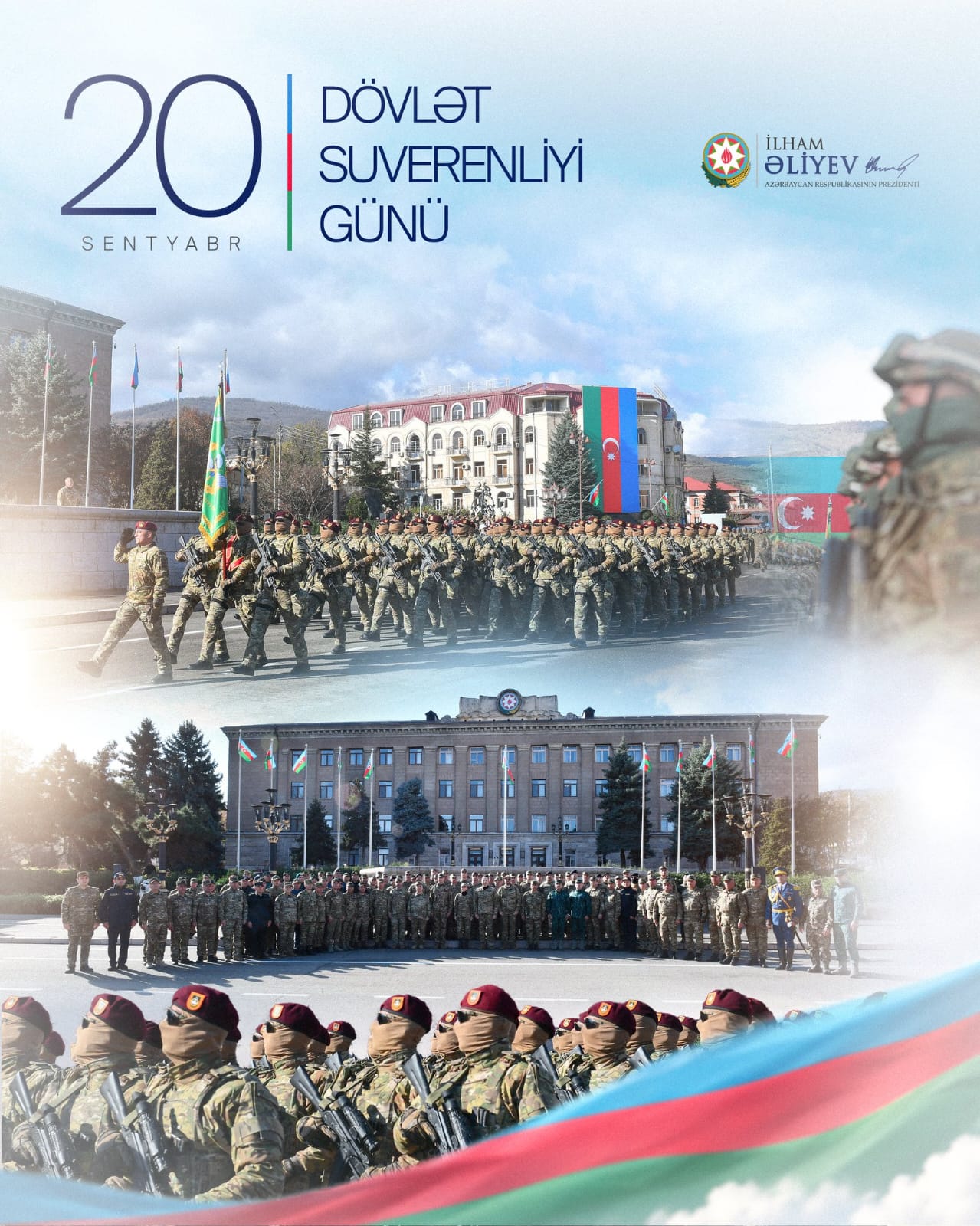
Following the glorious victory of the 2020 Patriotic War, in which Azerbaijan liberated its occupied territories including the historic city of Shusha, illegal armed formations remained in parts of the Karabakh region, in violation of Azerbaijan’s sovereignty and the commitments of the November 2020 trilateral statement. After repeated provocations, Azerbaijan launched local antiterror measures on 19 September 2023.
Within roughly twenty four hours, on 20 September 2023, the operation concluded with the illegal armed formations agreeing to lay down their arms and withdraw. The separatist regime that had existed for three decades came to an end, and Azerbaijan’s constitutional order was restored across its entire internationally recognised territory, in full accordance with international law and the relevant resolutions of the United Nations Security Council.
The connection between the two anniversaries is not a coincidence of the calendar. It is a line of cause and effect. The economic independence secured in 1994 built the foundation for the strong state that restored its territorial integrity in 2020 and 2023. Oil wealth, wisely managed, became national strength.
For Pakistan, Azerbaijan’s journey carries special resonance. Pakistan stood firmly with Azerbaijan throughout the years of occupation, consistently supporting its territorial integrity and the implementation of UN Security Council resolutions. The people of Pakistan celebrated the liberation of Karabakh as the victory of a brotherly nation.
The energy story of 20 September also speaks directly to Pakistan’s needs. Azerbaijan has emerged as a valuable partner in Pakistan’s search for energy security, with SOCAR and Pakistani institutions entering into arrangements for the supply of liquefied natural gas. As Pakistan pursues regional connectivity through initiatives such as CPEC, the example of Azerbaijan’s transport and energy corridors, linking the Caspian to Europe and Asia, offers lessons in how geography, when combined with vision, becomes opportunity.
The trilateral friendship of Pakistan, Azerbaijan, and Turkey, bound by faith, history, and shared strategic interests, gives both nations a platform to expand cooperation in energy, trade, defence, and connectivity.
20 September stands as one of the most meaningful dates in modern Azerbaijani history. In 1994, it marked the moment a young and embattled republic claimed control of its economic destiny. In 2023, it marked the moment that same republic completed the restoration of its sovereignty. Between those two dates lies the story of a nation that turned resources into resilience and resilience into victory.
As Azerbaijan marks this anniversary, its friends in Pakistan join in honouring the vision of Heydar Aliyev, the leadership of President Ilham Aliyev, the dedication of Azerbaijan’s oil workers, and the sacrifices of its heroes. The Contract of the Century was well named. Its legacy is a free, sovereign, and prosperous Azerbaijan.
The writer is Executive Editor at Pakistan Economic Network and Executive Director of the Centre for Regional Connectivity with Shared Future.