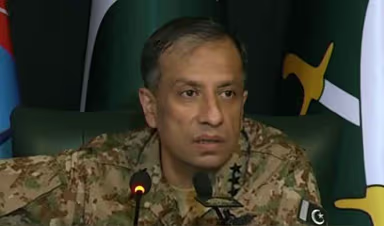
ISPR DG Lt Gen Ahmed Sharif Chaudhry has made it clear that the Makkah defense agreement is strictly defensive in nature. Should any of the three partners — Pakistan, Saudi Arabia or Türkiye — come under attack, the countries will take a joint decision on how to respond.
In an interview with Al Arabiya English, the Pakistan Army spokesperson said the agreement is designed as a joint defence shield aimed at regional peace, stability and security, not aggression. He also said the pact would not complicate Pakistan’s relations with Iran or affect its strategic relationship with China.
Asked what Pakistan would do if one of the partner countries came under attack, the ISPR DG said the operational details of the defence agreement had not been disclosed.
He explained that no country or military publicly releases details of its military operations or how specific defence commitments would be implemented. The practical response to an attack, he said, would be decided by Pakistan, Saudi Arabia and Türkiye themselves.
“How we will defend our country” also falls under operational classification, the spokesperson said, adding that such matters involve operational planning and classified information.
He noted that there are numerous other defence agreements around the world that contain specific commitments without publicly revealing how military operations would be carried out.
Agreement not Muslim alliance
The ISPR chief also clarified that the Makkah agreement does not describe itself as a Muslim alliance and contains no provision limiting participation to Muslim countries. He said the objective is to establish stability, peace and security in the region rather than create an alliance exclusively for Muslim states.
Any future expansion of the arrangement, he added, would be decided by the leadership of the three countries that signed the agreement. The decision over when and how to expand the pact rests with them.
Lt Gen Chaudhry said relations between Pakistan, Saudi Arabia and Türkiye did not emerge overnight. He said everyone, including China, understands the deep and historic nature of the three countries’ ties. The Makkah agreement has now formalised those existing relationships and clearly defined their scope.
According to the ISPR DG, Pakistan seeks strong and effective relations with its partners, while the defence agreement simply gives formal shape to longstanding strategic ties. He said no one has an issue with the agreement because its purpose is understood to be defence, peace and regional security.
Pakistan-China ties remain strategic
Responding to a question about whether the new defence arrangement could strengthen Pakistan-China relations or create concerns in Beijing, the ISPR DG said the relationships would reinforce one another.
He stressed that Pakistan’s relationship with China is strategic and based on mutual interests, so the question of comparing the two relationships does not arise.
All three countries in the Makkah arrangement, he said, also have excellent relations with China. The different partnerships are interconnected and can coexist, rather than being viewed as competing alliances.
No expected impact on Pakistan-Iran relations
Asked whether the Makkah agreement could create complications in Pakistan’s relations with Iran, Lt Gen Chaudhry said he did not think that would happen. He reiterated that Pakistan’s relationships with Saudi Arabia and Türkiye are longstanding and did not suddenly emerge with the signing of the agreement.
The Makkah agreement, he said, has formalised those strategic relations and is intended to create a joint defence shield, not promote aggression against any country.
The interview also addressed India’s expanding missile and air defence capabilities. the ISPR chief said India is spending vast sums on military hardware, but Pakistan does not want an arms race in the region. He said Pakistan has full confidence in its defence capabilities and possesses the ability to punish an aggressor if required.
At the same time, he stressed that Pakistan’s military capability is strictly defensive and that the country does not seek aggression against any other state.
Pakistan rejects interference in Afghanistan
The Pakistan Army spokesperson also addressed the situation in Afghanistan, saying Pakistan does not want any form of interference in the neighbouring country. However, he alleged that the Afghan Taliban regime is being used as a launching pad for the recruitment, training and attacks of terrorists.
The comments came in the broader context of Pakistan’s security concerns, while the DG ISPR maintained that Islamabad’s military posture remains focused on defence rather than aggression.
Agreement focuses on defence and regional stability
Overall, the ISPR DG described the Makkah defence agreement as a formalisation of deep and historic ties between Pakistan, Saudi Arabia and Türkiye.
He said its stated purpose is a joint defence shield and regional stability, while the details of how the three countries would respond operationally to an attack remain classified.
The leadership of Pakistan, Saudi Arabia and Türkiye will determine any future expansion of the agreement, while Islamabad intends to maintain its strategic relationship with China and continue its existing relations with Iran.