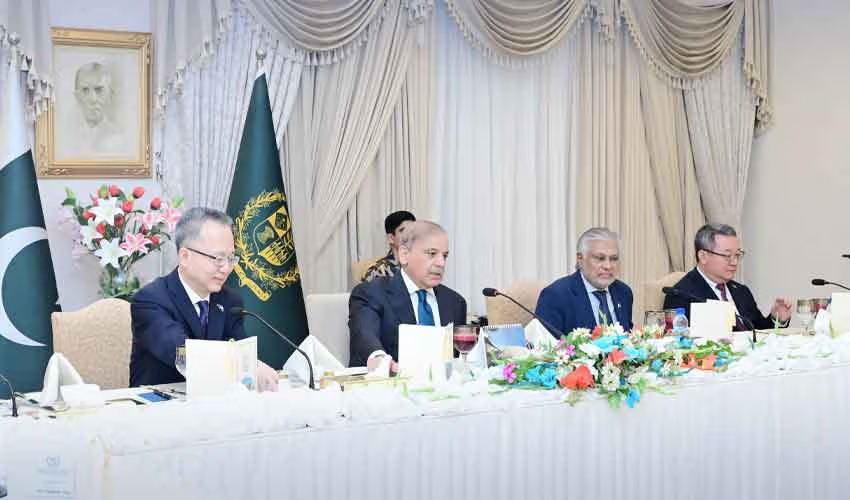
Prime Minister Shehbaz Sharif hosted a breakfast meeting in honour of Asian Development Bank (ADB) Vice President for South, Central and West Asia Ying Ming Yang in Islamabad, where both sides reviewed Pakistan’s long-standing development partnership with the bank.
The meeting also discussed priority initiatives under the new Country Partnership Strategy (CPS) 2026–2030, including infrastructure modernization, regional connectivity, private-sector development, energy and food security.
Prime Minister Sharif welcomed Ying Ming Yang on his first official visit to Pakistan in his current capacity and appreciated the ADB’s continued professionalism and responsiveness.
The prime minister particularly acknowledged the bank’s timely support in completing transformative urban infrastructure, transport and public service projects across Pakistan.
The meeting reviewed the multi-decade cooperation between Pakistan and the ADB and explored ways to turn the priorities outlined in the new CPS 2026–2030 into practical development initiatives.
PM highlights economic reforms and stability
The PM said Pakistan had successfully navigated a difficult phase of economic recovery through rigorous fiscal, structural and administrative reforms.
He said the corrective measures had helped stabilize the economy and restore investor confidence. According to the prime minister, major international credit rating agencies, including Fitch, Moody’s and S&P, have also given Pakistan a stable economic outlook.
Reaffirming the government’s commitment to long-term economic transformation, Shehbaz Sharif said dedicated special task forces were actively working to remove administrative bottlenecks and other hurdles that could slow investment and development.
ML-1 upgrade takes centre stage
A major focus of the meeting was the modernization of the Main Line-1 (ML-1) railway corridor, which connects Karachi with Peshawar and remains one of Pakistan’s key infrastructure priorities.
Prime Minister Sharif said the ML-1 upgrade was crucial for modernizing the country’s freight and logistics system, strengthening regional trade connectivity and supporting large-scale industrial projects.
The meeting also emphasized the need for practical work and early groundbreaking on the ML-1 project to accelerate infrastructure development and modernize Pakistan’s overall connectivity system.
Cooperation in energy, food security and tech
The two sides also explored opportunities to expand cooperation across several strategic sectors. Discussions covered greater support for the private sector, energy security, food security and measures to improve Pakistan’s export competitiveness.
Artificial intelligence (AI) and information technology (IT) were also identified as areas where stronger collaboration could help support Pakistan’s economic transformation and development goals.
At the conclusion of the meeting, both sides agreed to translate the strategic priorities of the Country Partnership Strategy 2026–2030 into concrete and effective measures.