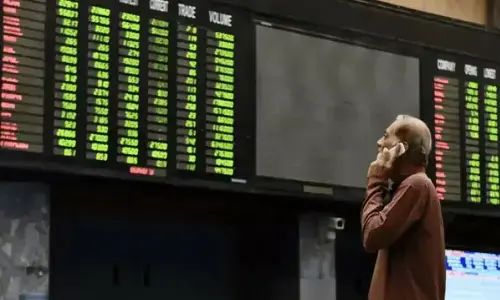
Selling pressure was observed at the Pakistan Stock Exchange (PSX), with the benchmark KSE-100 Index shedding over 800 points on Monday.
At 9:50am, the benchmark index was hovering at 173,152.71, down by 810.10 points or 0.47%.
“The KSE-100 is under intense pressure this morning,” said Behtari Capital.
“Investors are treading cautiously ahead of the federal budget, i.e. June 5, and lingering uncertainty in the Gulf,” it added.
Investor sentiment is dampened by reports that the government is struggling to balance IMF demands with populist political measures, said the report.
“While there is talk of relief for the salaried class (earning Rs. 150k-200k), the IMF is pushing for a record Rs17+ trillion revenue target, sparking fears of “super taxes” on the banking and industrial sectors in the upcoming June 5 budget,” it added.
Selling was observed in key sectors, including automobile assemblers, cement, commercial banks, oil and gas exploration companies, OMCs and power generation. Index-heavy stocks, including HUBCO, MARI, OGDC, POL, PPL, HBL, MCB, MEBL, NBP and UBL, traded in the red.
During the previous week, Pakistan equities posted a strong recovery during the outgoing week as easing geopolitical tensions in the Middle East and improving domestic economic indicators significantly boosted investor confidence, helping the benchmark KSE-100 Index gain 4% in a holiday-shortened trading week.
The benchmark KSE-100 Index surged by 6,119 points on a week-on-week basis to close at 173,963 points.
Internationally, Asian share markets firmed on Monday as the boom in all things AI continued to drive demand, offsetting a lack of progress in Gulf peace talks that challenged optimism on a re-opening of the Strait of Hormuz and lifted oil prices.
While negotiators from Washington and Tehran are apparently working to hammer out a deal, President Donald Trump has been notably silent on their progress. Speaking on Saturday, Defence Secretary Pete Hegseth said the US was ready to restart attacks on Iran if a deal could not be reached.
Tensions in the region were not helped by an Israeli push further into Lebanon in the battle against the Iranian-backed Hezbollah group.
Indeed, the lack of news nudged Brent up 1.9% to $92.89 a barrel, while U.S. crude added 2.4% to $89.46.
Asian share markets remain underpinned by demand for semiconductors and AI-related gear, with Japan’s Nikkei up a further 0.5%, having risen almost 5% last week to all-time highs.
South Korea rose 1.3%, after surging 8% last week, while Taiwan climbed almost 6% last week. MSCI’s broadest index of Asia-Pacific shares outside Japan added 0.2%.