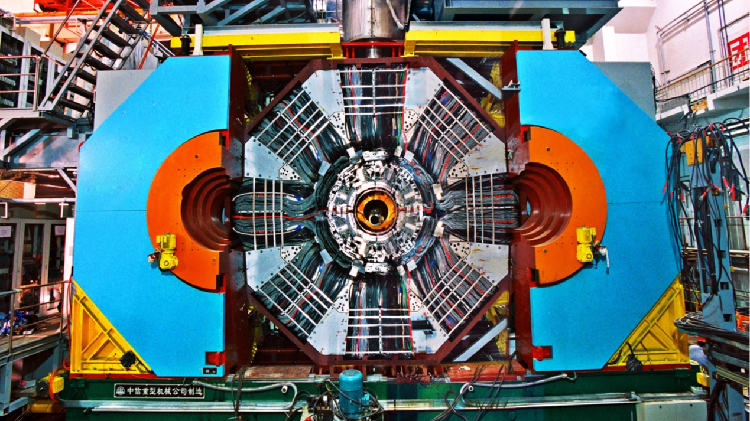
The achievement was made by the Chinese-led international collaboration of the Beijing Spectrometer III (BESIII) experiment, the institute said on Thursday.
In nature, atomic nuclei are composed of protons and neutrons, which are made up of quarks, with gluons mediating the strong interaction force between quarks. The standard model of particle physics holds that gluons can attract each other and bind together to form an entirely new kind of particle – the glueball. However, such a particle had not been discovered in any previous experiments.
Relying on the BESIII experiment at the Beijing Electron Positron Collider, the research team discovered a new particle, X(2370), in 2011. In 2024, the team measured the quantum state properties of X(2370) and found them consistent with the features of a glueball, providing crucial evidence toward confirming its existence.
In the latest study, the research team discovered multiple new decay modes of the X(2370) particle and successfully determined its “flavor-singlet” property, the most important characteristic distinguishing a glueball from other ordinary particles, thus confirming that the dominant component of X(2370) is precisely the glueball.
This is the clearest experimental result in the search for glueballs over nearly five decades, researchers said, adding that it verifies the theoretical prediction that gluons can bind with one another to form a new type of matter, and is of great significance for testing the standard model of particle physics.