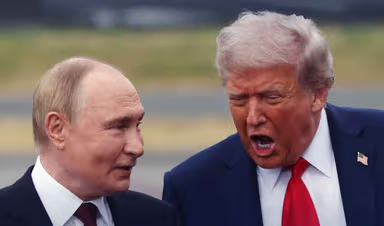
US President Donald Trump has defended his decision to ease sanctions and tariffs linked to Russia, saying significant progress is being made towards ending the Russia-Ukraine war and that he does not want to take steps that could derail negotiations.
Trump also defended a separate agreement to increase Russian diesel supplies to global markets, arguing that the move could help American consumers and businesses facing higher fuel costs amid disruptions caused by the US-Israeli war on Iran.
In a post on Truth Social on Sunday, Trump said his decisions were intended to prevent Russia from walking away from the negotiating table.
“I do not want to take any step that might drive Russia away from the negotiating table,” Trump said, adding that significant progress was being made in negotiations and efforts to secure the release of hostages.
The US president reiterated his desire to end the conflict, saying he was actively working towards a peace agreement between Moscow and Kyiv.
Trump also said Russia was providing very little assistance to Iran, describing its support as practically nonexistent. He said he wanted the situation to continue and intended to take steps to prevent Russia from providing further assistance to Tehran.
Trump criticises Zelenskyy over attacks on Russian refineries
Trump sharply criticised Ukrainian President Volodymyr Zelenskyy over attacks on Russian diesel refineries, arguing that the strikes were damaging global fuel markets, including the US economy.
According to Trump, the attacks were affecting businesses and American farmers at a time when energy markets were already under pressure.
He argued that Russia continued to supply millions of barrels of diesel to international markets at low prices despite the attacks on its refineries.
Trump maintained that disrupting Russian fuel production could worsen diesel shortages and increase pressure on consumers and businesses.
The US president also questioned Zelenskyy’s commitment to ending the war, claiming that the Ukrainian leader did not want peace and might never have genuinely wanted to end the conflict.
Trump says Ukraine could have secured better deal
Trump said Zelenskyy could have negotiated a much better peace agreement two years ago than what might be possible now.
He criticised the financial assistance provided to Ukraine by European countries and former US President Joe Biden, arguing that the aid had failed to prevent extensive destruction and territorial losses.
Trump said Ukraine had been devastated by the war, claiming that large portions of its territory had been lost and that it had lost access to seas and maritime regions.
He also referred to the large number of people killed during the conflict, reiterating that his priority was to bring the fighting to an end.
However, Trump’s remarks about Ukraine’s territorial losses and prospects for a peace agreement reflect his assessment of the conflict, rather than the terms of any confirmed settlement.
Final decision on Russia sanctions pending
Trump’s comments came a day after he signed an executive order waiving key sanctions and tariffs connected to Russia under legislation known as the Graham Act, which he signed last month following pressure from lawmakers seeking to increase economic pressure on Moscow over its war in Ukraine.
The measures included tariffs on Russian goods and penalties on countries purchasing Russian oil and gas. They had been scheduled to take effect the following week.
The executive order issued on Friday did not specify how long the waiver would remain in place.
Speaking to reporters at his Mar-a-Lago club in Palm Beach, Florida, Trump said he had not yet announced a final decision on the matter.
“A lot of you don’t know what my decision is yet, but we’ll figure it out, and you’ll figure it out,” he said.
US Secretary of State Marco Rubio said the administration wanted additional time to evaluate the economic implications of the sanctions and tariffs that Trump had waived.
Rubio said the president intended to use a period of up to 60 days to assess the potential consequences for the global economy and the United States.
“I think the president wants to take the 60-day period of time to sort of analyze what imposing both sanctions and tariffs will mean to the global economy and even to the US economy,” Rubio said before boarding a plane for a trip to Uzbekistan.
The sanctions waiver drew criticism from Zelenskyy, who warned that easing pressure on Russia could embolden Russian President Vladimir Putin and prolong the war.
Agreement to increase Russian diesel supplies
The Trump administration has also defended a separate agreement with Russia aimed at increasing diesel supplies to international markets as fuel prices rise amid the war involving Iran and disruptions to energy supplies.
Rubio said the diesel would reach international markets regardless of the agreement, arguing that the arrangement could determine how much of the supply reached American consumers.
“That diesel is going to be sold one way or the other,” Rubio said. “The only difference is how much of it the United States was going to get.”
Trump said Russia would initially supply more than 300,000 metric tons of diesel to the United States, with additional shipments expected in November and beyond.
The agreement has been presented by the administration as an effort to ease fuel costs while encouraging Moscow to pursue a peaceful resolution to the conflict in Ukraine.
US energy secy calls diesel deal incentive for peace
US Energy Secretary Chris Wright defended the agreement, describing it as an incentive intended to encourage Russia to reduce hostilities rather than provide Moscow with financial relief.
Speaking on ABC’s This Week, Wright said the agreement was “a carrot to try to end the war, not an economic lifeline” to Russia.
In a separate interview on CNN’s State of the Union, Wright said Russia would need to reduce the intensity of its conflict with Ukraine to increase the amount of diesel it could export.
He argued that additional Russian diesel supplies could benefit American consumers while also creating an incentive for progress towards peace.
“If Russia can bring additional diesel to the market and export it, it would benefit American consumers,” Wright said, adding that the arrangement could also represent a step towards ending the war.
The administration’s position is that the agreement could serve both economic and diplomatic objectives by increasing fuel availability while encouraging a reduction in hostilities.
Global conflicts affecting energy markets
Rubio said the sanctions waiver and diesel agreement reflected the growing challenge of managing simultaneous conflicts in the Middle East and Ukraine.
Both conflicts have disrupted energy supplies and placed pressure on global markets, complicating the administration’s efforts to balance diplomatic objectives with domestic economic concerns.
“These conflicts around the world are starting to crash into each other,” Rubio said.
The administration has defended its approach as an attempt to manage the economic fallout while keeping diplomatic channels open with Moscow.
Trump has reiterated that his priority is to end the Russia-Ukraine war, while the sanctions waiver and diesel agreement remain under review and have drawn criticism from Kyiv.
Zelenskyy warns of difficult relations with US
Ukrainian President Volodymyr Zelenskyy has voiced concern over Washington’s approach to the war, saying the United States is putting pressure on Ukraine to surrender to Russia.
Zelenskyy has also complained that the US is delaying the supply of interceptor missiles needed by Ukraine, adding to concerns over the country’s defence capabilities.
He described the current period as difficult and dangerous for relations between Ukraine and the United States.
His remarks reflect growing tensions between Kyiv and Washington over the terms of a potential peace agreement, military assistance and the Trump administration’s decision to ease certain economic measures against Russia.