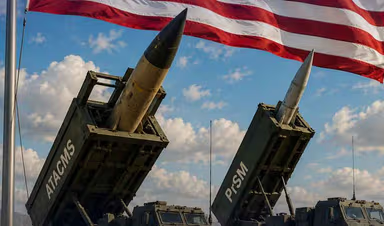
The US Defense Department’s inspector general has acknowledged that the war with Iran created strategic shortfalls in American munitions and exposed major bottlenecks in the defense supply chain, offering the first detailed government accounting of the conflict’s cost and damage.
The congressionally mandated report, covering the war from February 28 through June 30, estimated the conflict had cost the US military about $33.4 billion, while documenting extensive losses to aircraft, drones, bases and other military equipment.
The inspector general said the expenditure of weapons during Operation Epic Fury resulted in “strategic inventory shortfalls” and revealed bottlenecks in the US defense industrial base’s ability to replenish munitions.
The report said the Pentagon is working to streamline procurement procedures and production lead times while stockpiling critical materials, components and selected munitions so it can respond more rapidly to future contingencies.
However, the defense industrial base requires “significant lead time” to increase production capacity. The report identified persistent bottlenecks involving solid rocket motors, high-grade explosives and propellants, as well as difficulties recruiting skilled manufacturing workers.
Experts have previously estimated that replenishing advanced missiles and defensive interceptors to pre-war levels could take about three years.
Trump, Hegseth reject shortage claims
The findings contrast with repeated assurances from US President Donald Trump and Defense Secretary Pete Hegseth that the US military has sufficient weapons for its operations.
Hegseth has denied reports that American forces are running low on munitions. Trump also said Monday on Truth Social that the United States is producing more “Exquisite and Elite Weapons” than at any point in its history and that they are being delivered daily to US forces in the Middle East and elsewhere.
Two weeks earlier, Trump said the US had “virtually unlimited” ammunition and criticized reports about weapons shortages. Last month, he also said the country had “massive amounts” of ammunition and that defense companies were building the largest number of plants and factories in US history.
CNN had previously reported shortages of long-range guided missiles and air-defense interceptors, including concerns that the US military had nearly exhausted 80% of its THAAD interceptor stock.
War cost $33.4bn by June
The inspector general estimated that the Iran war cost approximately $33.4 billion as of June 29.
That figure includes $22.3 billion in expended munitions, $3.7 billion in equipment losses based on replacement costs and $7.4 billion in other expenditures. The estimate does not include the cost of repairing damaged infrastructure and facilities.
The Pentagon had publicly estimated the war at $37.5 billion in July, while NBC News reported that internal US estimates had placed the eventual cost at between $80 billion and $100 billion.
Defense Secretary Hegseth told Congress on July 21 that without supplemental funding, the Pentagon could face critical shortfalls affecting its ability to pay service members, replace equipment and munitions and maintain global operations.
The White House had submitted an $87.6 billion emergency supplemental funding request to Congress on June 24, including $67.1 billion for the Pentagon, with $21 billion specifically allocated for munitions.
US aircraft and drones suffered heavy losses
The report provides one of the first official accounts of the damage suffered by US military equipment during the opening months of the war.
It said four F-15E fighter jets, an F-35A Joint Strike Fighter and an A-10 Warthog were destroyed or extensively damaged. Twelve KC-135 refueling aircraft and nine other aircraft were also reported destroyed in the broader accounting.
A separate portion of the report said seven KC-135 refuelers were damaged or destroyed, including five hit by Iranian munitions while on the ground in Saudi Arabia.
More than 30 MQ-9 Reaper drones had been destroyed by June, according to the report, citing the Congressional Research Service. The drones cost around $30 million each.
Another KC-135 crashed in Iraq following a collision with another KC-135, killing six service members. The report classified those deaths as occurring during a non-hostile incident.
The report also recorded the death of a helicopter pilot in a crash in the Arabian Sea as a non-hostile incident.
14 US troops killed, hundreds wounded
Seven US service members were killed in action between February 28 and June 30, while seven others died in non-hostile incidents during the same period.
The report said 417 service members were wounded during the period covered by the report. It added that another four US troops were killed in action in July, bringing the documented combat deaths higher after the report’s June 30 cutoff.
During the first 24 hours of the war, US Central Command said American forces struck more than 1,000 targets. The scale of those attacks was not repeated in the later months of the conflict.
Iranian attacks damaged US bases
The inspector general said Iranian strikes damaged or destroyed hundreds of buildings and structures at US bases in Kuwait, Bahrain, Qatar, the United Arab Emirates, Saudi Arabia, Iraq, Oman and Jordan.
The report does not provide a total repair cost for the military facilities because it remains unclear which bases will ultimately be rebuilt and who will pay for the work.
Iran also targeted the US Navy’s main regional logistics hub in Bahrain with drones and ballistic missiles, according to the report.
The damage forced US Central Command to shift personnel, assets and storage facilities and move supply operations to alternative hubs much farther away, including Diego Garcia, a US-UK base in the Indian Ocean.
The change resulted in logistics cycles of between 14 and 18 days for supporting US operations in the Middle East.
Acting Navy Secretary Hung Cao recently described the damage to Bahrain as severe, saying Iran had “blew the hell out of Bahrain” and that he had established a task force to assess whether the Navy needed to repair the facility to sustain regional operations.
Medical evacuations faced new challenges
Iranian strikes also changed how US forces operated across the region.
The report said CENTCOM shifted personnel, assets and storage facilities as American positions came under attack from Iran and allied proxy forces.
Among the changes was the withdrawal of Army medical evacuation helicopters from Iraq and Kuwait. As a result, most medical evacuations were conducted by ground, with injured personnel transported by local ambulances to nearby treatment facilities.
The report also described intermittent shortages of supplies and disruptions to the military’s regional mail system, adding to difficulties faced by US sailors deployed for unusually long periods in the Persian Gulf.
US forces also conducted as many as 5,000 flights from European bases in support of the war, despite Trump repeatedly complaining that European allies had not done enough to support the US effort.
Bahrain attack disrupted naval logistics
The attack on the US naval facility in Bahrain forced American forces to rely more heavily on distant logistics infrastructure.
With Bahrain facing significant damage and challenges in establishing adequate naval bases and support ports, Diego Garcia became a major alternative sea logistics hub.
The resulting 14-to-18-day resupply cycles complicated operations at a time when US forces were conducting airstrikes against Iran and, in more recent months, enforcing a blockade around Iranian ports.
US military and intelligence officials have privately discussed whether some of the changes to America’s Middle East footprint could become permanent after the war, including possible long-term reductions in personnel and facilities.
US diplomatic facilities also hit
The inspector general’s report, prepared with the State Department and US Agency for International Development inspector general offices, also detailed damage to American diplomatic facilities.
The State Department sustained more than $208 million in damage across Iraq, Kuwait, Saudi Arabia and the UAE.
Of that total, approximately $184 million was attributed to damage to diplomatic facilities, while another $25 million resulted from delays to construction projects.
The State Department had previously reported another $113 million in conflict-related costs, including nearly $80 million for contingency measures such as evacuations.
Embassies and consulates came under attack
The US Embassy in Riyadh was struck by two Iranian drones in early March, causing extensive damage, including damage to a CIA station located on the compound.
Around the same time, a drone targeted the US consulate in Dubai and damaged a utility building. Then-US Secretary of State Marco Rubio said the drone had struck a parking lot adjacent to the main chancellery building.
The US Embassy in Kuwait was forced to suspend operations completely in March after being damaged by Iranian drones. It resumed emergency operations for Americans in late June.
More than 600 attacks against US facilities in Iraq were reported between February and May, according to a senior State Department official. Those attacks produced the largest diplomatic damage bill, estimated at roughly $157 million.
Thousands of diplomats and citizens evacuated
The conflict also forced the United States to remove thousands of personnel from the region.
Between February 23 and June 30, as many as 3,500 diplomatic personnel were outside the region, with most US posts operating under authorized or ordered departure arrangements.
Within weeks of the war’s start, the Trump administration placed Bahrain, Iraq, Jordan, Qatar, Saudi Arabia and the UAE under ordered departure. Non-emergency personnel and all family members were required to leave under those orders.
Authorized departure allowed non-emergency personnel to leave voluntarily.
Most US diplomatic posts remained under “restricted operations,” meaning normal staffing had not resumed even after six months of ordered departure. Some diplomats and family members had begun returning to the region.
The State Department also evacuated about 9,000 US citizens from countries across the Middle East and Europe in the weeks and months following the February 28 start of the war.
The evacuation operation used private and commercial flights as well as land and sea transportation and had cost more than $11 million by late June.
War’s end remains uncertain
Trump initially predicted that the war would last only weeks. Over the weekend, however, he said the conflict could continue until “right after” the November midterm elections, or potentially end before then.
The inspector general’s report does not address what was likely a US strike on an elementary school in Iran during the initial hours of the conflict. The US military has yet to publicly release an internal investigation into that bombing, although NBC News reported in June that an investigation was being finalized.
The Pentagon did not immediately respond to requests for comment on the inspector general’s findings.
The report nevertheless provides the most comprehensive official picture so far of the war’s impact on US weapons stocks, military assets, bases, diplomatic facilities, personnel and logistics networks, highlighting the substantial strain the conflict has placed on America’s military infrastructure and defense industry.