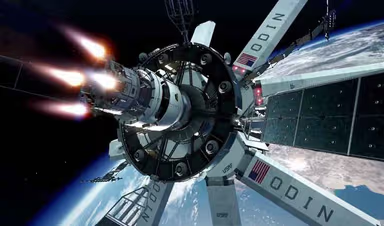
US Secretary of the Air Force Troy Meink said Monday that the US now has “on-orbit space control weapons” capable of defending American forces against hostile adversaries.
Speaking at the Air, Space and Cyber Conference in Maryland, Meink said the disclosure was deliberate but declined to reveal the weapons’ specific capabilities or when they were deployed.
Meink said the United States needed to remain prepared for “evolving threats” and ensure that its forces could operate freely in space, which he described as increasingly important to both US military and economic security.
“This is why the United States now has on-orbit space control weapons capable of defending the Joint Force against hostile adversary action,” Meink said.
He stressed that the wording of his announcement was important from a deterrence perspective, arguing that providing additional details about the systems could undermine that objective.
“We’re not going to talk about the specifics of what we are doing, whether we’ve tested, not tested, or anything else,” Meink said.
The Air Force secretary said the US must maintain dominance not only in the air but also in space, adding that Washington had taken steps to ensure it could respond if its space assets came under threat.
Space weapons can have offensive, defensive roles
A US Space Force spokesperson said “space control” covers the missions needed to contest and control the space domain through both kinetic and non-kinetic means.
Those capabilities can be used to disrupt, degrade or, if necessary, destroy an adversary’s space systems. The spokesperson said such weapons can serve offensive as well as defensive purposes at the direction of combatant commands.
The Space Force has previously described space control as involving activities conducted both in orbit and from Earth. These could include jamming satellite communications or attacking satellite ground stations.
The service has also said that orbital strikes can involve kinetic weapons that physically destroy targets as well as non-kinetic systems.
US links move to Russia and China
American military officials have for years warned that Russia and China are developing capabilities designed to attack or disrupt satellites, which have become critical to modern warfare.
US Space Force assessments say China “develops and operates space and counterspace capabilities as part of a military modernisation strategy”, while Russia views space as a warfighting domain and considers space superiority a potentially decisive factor in future conflicts.
Space Force Chief of Operations General Chance Saltzman said in July that China was rapidly developing capabilities, including space-based weapons designed to locate and destroy targets. He described the Chinese programme as a “substantial” threat.
The US has also warned since 2007 about Russian and Chinese weapons testing and the operationalisation of counter-space capabilities.
Russia’s satellite activities raise concerns
The concerns extend beyond traditional weapons. In early February, it was reported that two Russian satellites had likely intercepted communications from at least a dozen European satellites since Russia’s invasion of Ukraine in 2022.
Those interceptions may have enabled Russian intelligence services to access sensitive information transmitted by the satellites and, hypothetically, could have provided a way to take control of them.
In 2024, Washington said Russia had launched a satellite that it believed could be capable of attacking other satellites. Moscow did not publicly comment on the US assessment.
The growing competition has raised fears that Earth’s orbit could become an increasingly contested military environment, particularly because satellites provide troops with communications, GPS, intelligence, surveillance and targeting information.
Golden Dome adds another space dimension
Meink’s announcement comes as the Trump administration pushes ahead with its “Golden Dome” missile defence programme, which is intended to protect the United States against missiles and other airborne threats.
Space-based capabilities and interceptor missiles are expected to form a crucial component of the planned defence architecture. Meink said Monday that the programme had moved from an initial contract to “flight-ready hardware” for space-based interceptors.
The Space-Based Interceptor programme is one of the systems Meink specifically highlighted. He also referred to the Space-Based Air-Moving Target Indication constellation, although he did not provide detailed information about either system.
Space-based interceptors would be designed to intercept incoming missiles in space, making them a defining feature of the Golden Dome concept.
What could US orbital weapon be?
Despite the historic disclosure, the US has not said exactly what weapon or weapons are currently stationed in orbit, nor how long they have been deployed.
Space weapons can take several forms, including cyber capabilities, lasers and satellites designed to manoeuvre into or physically collide with other spacecraft.
Clayton Swope, deputy director of the Aerospace Security Project at the Center for Strategic and International Studies and a former CIA technical intelligence officer, said Meink’s statement was too vague to establish exactly what Washington was capable of doing.
He argued that a stronger deterrent would require Russia and China to have at least a general understanding of the weapon’s destructive potential and what actions might cross a threshold that would trigger a US response.
Victoria Samson, chief director of space security and stability at the Secure World Foundation, suggested the system could be a space-based jammer. She noted that the US has generally sought to avoid actions that create orbital debris, which can result from kinetic attacks.
However, Samson warned that the announcement could backfire if China or Russia respond by openly acknowledging similar weapons.
“This becomes a self-enforcing cycle and eventually someone is going to use one of those weapons,” she said.
Sam Lair, a fellow at the Foreign Policy Research Institute, similarly warned that other governments could use the US disclosure to justify existing or new counter-space programmes.
He was sceptical that the announcement alone would trigger entirely new programmes elsewhere, but said it would provide rhetorical ammunition to supporters of such initiatives.
Space warfare could threaten satellites and Earth
The prospect of conflict in orbit has concerned military planners for decades as modern armed forces have become increasingly dependent on satellites.
A major conflict could involve efforts to disable or destroy satellites used for military communications, navigation, surveillance, intelligence and targeting. Such attacks could also affect civilian communications and other systems that underpin the global economy.
A kinetic conflict in space could create another long-term problem: orbital debris.
Destroyed satellites can generate fragments travelling at extremely high speeds. Those fragments could collide with other spacecraft, increasing the danger to satellites and making future launches and space operations more difficult.
The risk is becoming more significant as Earth’s orbit grows increasingly crowded.
SpaceX alone operates around 11,000 Starlink satellites and has plans for thousands more launches in the coming years, adding to the growing number of spacecraft operating around Earth.
US Space Force created for space warfare
The US Space Force, the newest branch of the American military in more than 70 years, was established in 2019 to protect US assets in space.
Those assets include hundreds of satellites supporting American communications and surveillance.
The Trump administration has since expanded the stated role of the Space Force. Last year, Trump issued an executive order emphasising that the service should not only defend US space assets but also function as an attacking force when required.
The Space Force has described its mission as ensuring the US can contest and control the space domain, using both kinetic and non-kinetic capabilities.
The service says those capabilities may be employed offensively or defensively under the direction of combatant commands.
Space weaponisation faces treaty limits
The weaponisation of space has existed alongside international restrictions for decades.
A 1967 treaty prohibits weapons of mass destruction from being placed in orbit. However, the agreement does not prohibit every type of conventional space weapon, leaving major powers including the US, Russia and China to develop or explore other capabilities.
Those efforts include systems capable of targeting rival satellites, which are now indispensable to military communications, navigation and surveillance.
US officials argue that Russia and China’s development of counter-space capabilities has made space an increasingly recognised warfighting domain.
Meink’s disclosure therefore represents a significant shift in Washington’s public messaging: the US has moved from discussing the possibility of space warfare to openly confirming that it possesses weapons already operating in orbit.
Disclosure intended as warning
The US Space Force said its decision to discuss the capabilities publicly was intended to strengthen deterrence and reduce the risk of miscalculation.
“Open communication strengthens deterrence, prevents adversary miscalculation, and normalizes space operations alongside the other services,” the Space Force spokesperson said.
Meink likewise said the United States needed to be prepared for threats wherever they emerged and maintain the ability to operate freely in space.
But experts caution that openly acknowledging orbital weapons could accelerate an already growing competition between Washington, Moscow and Beijing.
For now, the exact identity, destructive potential and deployment timeline of the US orbital weapon remain classified, leaving the announcement itself as the clearest public confirmation yet that the United States is preparing for a future in which space is treated as an active military battlefield.