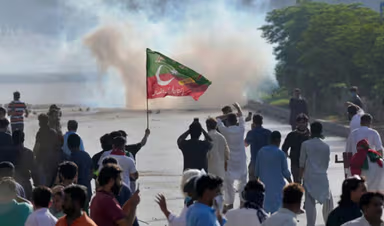
The Islamabad High Court’s larger bench has issued a short order in the case concerning the PTI’s potential protest on September 27.
The larger bench, headed by Chief Justice Sardar Sarfraz Dogar, disposed of the petition filed against the proposed protest. The court has rejected the plea to bar the PTI from protesting and instead issued clear guidelines to protect citizens’ rights.
The IHC ruled that no political party has the authority to block public highways or any other public places.
It further directed provincial chief ministers to ensure that state machinery is not used in connection with the protest.
The Islamabad administration was also directed to ensure that any protest does not disrupt citizens’ daily activities or cause inconvenience to the public.
Verdict reserved
The Islamabad High Court earlier reserved its verdict on a petition seeking to prevent a potential Pakistan Tehreek-e-Insaf (PTI) protest or long march planned for September 27.
During the hearing, the court questioned the Khyber Pakhtunkhwa police chief about his responsibility to prevent illegal activity, while videos of previous PTI protests were played in the courtroom.
Chief Justice Sardar Sarfraz Dogar summoned the inspector general of Khyber Pakhtunkhwa to the rostrum and directed him to read out his affidavit submitted to the court.
After hearing the affidavit, the chief justice asked the KP IG whether police would intervene if an illegal or unconstitutional act took place. The KP IG replied that if any illegal activity occurred in the province, the police would certainly intervene to stop it.
The CJ then directed the KP police chief to ensure that any illegal or unconstitutional gathering was halted and protesters were dispersed.
The judge also remarked that the IG’s sworn statement was being placed on record, making it clear that the police would stop and disperse protesters if any illegal act occurred within their jurisdiction.
Videos showing the use of state machinery during a previous PTI protest were also played during the hearing.
The proceedings focused on concerns surrounding the potential September 27 protest and the authorities’ ability to respond if demonstrators move towards Islamabad.
Islamabad AG highlights past protest
The advocate general of Islamabad told the court that the capital had been “stormed with full force” during a PTI protest in 2024. He said the authorities did not have the capacity to stop such an onslaught by force and could not open fire on their own citizens.
According to the advocate general, the authorities could instead take preemptive measures, including placing shipping containers and making advance security arrangements to restrict the movement of protesters.
Permission required for rallies
The Islamabad advocate general also told the court that permission from a magistrate is mandatory for holding a public meeting or rally in the federal capital. He said the district magistrate has the authority to reject an application if the requirements for holding such an event are not satisfied.
The advocate general further argued that both of PTI’s stated demands were illegal. He maintained that the courts are the appropriate forum for seeking the release of a convicted prisoner, while the other demand involved attempts to oust the government through street protests.
Court reserves verdict
The hearing concluded with the Islamabad High Court reserving its verdict on the petition against the potential PTI long march.
The court’s proceedings placed particular emphasis on the responsibility of the KP police to prevent any illegal or unconstitutional gathering and disperse protesters if such activity takes place.