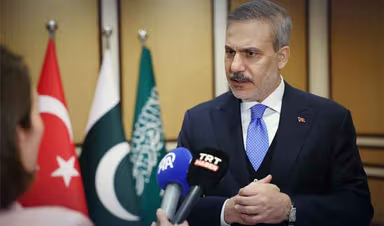
The Makkah Joint Defence Alliance has made significant progress towards establishing its institutional structure, with key decisions approved for setting up a General Secretariat and a Joint Military Command, Turkish Foreign Minister Hakan Fidan said in Islamabad.
Speaking to the media following the second regular meeting of the alliance’s Strategic Political and Defence Committee, Fidan said the agreement aims to pool the military and defence industry capabilities of member states to strengthen their collective capacity and contribute more effectively to peace and stability.
Fidan said institutionalising and operationalising the Makkah Joint Defence Alliance had remained the primary priority since the agreement was signed.
He said all decisions in principle regarding the establishment of a General Secretariat as the alliance’s civilian headquarters and a Joint Military Command as its military headquarters had been taken. Most of the decisions were approved during Friday’s meeting, while some matters were deferred to the next session, he added.
Fidan said the alliance’s committee had so far held two regular meetings and one extraordinary meeting, while its permanent committees were continuing their work.
Defence cooperation, joint operations, training
The Turkish foreign minister said institutionalisation efforts covered a broad range of areas, including the structure of the secretariat, joint operations, force allocation, military training, planning, organisation and international relations.
He stressed that the agreement was designed to integrate the military and defence industrial capabilities of member countries, enabling them to generate greater collective strength and influence.
“The primary goal of this alliance is for countries to pool not only their military capabilities but also their defence industry capabilities to generate greater strength and influence and make a greater contribution to peace and stability,” Fidan said.
He added that Turkish President Recep Tayyip Erdogan’s commitment to the Makkah Joint Defence Alliance was shared by other leaders of the member states.
Regional security challenges discussed
The committee meeting also addressed several regional and international developments, including threats posed by the Houthis, tensions between the United States and Iran, and the situation in Ukraine.
Fidan said Ukraine and other regional issues were also discussed during the committee’s meeting and bilateral talks.
The discussions also covered the alliance’s approach towards countries seeking membership, with the Turkish foreign minister saying significant deliberations had taken place and several decisions in principle had been reached on the matter.
Türkiye to host next committee meeting
Fidan announced that Türkiye would host the committee’s next meeting as member states continue efforts to formalise the alliance’s institutional framework and strengthen defence cooperation.
The latest meeting marks another step towards establishing the alliance’s civilian and military structures, with member countries working to coordinate their defence capabilities, planning and operations.