ISLAMABAD, Nov. 25 (Xinhua) — Muhammad Farooq, deputy director general of Space Application Center for Climate Change at Pakistan’s Space and Upper Atmosphere Research Commission (SUPARCO), the country’s national space agency, is hopeful that Pakistan’s first astronaut in space, Muhammad Zeeshan Ali, will open new avenues for scientific development in the country, which has remained steadfast over the years.
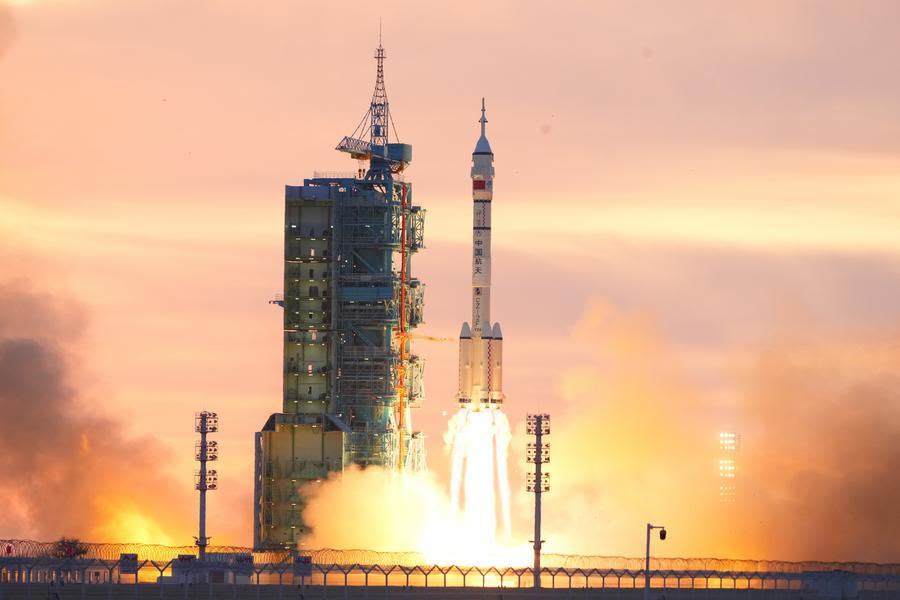
The China Manned Space Agency (CMSA) announced on Wednesday that the launch of the Shenzhou-24 crewed spaceship was “a complete success.” Ali, selected as a payload specialist for the Shenzhou-24 spaceflight mission, became the first foreign astronaut to board China’s Tiangong space station.
“I saw Ali during his training at SUPARCO after he was selected in the first round. He was preparing to conduct scientific experiments in microgravity and was very enthusiastic about becoming Pakistan’s first astronaut in space,” he said.
“There is no doubt that this is a great honor for him and for Pakistan’s entire population of 250 million. He has undergone training, and I am confident that he will successfully fulfill his responsibilities and make the country proud,” Farooq added.
“SUPARCO aims to explore deep space and conduct scientific and technological experiments in space, enabling our scientists to contribute to long-term space missions. Ali’s mission is just the beginning of the realization of our space vision, in which China is playing a significant role,” Farooq told Xinhua.
According to a CMSA spokesperson, four China-Pakistan cooperative projects in the fields of biotechnology and materials will be conducted during the Shenzhou-24 mission. Ali will also conduct an in-orbit experiment on photosynthetic cyanobacteria.
Ali’s preparations for the mission also included learning the Chinese language and familiarizing himself with Chinese culture, reflecting the growing people-to-people exchanges accompanying China-Pakistan space cooperation.
Muhammad Arslan, a Chinese language teacher at the Confucius Institute of Beijing Language and Culture University at the National University of Modern Languages in Islamabad, recalled Ali as an enthusiastic learner with a keen interest in the Chinese language and culture. “He was attentive in class and good at summarizing what he had learned.”
Beyond the classroom, Ali also practiced Chinese calligraphy, watched Chinese films, and learned to use chopsticks, immersing himself in Chinese culture.
“Almost everything about China fascinated him. Even after traveling to China for further training, he continued to seek my guidance on his Chinese language studies,” Arslan said.
At the Institute of Space Technology, a university in Islamabad, students and teachers see Ali’s journey as a first step towards the advancement of space studies in Pakistan.
“We have been launching satellites through SUPARCO, but sending a human into space to conduct scientific experiments marks a significant step forward. These experiments will not only benefit Pakistan but also contribute to the advancement of humanity as a whole, as they are expected to generate knowledge that will be useful to nations around the world,” Abdul Waheed, associate professor and director of the Global Navigation Satellite Systems and Space Education Research Lab at the institute, told Xinhua.
“This is a great opportunity for our students and the entire nation. It will inspire young people to explore space, learn about space science and astronomy, and think about how Pakistan can one day have its own space station or reach the Moon and Mars,” he added.
“Every Pakistani dreams of seeing the Moon and stars up close. That dream is now becoming a reality. Zeeshan Ali is, in a way, living the dream of the entire nation. His journey will inspire every Pakistani, particularly students and young people,” Waheed said.
For Syed Wasif, a space sciences student at the institute, space cooperation between Pakistan and China has brought renewed ambition and opened up new possibilities for students pursuing careers in the field.
“This development has significantly expanded our industry’s horizons and created new opportunities for students like us. We are currently completing our bachelor’s degrees, and many of us plan to pursue master’s and doctoral studies in this field. This mission has paved the way for us and given us a clearer path towards our future careers,” he added.
For Pakistan, Ali’s mission represents more than an individual achievement. It marks a new chapter in the country’s pursuit of scientific advancement and offers young people a tangible reason to dream beyond the limits of Earth. With growing China-Pakistan cooperation in space science and technology, the mission is expected to encourage a new generation of Pakistani scientists, researchers, and engineers to pursue careers in space exploration.