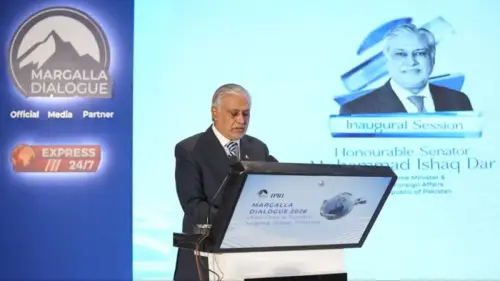
Deputy Prime Minister and Foreign Minister Ishaq Dar on Tuesday called for a more representative multipolar global order, saying Pakistan believed international cooperation and respect for agreed rules were essential to addressing growing geopolitical rivalries and global uncertainty.
Addressing the inaugural session of the seventh Margalla Dialogue in Islamabad, Dar said intensifying competition among major powers, the growing overlap between geopolitics and economics, and rapid technological advances were reshaping the international landscape.
“The answer lies in strength at home and effective diplomacy abroad,” Dar said, identifying domestic economic resilience and proactive diplomacy as key to Pakistan’s ability to navigate an increasingly uncertain world.
He said the international security architecture was facing mounting pressure from strategic competition and the weakening of arms control agreements. Political divisions were also undermining multilateral institutions, particularly the United Nations, he added.
Dar said Pakistan supported a multipolar international system that provided a more meaningful voice to a wider range of countries, stressing that such an arrangement required effective multilateralism and adherence to internationally agreed rules.
Highlighting emerging technological challenges, he said artificial intelligence, cyber capabilities and biotechnology were creating both opportunities and risks, while existing institutions were struggling to keep pace with these developments.
Referring to the situation in Gaza, Dar warned that the principle of “might is right” was gaining ground in international affairs. He said Pakistan had used its 2025-2026 membership of the UN Security Council to advocate the peaceful settlement of disputes.
He also highlighted Pakistan’s diplomatic engagement to promote regional stability, including its facilitation of talks between the United States and Iran and engagement with China, Saudi Arabia, Türkiye and Egypt.
On South Asia, Dar reiterated Pakistan’s commitment to protecting its sovereignty while pursuing a peaceful resolution of the Jammu and Kashmir dispute.
He stressed that strengthening the domestic economy and expanding economic diplomacy were crucial to Pakistan’s ability to respond to changing global dynamics.
Earlier, Islamabad Policy Research Institute (IPRI) President Lt Gen (retd) Majid Ehsan said unilateralism, geopolitical competition and conflicts across several regions were placing the existing international order under increasing strain.
Welcoming participants to the seventh edition of the dialogue, Ehsan said the forum, launched in 2019, had evolved into an international platform bringing together academics, policymakers and practitioners to discuss global, regional and domestic challenges.
Describing the current geopolitical environment as a game of Tetris, he said countries were facing rapidly changing strategic choices while their room for manoeuvre was shrinking.
“On the global geostrategic Tetris board, the pieces containing geopolitical choices are falling faster while time and space is running out,” he said.
Ehsan outlined three possible trajectories for the emerging international order: a division of the world into spheres of influence dominated by the United States and China; a return to cooperation between the two powers; or a hybrid arrangement combining bipolarity and multipolarity.
Under the third scenario, countries could pursue different partnerships in infrastructure, technology, energy and security rather than align exclusively with one major power.
He also warned that the international framework established after World War II, including the UN Charter, Geneva Conventions and international legal arrangements, was facing pressure from unilateral actions.
Citing conflicts in Gaza, Iran, Ukraine and Afghanistan, as well as crises in Africa, Ehsan said the international system had struggled to ensure peace and stability.
He said Russia’s war in Ukraine continued to affect Europe’s security, energy markets and economy, while the conflict involving Iran, the United States and Israel threatened global energy prices, inflation and supply chains.
The two-day dialogue, being held under the theme “Global Order in Transition: Navigating Strategic Uncertainty”, features discussions on global power realignment, connectivity and competition between South and West Asia, technological transformation, national resilience and non-traditional security challenges.