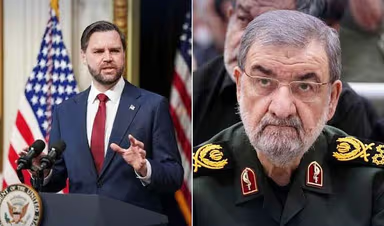
The United States has opened a new diplomatic channel with one of Iran’s prominent hard-line figures in an effort to revive negotiations, even as Trump continues to warn that military action could resume if Tehran fails to meet Washington’s demands.
According to The Wall Street Journal (WSJ) and Axios, Vance sent a letter to Mohsen Rezaei, secretary of Iran’s Supreme National Security Council, focusing on restarting ceasefire negotiations and establishing a framework for talks rather than presenting a concrete peace treaty.
The WSJ first reported that Vance had sent the letter to Rezaei, citing US officials and people familiar with the matter. Axios subsequently reported that the letter was sent at Trump’s direction and that the US president was enthusiastic about the initiative.
The exact date on which the letter was sent remains unclear. Reuters said it could not immediately verify the WSJ report.
US officials reportedly believe direct engagement with hard-line Iranian leaders could produce better results. The outreach also represents the highest-level US contact with Tehran in several months, according to Axios.
The immediate objective is to restart negotiations and establish a framework through which both sides could pursue a ceasefire and broader settlement.
However, Washington has made clear that Iran’s nuclear programme must be part of any negotiations aimed at preventing further US strikes.
According to Axios, Vance stressed in the letter that discussions on the nuclear issue would be necessary to halt potential American attacks.
Who is Mohsen Rezaei?
Rezaei is the secretary of Iran’s Supreme National Security Council, the country’s top security body. He previously served as the longest-serving commander of Iran’s Islamic Revolutionary Guard Corps (IRGC).
He is regarded as an influential hard-line figure and has advocated military operations against the United Arab Emirates, as well as attacks on data centres and other critical infrastructure across the region, according to the WSJ.
Rezaei has also said Iran would not negotiate with the United States unless Tehran’s demands were met.
His position within Iran’s security establishment makes the reported correspondence a significant diplomatic development, particularly as Washington seeks a way to resume negotiations amid continuing threats of military action.
Axios reported that Rezaei has a direct line to Iran’s Supreme Leader, Mojtaba Khamenei.
A spokesman for the vice president’s office declined to discuss the reported letter with the WSJ after the White House referred the newspaper’s request for comment to Vance’s team.
An Iranian Foreign Ministry spokesman said he had not been informed about the letter, while Rezaei could not be reached for comment, according to the newspaper.
Trump denies directing Vance to initiate negotiations
Trump has denied reports that he instructed Vance to initiate negotiations with Iran, although he acknowledged that the vice president had asked for his opinion about a proposed humanitarian effort.
Speaking to reporters, Trump said Iran needed medical supplies and described the proposed contact as an effort to help people who were ill.
“No, what it is is that they need help with medical supplies and various things,” Trump said when asked whether he had directed Vance to communicate with Iran.
“He asked me what I thought. I said, if you want to do that, that’s okay. Basically, it’s getting supplies in to help people that are not well,” he added.
Trump’s comments presented the reported outreach in humanitarian terms, contrasting with his recent threats to launch another major attack against Iran.
The US president has also claimed that Iran has suffered a crushing defeat and suggested that the conflict could end soon. He has portrayed the outcome as a potential American success comparable to Venezuela, while warning that Washington could pursue its objectives through military action if diplomacy fails.
The reported letter, meanwhile, points to continuing efforts to explore negotiations even as the administration maintains pressure on Tehran.
Qatar-led mediators prepare new draft agreement
Vance’s reported outreach comes as regional countries continue efforts to revive ceasefire negotiations between Iran and the United States.
On Tuesday, Rezaei met Mojtaba Khamenei after holding talks with representatives from Saudi Arabia, Türkiye and Pakistan. The meetings marked the first high-level contact between Iran and the three countries, according to the report.
Qatari mediators presented Tehran with a new draft agreement on Sunday aimed at ending the war involving Iran, the United States and Israel. An official briefed on the negotiations told the WSJ that Iran was expected to respond to the proposal by the end of the week.
The draft reportedly establishes a seven-day timeline addressing the concerns of both Tehran and Washington, with daily confidence-building measures required from each side.
The timeline could begin early next week, while several countries would serve as guarantors of the proposed agreement, the official said.
The diplomatic effort seeks to reconcile Washington’s demand for discussions on Iran’s nuclear programme with Tehran’s demands for economic relief and changes to US restrictions.
The fate of Iran’s enriched uranium stockpile, the US naval blockade of Iranian ports and the release of frozen Iranian assets remain central points of disagreement.
US warns nuclear issue must be addressed
Washington’s reported message to Rezaei indicates that the nuclear programme will remain a central issue in any renewed negotiations.
US officials have warned that Iran must be prepared to discuss its nuclear activities if it wants to avoid further attacks. Tehran, however, has maintained that its demands must be addressed before it agrees to negotiations on Washington’s terms.
The two sides have yet to announce a formal agreement arising from the reported letter or the latest regional mediation efforts.
The diplomatic push is unfolding as Trump threatens to resume military action after the November 3 US midterm elections, increasing pressure on mediators to secure progress before the possibility of renewed strikes grows.