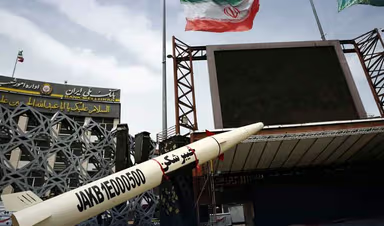
Iran has warned that it could expand any renewed conflict with the United States to American military bases across the Middle East if US forces continue escorting vessels through the strategically vital Strait of Hormuz.
Tehran has also threatened potential strikes against airports, oil pipelines and other civilian infrastructure in neighbouring Gulf countries if the US and Israel resume their air campaign, raising concerns over regional security and global energy supplies.
Iran’s Islamic Revolutionary Guard Corps (IRGC), the ideological arm of the country’s military, issued the warning on Thursday in a statement published on its Sepah News website.
“The US military must know that if this trend continues, the conflict will extend to its bases in the region,” the Guards said, describing the statement as a serious warning.
The threat comes as US forces increasingly escort commercial vessels through the Strait of Hormuz, prompting Iran to intensify its attacks on ships attempting to navigate the waterway without Tehran’s authorisation.
Iran has also communicated warnings through diplomatic channels, signalling that a renewed US-Israeli air campaign could trigger retaliation extending beyond military targets to civilian and energy infrastructure across the Persian Gulf.
Although the warnings are intended to deter further attacks, Iran retains substantial missile and drone capabilities that could make its threats a significant regional security concern.
Iran claims attacks on ships in Persian Gulf
The IRGC said its forces tracked four ships that had previously used what Tehran described as an “illegal” route through the region and struck them simultaneously while they were transferring oil between vessels in the north-central Persian Gulf.
According to the Guards, fires were still burning on the targeted ships following the attacks. The claims have not been independently verified.
Iranian forces also claimed that three other vessels struck mines west of the Strait of Hormuz overnight, caught fire and were brought to a halt.
In a statement, the IRGC blamed the incidents on Washington’s efforts to encourage ships to use what it called an illegal, mined passage, arguing that the US was contributing to a growing number of maritime incidents.
The reported attacks come amid rising tensions over control of the waterway, with Washington continuing to escort vessels while maintaining a naval blockade on Iranian ports to put pressure on Tehran’s economy.
Iran warns of wider strikes on critical infrastructure
Iranian officials have suggested that any renewed confrontation could extend beyond military installations to include strategic infrastructure and technology facilities.
Mohsen Rezaei, secretary of Iran’s Supreme National Security Council, warned that American assets across the region could face a broader range of threats if hostilities resume.
“The US has valuable assets in the region. In case of war, cables, data centers and AI facilities could also come within range. If the conflict starts again, we will have a broader plan,” Rezaei said, according to Iran’s Tasnim News Agency.
Rezaei also asserted that Iran controls the Strait of Hormuz, saying, “The Strait of Hormuz is under Iran’s control and we manage it.”
He further claimed that Iranian forces had targeted an average of five vessels belonging to what Tehran calls smugglers each night over the preceding two or three months.
Iran’s broader warnings have also highlighted airports, pipelines and other civilian facilities in neighbouring Gulf states as potential targets if the United States and Israel restart their air campaign.
Why Strait of Hormuz matters
The Strait of Hormuz lies between Iran to the north and Oman to the south. At its narrowest point, the waterway is approximately 30 kilometres (19 miles) wide.
Before the war began in February, around one-fifth of the world’s oil supplies passed through the strait, making it one of the most important routes for global energy shipments.
Iran claims authority over the passage and has repeatedly threatened or attacked vessels attempting to cross without its approval. The United States, meanwhile, has increased naval escorts to facilitate shipping through the waterway.
The competing actions have heightened the risk of further maritime confrontations, disruptions to oil and gas shipments, and potential damage to energy infrastructure throughout the Gulf.
US-Iran negotiations remain deadlocked
The latest threats come as efforts to negotiate an end to the conflict remain stalled. Washington continues to maintain a naval blockade on Iranian ports as part of its campaign to exert economic pressure on Tehran.
Iran’s warnings indicate that a renewed military confrontation could extend well beyond the immediate battlefield, potentially affecting American military installations, commercial shipping, civilian infrastructure and critical digital facilities across the Middle East.
With the Strait of Hormuz remaining central to the confrontation, any escalation could have consequences for regional stability and international energy markets.