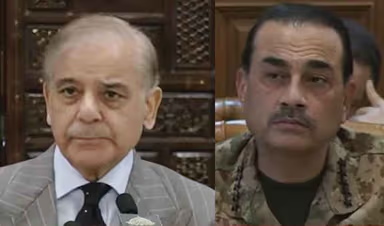
Prime Minister Shehbaz Sharif has defended the imposition of Governor’s Rule in Khyber Pakhtunkhwa, describing it as a decision taken out of necessity amid worsening security conditions and the province’s long-standing public-service challenges.
Chairing a high-level meeting of the Provincial Apex Committee for the National Action Plan (NAP) at Governor House in Peshawar, the prime minister received a detailed briefing on the emergency imposed in 12 districts and measures aimed at preventing terrorism and improving conditions across the province.
The meeting brought together federal and provincial leaders, senior military commanders and civil officials, who reiterated their commitment to protecting citizens’ lives and property and eliminating terrorism, its facilitators and financial backers.
Deputy Prime Minister and Foreign Minister Ishaq Dar and Chief of Army Staff Field Marshal Asim Munir attended the meeting, according to an official statement.
Other participants included Khyber Pakhtunkhwa Governor Faisal Karim Kundi, and federal ministers Ahsan Iqbal, Mohsin Naqvi, Azam Nazeer Tarar, Amir Muqam, Ahad Cheema, Muhammad Aurangzeb and Attaullah Tarar.
Ali Pervaiz Malik, Awais Leghari, Adviser Rana Sanaullah and senior military and civil officials also participated.
The committee reviewed measures for countering terrorism, restoring law and order and advancing development in Khyber Pakhtunkhwa. Participants paid tribute to the people and security personnel who had sacrificed their lives for peace in the province.
Shehbaz says Governor’s Rule imposed out of necessity
Addressing the meeting, Shehbaz Sharif described Khyber Pakhtunkhwa as a beautiful province inhabited by brave people, but said it had suffered from insecurity and a lack of basic public amenities.
He said emergency measures and Governor’s Rule had become necessary because of the circumstances confronting the province. The prime minister maintained that the steps taken in KP were authorised by the Constitution and law.
“Should we have just stood by and watched Khyber Pakhtunkhwa continue to burn?” he asked, arguing that the government could not remain a silent spectator to continued bloodshed.
Shehbaz said he had consulted President Asif Ali Zardari twice over the deteriorating situation. He added that a political committee had worked intensively during 48 hours of negotiations before difficult decisions were taken.
The prime minister also thanked allied political parties for supporting the decision, extending special thanks to President Zardari and PML-N leader Nawaz Sharif.
PM blames previous PTI govt for security lapses
Shehbaz Sharif said security forces had made immense sacrifices to eliminate terrorism across Pakistan, with peace established in Khyber Pakhtunkhwa and the wider country by 2018.
He alleged that terrorists were subsequently invited back during the previous PTI government, undermining those gains and leaving residents to bear the consequences. He described the alleged reversal as a grave injustice to the country and an insult to the sacrifices of security personnel and civilians.
The prime minister said around 80,000 people had been martyred in the war against terrorism, while Pakistan had suffered losses worth billions of dollars. He also noted that many political families and ordinary households in Khyber Pakhtunkhwa had endured devastating losses.
Shehbaz accused the previous provincial government of neglecting public welfare, including education, healthcare and security. He described the situation as an example of what he called criminal negligence and a failure to respect the sacrifices made to restore peace.
Police vacancies and incomplete Safe City project
The prime minister said approximately 5,000 police positions had remained vacant during the previous provincial government’s tenure.
He also criticised the failure to complete the Safe City project in Khyber Pakhtunkhwa, adding that insufficient attention had been paid to the training and professional development of the police and Counter-Terrorism Department (CTD).
According to Shehbaz, shortcomings in recruitment, training, modern equipment and operational preparedness contributed to the resurgence of terrorism in recent years.
He said security forces in the province had not received adequate training, modern weaponry or equipment, despite KP’s central role in Pakistan’s fight against militancy.
PM cites Rs800bn in counterterrorism resources
Shehbaz Sharif said all provinces had agreed under the 2010 National Finance Commission (NFC) Award to provide resources to Khyber Pakhtunkhwa for counterterrorism because the province stood on the front line of the fight against militancy.
He cited more than Rs800 billion provided specifically for counterterrorism efforts, arguing that the resurgence of terrorism despite these resources was deeply regrettable.
The prime minister said the federal government had assured former KP chief ministers Ali Amin Gandapur and Sohail Afridi that it would stand with the province in confronting terrorism. He stressed that resources must be used transparently and effectively.
Shehbaz also questioned whether the state could remain passive if a political party acted against it, saying such conduct could not be tolerated. His remarks formed part of his defence of the federal government’s recent decisions concerning the province.
Advisory council and development
The prime minister said an advisory council comprising what he described as capable and honest people from different fields had been established to help address Khyber Pakhtunkhwa’s challenges.
He said the people of the province had waited for around 13 years for their problems to be resolved and deserved access to basic amenities close to home.
Shehbaz said the federal government, working with the military leadership and provincial stakeholders, would seek to improve security and deliver development. He added that the success of the changes would be judged by whether they produced positive results for residents.
He also referred to efforts over the previous two and a half years to stabilise the national economy, saying the work of the government and military leadership had helped restore confidence. He said both Pakistan’s friends and adversaries acknowledged the country’s economic progress.
The prime minister pledged to work towards restoring an era of peace, prosperity and development in Khyber Pakhtunkhwa, promising that the federal government would help address the province’s problems.
Shehbaz alleges corruption in KP projects
The prime minister also criticised the PTI, saying a party that had sought votes on an anti-corruption platform was itself facing allegations of corruption.
He referred to alleged irregularities worth Rs100 billion in a clean drinking water project and a Rs37 billion scandal in Kohistan. He also alleged that contracts under a gold project had been awarded to favoured individuals.
Shehbaz also expressed grief over the deaths of children and a teacher following a school roof collapse in Peshawar. He said he had directed Governor Faisal Karim Kundi to ensure a thorough and transparent investigation into the incident, adding that those affected by the tragedy deserved answers.
Kundi calls for coordinated action
Addressing the Apex Committee, Governor Faisal Karim Kundi said restoring law and order was the province’s foremost priority and that the people of Khyber Pakhtunkhwa wanted peace.
He paid tribute to the martyrs of the Army, Frontier Corps (FC) and police, saying their sacrifices demanded an effective and sustainable strategy against terrorism.
Kundi said lasting peace and stability required continued support from the federal government and close coordination among all institutions. If the institutions worked together, he argued, the process of peace and development could not be halted.
He stressed that the objective must be to eliminate the entire terrorist network, including its facilitators and financial backers, while devising a practical strategy to address the province’s problems.
The governor thanked the federal government for its support and said the goal was to build an environment in which every citizen felt safe and included in the development process.
He said cooperation between the federal and provincial governments was essential to public safety and prosperity, adding that Khyber Pakhtunkhwa should become an example of peace, stability, development and progress.