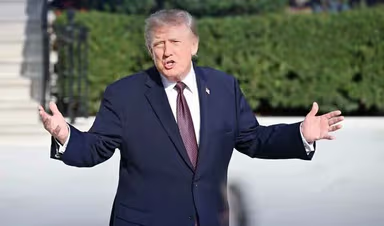
US President Donald Trump has issued a fresh warning to Yemen’s Houthi rebels over their escalating attacks on Saudi Arabia, accusing the group of acting at Iran’s behest and deliberately trying to drive up oil prices ahead of the US midterm elections.
Trump stopped short of announcing military action against the Houthis but said Washington would decide on Iran “very soon”. He also indicated that he might ask Türkiye to intervene in support of Saudi Arabia as attacks on key regional targets and shipping routes raise concerns about energy supplies.
In a post on his Truth Social platform on Tuesday, Trump accused the Houthis of resuming attacks after a prolonged period of relative quiet following US strikes against the group in Yemen last year.
“The Houthis are behaving very badly,” Trump wrote, alleging that the group had returned to attacking Saudi Arabia “probably at the behest of Iran”.
He said the Houthis had previously learned a lesson when the United States launched attacks against them and later halted its military campaign at their request.
Trump warned that he would not forget the latest attacks, making clear that his response could extend beyond the November 3 US midterm elections.
“I’ll be there after the elections, and I will never forget!” he wrote.
The US president also argued that the Houthis were deliberately attempting to increase oil prices before the elections, although he did not provide evidence for the allegation.
In his post, Trump described Iran as a failing nation with no navy, no air force, a severely weakened economy and inflation exceeding 300%. He also argued that the US election timing was irrelevant to him, saying he had already won in what he described as a massive landslide.
Trump declines to confirm possible US strikes
Speaking to reporters outside the White House on Tuesday, Trump declined to say whether the United States had decided to launch strikes against Houthi targets.
“They’re behaving very badly,” he said when asked about the group’s continued attacks on Saudi Arabia.
Trump made the remarks before boarding Marine One for a trip that included a campaign rally in Wasilla, Alaska, ahead of the US midterm elections. He had also discussed the possibility of military action against the Houthis on Saturday, following a deadly attack on Riyadh’s King Khalid International Airport.
On Monday, as he departed the White House for Ohio, Trump again criticised the group but offered no details about his intended response.
“Well, the Houthis are misbehaving very badly. No good,” he told reporters.
The remarks came as Saudi Arabia faced a series of missile and drone attacks that have heightened security concerns across the kingdom.
Houthi attacks kill 13, injure more than 300
Trump’s warning followed repeated Houthi attacks on Saudi Arabia, including strikes targeting King Khalid International Airport in Riyadh.
The airport attacks killed at least 13 people and wounded more than 300, according to the reports. Saudi authorities subsequently extended the suspension of airport operations until Saturday, disrupting air travel and raising concerns about the security of civilian infrastructure.
The attacks have intensified an already volatile regional conflict, with the Houthis also threatening commercial shipping in the Red Sea and the strategically important Bab al-Mandeb Strait.
The renewed violence has raised fears that disruptions to maritime traffic and energy infrastructure could further push up global oil prices.
The Houthis control large parts of Yemen and have been fighting the Saudi-backed Yemeni government in a civil war since 2014. The conflict has escalated amid the eight-month US-Iran war, which has widened regional hostilities and increased pressure on critical shipping routes.
Trump says Erdogan may support Saudi Arabia
Trump also raised the possibility of seeking Türkiye’s involvement in efforts to support Saudi Arabia against the Houthis.
Speaking to reporters before departing for Joint Base Andrews on Tuesday, Trump said he might ask Turkish President Recep Tayyip Erdogan to intervene in support of Saudi interests.
“President Erdogan, I think, would do as I ask,” Trump said.
He praised his relationship with the Turkish leader, describing Erdogan as a great friend and expressing respect for him. However, Trump did not specify what assistance he might request or whether the proposed involvement would be military, diplomatic or otherwise.
Trump also confirmed that he had spoken with Saudi officials, including Crown Prince Mohammed bin Salman, about the situation. He declined to disclose the substance of those conversations when questioned by reporters.
“You really think I can tell you that?” Trump asked one journalist. “I’d love to tell you, but I’m not gonna tell you that.”
Erdogan pledges Türkiye’s support for Saudi Arabia
Earlier on Tuesday, Erdogan spoke by telephone with Saudi Crown Prince Mohammed bin Salman and condemned the Houthi attacks on Saudi territory, according to Türkiye’s Communications Directorate.
Erdogan expressed sorrow over the loss of life and offered condolences to those affected by the attacks. He also assured the crown prince that Türkiye would continue supporting the kingdom.
“Türkiye will stand by Saudi Arabia in the coming period as well,” the directorate said, conveying Erdogan’s message.
The Turkish president expressed confidence that Saudi Arabia would overcome the situation and discussed recent regional developments and the attacks on the kingdom with the crown prince.
The call came as the Saudi-led coalition prepared a military operation targeting Houthi-held areas in Sanaa, Yemen’s capital.
Trump says US will decide on Iran ‘very soon’
Trump also addressed the wider US-Iran conflict, saying Washington would make a decision on Iran “very soon”, without specifying what action was under consideration.
“Iran is a failed country,” Trump told reporters, alleging that the country had no functioning economy, was facing inflation of around 300% and was struggling to pay its troops and other personnel.
In his Truth Social post, Trump put Iran’s inflation at 301% and described the country as having no navy or air force. These were the president’s characterisations of Iran’s military and economic position.
Trump also claimed that the United States controlled the Strait of Hormuz, adding that “a lot of oil is coming out” of the international waterway.
Regional conflict threatens oil prices
The latest developments have raised concerns about the potential impact of the conflict on global energy markets, particularly if Houthi attacks continue to target Saudi infrastructure or disrupt commercial shipping.
The Red Sea and Bab al-Mandab Strait are important maritime corridors for international trade and energy shipments. Any sustained disruption could increase shipping costs, delay deliveries and put additional upward pressure on oil prices.
Saudi Arabia’s military campaign against the Houthis has intensified as the group continues to launch attacks on the kingdom. Riyadh has sought international support to counter the missile and drone threats, while Washington has so far stopped short of publicly confirming direct US military intervention in the renewed campaign.