Yemen’s Iran-aligned Houthi rebels escalated their attacks on Saudi Arabia on Thursday, targeting airports and threatening the kingdom’s energy infrastructure as the widening conflict linked to the US-Iran war intensified regional tensions.
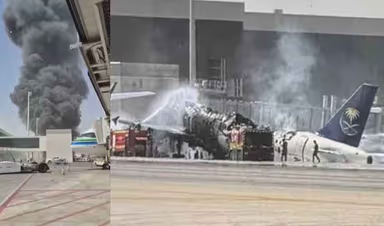
Three Saudi nationals were killed and several people wounded in two attacks on Riyadh’s King Khalid International Airport, Saudi Arabia’s General Authority of Civil Aviation said on Friday. Saudia Airlines also confirmed that one of its pilots died and an aircraft was damaged while parked at the airport.
Saudia Airlines identified the killed pilot as Captain Hamoud Ali Al-Kalthami, and extended condolences to his family, relatives and colleagues.
The airline said no passengers were aboard the aircraft when the incident occurred. Both the airline and civil aviation authorities reported that airport operations and flights had returned to normal.
“The Authority affirms the ongoing work – in integration and continuous coordination with relevant security agencies – to assess damages and take all necessary measures to ensure the safety of passengers and workers, and to maintain the security and safety of the civil aviation system in the Kingdom, noting the resumption of operational processes at the airport and the return of air traffic to normal,” the civil aviation authority said further.
Aircraft catches fire after Riyadh airport attack
The Houthis claimed to have struck Riyadh airport and warned workers to stay away from energy facilities, which they said would be targeted.
According to three people briefed on the matter, shrapnel from an interception or another projectile hit a Saudia Airlines aircraft while it was parked at an airport terminal on Thursday. The plane caught fire and sustained heavy damage, with video verified by Reuters showing thick black smoke and flames rising from the airport.
The initial account said no passengers were believed to have been aboard the aircraft at the time, although those briefed on the incident could not rule out injuries. Saudia Airlines subsequently confirmed that one employee had died in the incident.
Saudi Arabia’s government media office, civil aviation authority and Saudia Airlines did not initially respond to requests for comment. The airline and aviation authority issued updates on Friday confirming the fatalities and saying operations had returned to normal.
Airlines suspend flights
The Houthi attacks prompted Lufthansa and Air India to suspend flights to Riyadh, while airlines and passengers faced widespread disruption.
Data compiled by aviation analytics company Cirium showed that almost half of departures from Riyadh airport had been cancelled by 1500 GMT on Thursday. Another 31 cancellations were expected across Saudi airports on Friday.
Flight-tracking service FlightRadar24 also indicated numerous delayed arrivals and departures at King Khalid International Airport. The airport advised travellers to contact their airlines to confirm flight status before setting out.
The Saudi-led coalition fighting in Yemen said it had destroyed two ballistic missiles launched towards Riyadh and another missile aimed at Khamis Mushayt, which is home to a major airbase.
Separately, Saudi officials said debris from an intercepted missile had struck a kindergarten and a medical complex in Riyadh.
Saudi authorities had reported on Wednesday that three people had been killed during attacks on Riyadh airport and Abha airport in the kingdom’s southwest. The aviation authority’s subsequent statement on Friday specified that three Saudi nationals died and several people were wounded in two attacks on King Khalid International Airport.
Businesses, schools take measures
The attacks and explosions heightened concerns in Riyadh, where several multinational companies instructed employees to work from home.
Five people familiar with the matter said several firms based in the city’s King Abdullah Financial District (KAFD) issued work-from-home instructions after loud booms were heard on Thursday morning. Some of those familiar with the situation were employees directly affected by the measures.
Some diplomats also said they had received warnings, while schools in Riyadh informed parents that they had been instructed to shelter in place. Saudi authorities did not issue a public alert, and Reuters could not independently identify the source of the reported explosions.
The Saudi government did not respond to a request for comment, while KAFD was not immediately available to comment.
Riyadh was also scheduled to host the WPC Energy Congress, a major gathering of energy policymakers, during the week.
Saudi Arabia seeks support from allies
The Houthis say their attacks on Saudi Arabia are a response to the kingdom’s support for government forces in Yemen’s renewed civil war. Riyadh, meanwhile, backs an offensive by Yemen’s internationally recognised government to recover territory held by the rebels.
Saudi Arabia has sought assistance from allied countries, including Pakistan and Türkiye, as it attempts to reverse Houthi advances in southwestern Yemen near the southern entrance to the Red Sea. The requests have taken on greater urgency as attacks have expanded to Saudi cities, airports and infrastructure.
The kingdom has sought support even if it is limited to logistics and defensive capabilities. Türkiye, a NATO member, said on Wednesday it was sending mainly defensive and technical assistance to Saudi Arabia.
A Turkish official said the support was expected to include military equipment, intelligence sharing and weapons systems.
Syria is also considering possible assistance. One US defence official and one Syrian defence official said Damascus was carefully examining options that could include defensive aid to protect Saudi Arabia from attacks or an offensive deployment to help fight the Houthis.
In response to a request for comment from Syria’s foreign ministry, a diplomat said Syria stood firmly with Saudi Arabia but remained focused on domestic priorities, including recovery from its own civil war.
Yemen’s civil war reignites
Yemen’s long-running civil war, which had largely paused under a ceasefire in 2022, has erupted again in recent weeks amid the wider regional conflict involving the United States and Iran.
The Houthis seized stretches of Yemen’s Red Sea coast last month, including areas along the strategically important Bab el-Mandeb Strait. Their threats to shipping and attacks on Saudi cities and infrastructure have drawn the kingdom back into the fighting.
Saudi-backed forces launched a counterattack this week and recaptured some areas around the strait. However, the conflict continues to unfold across multiple fronts, with the Houthis also making territorial gains.
The rebels have surrounded Taiz, Yemen’s third-largest city, after capturing territory along its main mountain road towards Aden.
The fighting pits the Houthis against a coalition of Saudi-backed forces operating under Yemen’s internationally recognised government. The renewed conflict has further aggravated the humanitarian crisis in the Arab world’s poorest country, displacing 200,000 people since the fighting resumed.
The conflict’s expansion has raised concerns that additional regional powers could become involved in a prolonged and difficult campaign, including fighting in Yemen’s mountainous terrain.
As Saudi Arabia seeks to contain the Houthi advance and protect its airports and energy infrastructure, the involvement of Türkiye, Pakistan and potentially Syria highlights the growing regional implications of the renewed war.