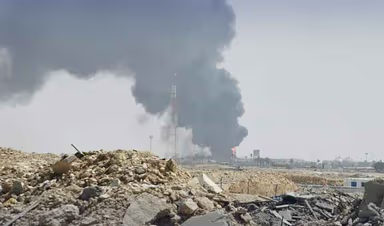
Houthis on Monday claimed they had launched a major wave of missile and drone attacks against Saudi Arabia, including an alleged strike on Riyadh’s King Khalid International Airport and an Aramco refinery.
The claims came as Saudi-led forces intensified their offensive in Yemen and Pakistan and Türkiye agreed to prepare military forces for rapid deployment to Saudi Arabia under a new mutual defence pact.
Houthi military spokesman Yahya Saree said the group carried out three military operations involving a large number of ballistic and cruise missiles and drones.
Saree said the first operation targeted King Khalid International Airport in Riyadh, claiming the attack hit its intended target and disrupted air traffic at the facility.
The second operation targeted an Aramco refinery in Rabigh, a Red Sea coastal city in Saudi Arabia’s Makkah region. The spokesman claimed the strike caused a fire at the oil facility.
The third operation targeted Abha Airport, the Khamis Mushait military base and Akfa camp in the southern Asir region. Saree also claimed attacks on other “sensitive sites” in Najran and Jazan in southwestern Saudi Arabia.
There was no immediate comment from Saudi authorities on the Houthi claims.
Loud explosions were reported in Riyadh on Monday evening as the Houthi attacks were announced.
Houthis say attacks were retaliation
Saree said the operations were carried out in response to 60 Saudi airstrikes and missile attacks during the preceding 24 hours.
According to the Houthi spokesman, those attacks targeted Sanaa and the Yemeni provinces of Al-Jawf, Taiz, Hajjah, Saada and Marib.
He said the total number of airstrikes and missile attacks carried out since the latest escalation began had reached 1,576.
Saree also warned international airlines operating through Saudi airspace against continuing their flights, saying the airspace was now within the group’s area of operations. He made an exception for airspace over Makkah and Madinah.
Saudi-backed forces launch major Yemen offensive
The Houthi claims came as Saudi Arabia and its Yemeni government allies launched an ambitious campaign aimed at retaking territory held by the group.
The Yemeni military said it had carried out more than 1,000 strikes and launched an offensive toward Houthi-held Sanaa. The Saudi-led coalition supporting Yemen’s internationally recognised government said 100 warplanes conducted sorties at dawn.
Turki Al-Malki, spokesman for the Saudi-led coalition, said on X that naval forces had struck Houthi “military targets” in Hodeida on Yemen’s Red Sea coast.
Also Read: Yemeni forces drive Houthis from Bab el-Mandeb Strait
According to Al-Malki, the strikes destroyed weapons depots, facilities storing booby-trapped boats and naval mines. He said the operation also thwarted a planned Houthi attack targeting waterways in the southern Red Sea.
Later, the military said pro-government forces had driven the Houthis from areas surrounding the Bab al-Mandab Strait, a vital route for international maritime traffic.
The reported gains included the port city of Mocha, Dhubab airport and Al-Omari military camp. Forces also said they had expelled the Houthis from several areas in Taiz in southwestern Yemen, where deadly fighting has intensified in recent days.
However, military sources stopped short of confirming an official recapture of Mocha. They said pro-government forces had cut off the only supply route to the port.
Yemeni military sources separately said the supply route to Houthi-held Mocha had been severed, but there was still no official confirmation that the port itself had been fully recaptured.
Houthis had seized key Red Sea territory
The latest offensive follows a major Houthi expansion last month, when the Iran-backed group seized large stretches of coastline along the Red Sea and the strategic Bab al-Mandab Strait.
The Houthis previously controlled much of northern Yemen, including the capital Sanaa and the western port city of Hodeida. The latest territorial gains represented some of the deadliest fighting in Yemen in years.
The group has also continued attacking neighbouring Saudi Arabia since Yemen’s civil war flared back into active fighting. It has declared a maritime blockade on Saudi-linked ships and repeatedly targeted Saudi oil infrastructure and tankers in the Red Sea.
The Yemeni government announced on Sunday that it intended to retake all territory held by the Houthis, much of which has remained under the group’s control for more than a decade and is home to most of Yemen’s population.
Pakistan, Türkiye agree to prepare troops
The widening conflict has also prompted a stronger security response from Saudi Arabia, Pakistan and Türkiye.
Representatives of the three countries held an emergency meeting in Riyadh on Monday under a joint defence agreement signed in August. The pact commits the countries to come to each other’s aid in the event of an attack.
Following the meeting, they agreed to take the necessary measures to provide the agreed military forces and capabilities and ensure their rapid deployment in Saudi Arabia.
The joint statement did not specify what role Pakistani and Turkish troops would perform once deployed in the kingdom.
The agreement comes after weeks of Houthi attacks against Saudi cities, military installations and economic infrastructure.
UN voices concern over escalating conflict
A spokesman for UN Secretary-General Antonio Guterres said he was “deeply concerned by the sharp escalation in fighting.”
The UN official also condemned what he described as continued Houthi cross-border attacks on Saudi Arabia.
The renewed fighting has become the most active front in the wider Middle East war in recent weeks, with the conflict spreading beyond Yemen’s borders and placing additional pressure on regional security.
The United Nations says more than 184,000 people have been displaced since the war resumed, further worsening an already severe humanitarian crisis in Yemen, the poorest country in the Arab region.
Houthi attacks put Saudi oil infrastructure at risk
Houthi attacks have repeatedly targeted Saudi oil infrastructure as well as tankers operating in the Red Sea.
A source in Saudi Arabia’s energy sector told AFP that a Sunday attack had again halted pumping through the East-West pipeline to the Red Sea. The pipeline is a key route for Saudi exports, particularly after Iran blockaded the Strait of Hormuz at the start of the wider Middle East war.
Crude prices were already soaring because of the regional conflict before the Houthis began targeting the world’s largest oil exporter.
Saudi Aramco chief executive Amin Nasser warned on Monday that global oil stockpiles were “scarily thin” because of the war.
“The system is already straining,” Nasser told the Energy Intelligence Forum in London.
The renewed fighting around both the Bab al-Mandab Strait and Saudi energy infrastructure therefore adds another layer of pressure to global oil supplies and maritime trade, already affected by disruptions around the Strait of Hormuz.