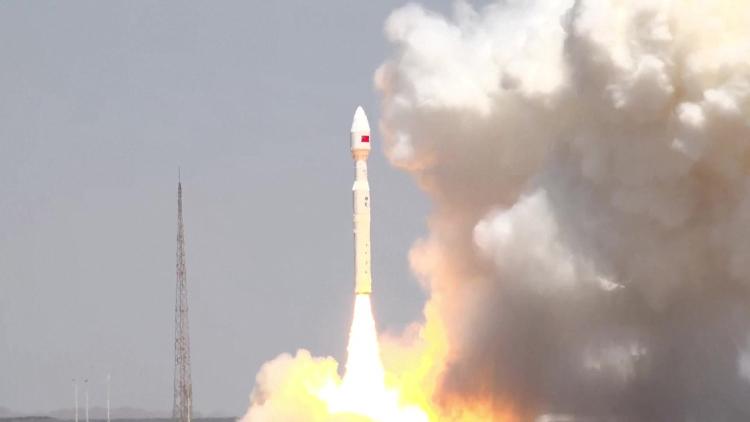
China’s commercial rocket firm CAS Space unveiled a partnership with the Guangzhou Laboratory on Monday to jointly develop space pharmaceutical payloads, with plans to conduct suborbital flight verification using a reusable spacecraft in 2027.
The first batch of payloads is slated to fly aboard the company’s Lihong-2 reusable launch vehicle. The mission will conduct crystallization experiments involving proteins and small-molecule drugs, along with preliminary technical verification of space pharmaceutical hardware, the firm said.
Headquartered in Guangzhou, the laboratory focuses on research into respiratory diseases and their prevention and control. Under the partnership, the lab will define scientific research questions related to drug crystallization and oversee experimental design, sample administration, ground operations and result analysis.
Xu Qiang, a principal investigator at the laboratory, explained that modern medicine has a strong demand for higher-resolution structural data, more stable drug crystal polymorphs, human-relevant disease models and more efficient screening platforms. The space environment may open new avenues for addressing some of these challenges.
Xu pointed out that the microgravity conditions in space enable certain proteins to form higher-quality crystals and create novel experimental settings for crystal-form screening and particle regulation of small-molecule drugs. Under such conditions, cells also tend to assemble into 3D aggregates, which can be used to investigate disease mechanisms and drug responses.
CAS Space noted that its Lihong series vehicles are designed for space medical research, biomedical trials, in-orbit manufacturing and space tourism. In January this year, the firm’s Lihong-1 rocket completed its suborbital flight test in northwest China.