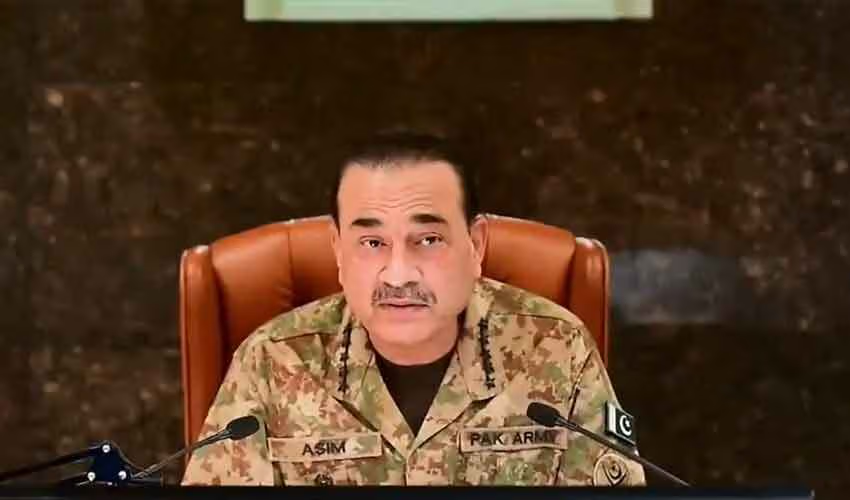
Chief of Army Staff and Chief of Defence Forces Field Marshal Asim Munir presided over the 277th Corps Commanders’ Conference at General Headquarters (GHQ), where the military leadership reviewed the prevailing security situation and reaffirmed Pakistan’s right to self-defence against terrorism emanating from Afghanistan.
The forum also stressed the importance of internal stability, stronger governance and public engagement, while warning that attempts to create unrest or a situation similar to May 9 would be met with decisive force.
The conference began with Fateha for the martyrs of the Armed Forces, law enforcement agencies and civil society who sacrificed their lives for the country.
According to ISPR, the participants paid rich tribute to the unparalleled sacrifices of the martyrs and resolved to maintain a high state of readiness amid the prevailing security environment.
Pakistan reaffirms right to self-defence
The Corps Commanders affirmed Pakistan’s right to self-defence and targeted action against terrorism originating from Afghanistan.
The forum stated that the Taliban leadership alone bears responsibility for the serious consequences of terrorism. The ISPR statement further alleged that the Taliban leadership was facilitating terrorism on behalf of India.
The participants commended the sustained and successful intelligence-based counter-terrorism operations being conducted by law enforcement agencies.
Governance needed alongside operations
The forum emphasized that military and law enforcement operations must be complemented by effective administrative and governance measures to eliminate terrorism.
Participants stressed the need to bring governance closer to people at the grassroots level and called for greater strategic engagement with the public.
The Corps Commanders also highlighted the importance of communicating with citizens about the causes of terrorism and developing an effective narrative around counter-terrorism efforts.
The participants called for the dismantling of the terror-crime nexus operating under the patronage or influence of vested interests.
The forum also underscored the need to strengthen police capacity as part of a broader approach to countering terrorism.
These measures, according to the ISPR statement, are to be pursued alongside kinetic operations and are in line with the National Action Plan and Vision Azm-e-Istehkam.
Army warns against May 9-like unrest
The Corps Commanders’ Conference underscored that internal stability is vital for Pakistan.
The participants resolved that any attempt to incite agitation, create violent unrest or produce conditions similar to those witnessed on May 9 would be dealt with through decisive force and the rule of law, without hesitation or discrimination.
The forum warmly welcomed the joint defence agreement between Pakistan, Saudi Arabia and Türkiye, describing it as significant for strengthening long-standing strategic ties and joint defence cooperation.
The commanders also strongly condemned Houthi attacks against Saudi Arabia and expressed indignation over the attacks.
The forum expressed solidarity with Saudi Arabia and reaffirmed Pakistan’s commitment to the security and sanctity of Haramain Sharifain.
The Corps Commanders’ Conference also reiterated Pakistan’s principled position on Indian Illegally Occupied Jammu and Kashmir (IIOJK).
The forum reaffirmed support for resolving the Kashmir dispute in accordance with relevant UN Security Council resolutions and the aspirations of the Kashmiri people.
Asim Munir stresses modernisation and preparedness
In his concluding remarks, Field Marshal Asim Munir commended the formations for their operational preparedness and professionalism.
He directed commanders to continue strengthening intelligence-based operations and enhance combat capabilities through the absorption of modern technology, improved training and multi-domain integration.
The COAS and CDF expressed confidence that Pakistan’s Armed Forces, with the unwavering support of the nation, remain fully prepared to safeguard the country’s sovereignty, territorial integrity and national security.