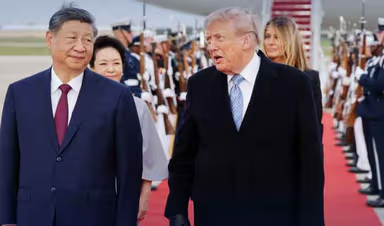
US President Donald Trump welcomed Chinese President Xi Jinping to Washington on Wednesday for a three-day visit, setting the stage for high-level talks aimed at stabilising relations between the world’s two largest economies despite deep disagreements over trade, technology, Taiwan and Iran.
Xi’s first visit to the United States in nearly three years was not expected to produce major breakthroughs, although Washington and Beijing appeared poised to extend an 11-month trade truce.
Trump greeted Xi personally at Joint Base Andrews in Maryland after the Chinese president arrived on Wednesday evening, underscoring the importance Washington has attached to the summit.
US Treasury Secretary Scott Bessent said the two sides had reached an agreement to extend their trade truce. China’s embassy in Washington did not immediately comment on the reported agreement.
At the arrival ceremony, Trump and Xi, accompanied by their wives, shook hands, spoke for several minutes and posed for photographs as a military band played. Cannons fired and a B-1 military bomber flew overhead as part of the elaborate welcome.
According to C-SPAN, which tracks presidential events, it was the first time in 11 years that a US president had welcomed a foreign leader at Joint Base Andrews. The last such reception was for Pope Francis in 2015 during Barack Obama’s presidency.
Xi, in a written statement released by the Chinese embassy and later carried by China’s Xinhua news agency, said China and the United States should be “partners, not rivals.”
He also said the “historical logic of peaceful coexistence” between Beijing and Washington had not changed. The statement did not refer to a trade agreement.
Trade truce extension offers positive signal
A limited trade agreement could provide relief to global markets still affected by the 2025 tariff war, which saw tariffs between the two largest economies climb above 100%.
Bessent told Fox News’ “Special Report” that the two countries had agreed to extend the trade truce until January 10. The agreement had previously been scheduled to expire on November 10.
The reported extension followed talks between Bessent and Chinese Vice Premier He Lifeng. The agreement had paused a broader trade confrontation that had involved mutual tariffs exceeding 100%.
US Trade Representative Jamieson Greer said the countries were also expected to make announcements involving agriculture and non-tariff barriers.
Greer said China was making progress toward a commitment to purchase 200 Boeing aircraft, although he gave no indication that additional orders were imminent.
Taiwan, technology, rare earths remain contentious
Despite the trade progress, major differences remain between Washington and Beijing.
The two countries continue to disagree over Taiwan, US export controls on computer chips and other technologies, China’s control of rare-earth mineral supplies, artificial intelligence and Beijing’s relationship with Iran.
Taiwan remains particularly sensitive. The democratically governed island is claimed by China, while the United States continues to support Taipei, including through arms sales.
People familiar with the plans said Xi was expected to press Trump to halt US arms sales to Taiwan. Sources told Reuters that the issue could arise during a planned visit by Trump and Xi to the US National Archives on Friday.
US allies in Asia have expressed concern about the possibility of Washington softening its support for Taipei in pursuit of economic gains with Beijing.
After their May summit, Trump said he was holding an arms package worth about $14 billion in abeyance, describing it as a “very good negotiating chip.”
Iran war adds another layer to US-China talks
The Iran war is also expected to feature in the discussions, although there has been little indication that Beijing is prepared to pressure its ally into accepting US demands.
The conflict has disrupted energy supplies and trade, creating additional economic concerns for both Washington and Beijing.
People familiar with the plans said China was offering help in putting pressure on Iran in exchange for concessions related to Taiwan, although the extent of any Chinese role remained uncertain.
The meeting comes at a difficult political moment for Trump, who is facing public discontent over the nearly seven-month war with Iran. His Republican Party is also heading into November’s congressional elections amid political pressure.
Xi arrives in Washington with China’s trade performance surging, although he faces domestic challenges including weak household spending and a prolonged property-market downturn.
China’s sweeping corruption crackdown within the military has strengthened Xi’s control but has also raised questions about the readiness of the People’s Liberation Army.
Potential agreements beyond trade
Although major breakthroughs are not expected, Thursday’s talks could produce agreements in several areas.
The two countries could announce measures to reduce tariffs in specific sectors, cooperate against drug trafficking and expand military-to-military communication.
Trump is also expected to seek the release of some Americans and other individuals detained in China.
Artificial intelligence could provide another area for dialogue. The United States and China are competing intensely in AI, but both governments have also expressed concerns about the risks posed by the misuse of the technology.
Bessent discussed AI with He Lifeng over the weekend. US Secretary of State Marco Rubio said there was emerging thinking about creating something similar to a Cold War-era hotline to prevent dangerous incidents that could affect economies and societies or potentially lead to conflict between countries.
However, analysts said the intense strategic competition between the two powers could restrict AI cooperation to symbolic or limited agreements.
Leaders arrive with different strategic outlooks
Analysts said neither Trump nor Xi appears to believe he needs to make major compromises.
Edgard Kagan, a former White House official now with Washington’s Center for Strategic and International Studies, said Trump believes the US economy will strengthen over time, while Xi believes China is gaining ground and that “time is on China’s side.”
Former Deputy Secretary of State Kurt Campbell described the summit as being less about detailed negotiations and more about two powerful leaders projecting strength.
He compared the encounter to what was historically known as “single combat,” involving leaders representing their respective civilisations measuring their strength against each other.
State dinner to bring together technology chiefs
The summit will feature extensive ceremonial events in addition to diplomatic discussions.
A state dinner is scheduled for Thursday, alongside a White House military ceremony and a visit to the National Archives, where the original Declaration of Independence and Constitution are housed.
The dinner is expected to bring together executives from major US and global technology companies, including Apple CEO Tim Cook, Amazon’s Jeff Bezos, Alphabet CEO Sundar Pichai, OpenAI CEO Sam Altman, Tesla CEO Elon Musk and Nvidia CEO Jensen Huang.
Despite the guest list, people familiar with US plans said Trump was expected to maintain firm export controls on advanced US technology that Beijing wants Washington to loosen.
Summit designed to project stability
Despite their deep disagreements, Washington and Beijing have pressed ahead with the summit as both sides seek to project stability between the world’s biggest factory and its largest consumer market.
The visit is Xi’s first trip to Washington in more than a decade and marks the second meeting between the two leaders this year.
Trump is also seeking to reciprocate the grand welcome he received in China in May. The US president is expected to host Xi through ceremonies spanning the White House South Lawn, State Floor and Rose Garden.
As with their previous two meetings since 2025, the summit is expected to feature a highly scripted programme. Rather than holding a joint press conference at the conclusion, the two countries are expected to issue separate announcements highlighting the messages each government wants to convey to domestic audiences.
Campbell said the summit would provide both leaders with an opportunity to demonstrate strength while keeping relations stable.
Both sides have reasons to avoid further escalation
Xi appears to be entering the summit from a position supported by strong Chinese trade performance and Beijing’s control over rare-earth supplies, which provide an important source of leverage.
At the same time, both governments have incentives to prevent relations from deteriorating further. Trump is dealing with political pressure over the Iran war, while Xi is confronting economic challenges at home.
Beneath the diplomatic ceremony, however, disputes over Taiwan, export controls, artificial intelligence and other strategic issues could quickly reignite tensions.
The two countries could also discuss military communication mechanisms aimed at reducing the risk of unintended escalation.
More Trump-Xi talks could follow
Another meeting between Trump and Xi is considered possible later this year, potentially on the sidelines of the Asia-Pacific Economic Cooperation summit in China in November or the Group of 20 meetings in the United States in December.
For Trump, the Washington visit caps a week of diplomacy that began with a two-day stay in New York for the United Nations General Assembly.
Nearly seven months of conflict with Iran have pushed up US energy prices, while Trump’s Republican Party faces the November congressional elections.
For Xi, the summit comes as China records stronger trade activity but continues to contend with weak domestic consumption and problems in its property market.
The Washington summit is therefore expected to produce carefully managed areas of cooperation while leaving the deeper strategic rivalry between the United States and China unresolved.