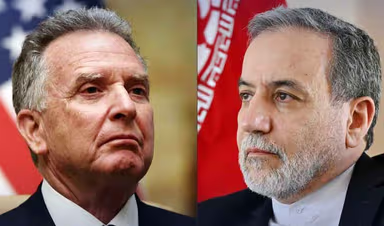
US President Donald Trump said US and Iranian officials held a “very good” and “very productive” three-hour meeting on the sidelines of the United Nations General Assembly in New York, signalling renewed diplomatic activity despite his threats against Tehran.
Trump said another meeting would take place in the “very near future” and expressed confidence that a deal could eventually be reached.
Trump said US Special Envoy Steve Witkoff and Jared Kushner participated in the discussions with the Iranian side. He described the meeting as highly productive and said significant progress was being made towards a possible agreement with Iran.
The White House later clarified that Trump himself did not participate in the meeting. Witkoff and Kushner represented Washington, while Iranian Foreign Minister Abbas Araghchi was involved on Tehran’s side. Iranian officials said the discussions were conducted indirectly through intermediaries, with mediators shuttling between the two delegations.
Witkoff said he felt “very good” about the meeting. In a statement, he said lengthy discussions had taken place through mediators and that one round had concluded with an outcome that he hoped would prove constructive and promising.
He added that the mediators would continue communicating and exchanging messages between the US and Iranian delegations.
Conditions for reopening Strait of Hormuz
The talks focused in part on conditions for ending the conflict and reopening the Strait of Hormuz, one of the world’s most important energy shipping routes.
Iranian state media reported that Araghchi conveyed Tehran’s conditions to Witkoff. These included the immediate lifting of the US naval blockade, the release of frozen Iranian assets and an end to the war across all “resistance” fronts.
Iran has also indicated through intermediaries that it could reopen the Strait of Hormuz within seven days if Washington takes reciprocal steps to ease military and economic pressure and lifts its blockade. The proposal represents a relaxation of some of Tehran’s earlier conditions for reopening the strategic waterway.
A senior Iranian official reportedly conveyed the proposal through intermediaries to Washington. The development came amid intensive diplomatic activity in New York, where officials from both sides are exploring possible terms for resuming negotiations and ending the conflict.
Trump says another meeting coming
Speaking to reporters during his meetings at the UN General Assembly, Trump said the talks had gone well and that another meeting with Iranian officials was scheduled for the near future.
Trump said reaching an agreement was in Iran’s interest and expressed confidence that a deal could be reached. He also said Iran faced a choice between what he described as “potential greatness” and “obliteration.”
Earlier in the day, Trump had told world leaders that he was considering whether to reach an agreement that would allow Iran to rebuild or take further military action against the Islamic Republic. His comments came as the nearly seven-month US-Iran conflict continued.
Trump has repeatedly stressed that Iran must not be allowed to obtain a nuclear weapon. He said the overwhelming majority of US actions against Iran were aimed at preventing Tehran from developing nuclear weapons.
Further action against Iranian nuclear sites
Trump also suggested that the United States could take further military action against Iranian nuclear facilities. He referred to the Pickaxe Mountain and said that no activity was currently visible there. Trump indicated that if activity were detected, the facility could be destroyed.
His comments followed his broader warning that Iran could face severe consequences if it failed to reach an agreement with Washington.
At the same time, Trump said he expected prices to fall significantly once the war ends, highlighting the economic consequences of the prolonged conflict and disruption to energy supplies.
Hormuz remains central to negotiations
The Strait of Hormuz has emerged as one of the central issues in the latest US-Iran diplomatic contacts. Shipping through the waterway has fallen dramatically during the conflict, adding pressure to global energy markets.
Iran’s latest proposal to reopen the strait within seven days is conditional on US measures to reduce military and economic pressure. Tehran has previously demanded an end to US military action, sanctions and other forms of pressure before agreeing to restore normal passage.
The renewed discussions therefore bring together several unresolved issues, including the nuclear question, the war, US sanctions and blockade measures, frozen Iranian assets and the future of shipping through Hormuz.
Talks come despite threats from Washington
The latest diplomatic contact came only hours after Trump delivered a strongly worded speech at the UN General Assembly in which he warned Iran of potentially devastating consequences if no agreement was reached.
Despite the rhetoric, Trump later said negotiations were progressing and indicated that another round of discussions was imminent. Reuters also reported that Iran had signalled a willingness to revive stalled negotiations while seeking relief from US military and economic pressure.
US Secretary of State Marco Rubio had earlier indicated that Trump was open to meeting Iranian President Masoud Pezeshkian during the UN gathering. Pezeshkian arrived in New York for the General Assembly, creating the possibility of further high-level diplomatic engagement.
For now, no formal agreement or specific breakthrough has been announced. However, the three-hour New York discussions, Iran’s proposal on the Strait of Hormuz and Trump’s announcement of another meeting indicate that diplomatic channels between Washington and Tehran remain active.