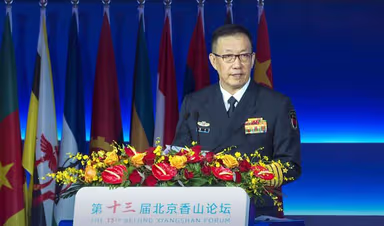
Chinese Defence Minister Dong Jun has urged countries to avoid provocative actions and prevent the return of what he described as “regressive” historical trends, in remarks widely seen as an indirect warning to Japan.
Speaking at the Beijing Xiangshan Forum on Wednesday, Dong called for greater restraint and a more equal approach to resolving international disputes as tensions continue to simmer over Taiwan, the South China Sea and the wider regional security order.
Dong said the world had reached a “fragile moment” and called for countries to learn from history while remaining alert to what he described as hegemony, militarism and historical revisionism.
“We must bear in mind the lessons of history and remain highly vigilant against all latent manifestations of hegemony, militarism and historical revisionism,” he said in his opening speech.
He urged the international community not to overlook or tolerate such behaviour, calling for broad cooperation to prevent what he described as the resurgence of “historical dregs” from exploiting current tensions.
Although Dong did not directly name Japan, his comments come against a backdrop of worsening China-Japan relations and were interpreted by Reuters as a veiled criticism of Tokyo.
China-Japan tensions remain high
Relations between China and Japan deteriorated sharply last year after Japanese Prime Minister Sanae Takaichi suggested that a hypothetical Chinese attack on Taiwan could trigger a Japanese military response.
Beijing subsequently accused Japan of seeking a return to its militarist past, pointing to Japan’s occupation of northeast China’s Manchuria in 1931 and the subsequent full-scale war between Japan and the then-Republic of China.
The latest Chinese warning comes as Beijing continues to view democratically governed Taiwan as part of its territory and has increased military pressure around the island, including periodic military exercises. Taiwan rejects Beijing’s sovereignty claims.
Beijing calls for different security model
Dong avoided directly criticising the United States or its regional allies, including Japan, and instead focused his address on long-standing Chinese positions regarding international security. He called for a peaceful, multipolar world built on “partnership rather than alliance” and “win-win rather than zero sum”.
Dong also urged countries to prevent provocative actions that could place regional interests at risk for the benefit of individual countries or groups.
He said the international community should take timely preventive measures to stop conflicts from escalating into major disputes and argued that legitimate security concerns of all countries should be taken into account.
The Chinese defence minister also stressed that the multilateral system must be upheld and that regional countries should be allowed to determine their own futures without external interference.
China rejects force as solution
Dong said military force could not resolve the underlying causes of disputes and warned that coercion through force could deepen divisions. He called for an “equal and orderly multipolar world” and said the international community must respect the sovereignty and aspirations of the parties involved.
He also argued that a path towards security based on cooperation rather than confrontation must be found.
Dong said the Chinese military was ready to work with all sides to safeguard regional stability, reinforcing Beijing’s call for greater military and diplomatic engagement.
Xi-Trump summit adds significance
Dong’s remarks came one week before Chinese President Xi Jinping is expected to travel to the United States for a summit with US President Donald Trump.
The timing has added significance to the relatively restrained tone of the speech. Recent analysis noted that Dong avoided direct criticism of Washington while still promoting Beijing’s preference for cooperation over military alliances.
The Xiangshan Forum is also taking place amid questions over the future of traditional US security commitments in Asia and continuing disputes involving Taiwan and the South China Sea.
Xiangshan Forum draws global security officials
Around 2,000 military officers, diplomats and academics from about 100 countries are attending the three-day forum, which runs through Thursday.
Participants include regional defence ministers, a senior Pentagon official, Russian academics and representatives of Afghanistan’s Taliban government. The forum is widely viewed as China’s more tightly managed counterpart to the Shangri-La Dialogue in Singapore.
The gathering comes as China expands its military diplomacy, including bilateral exercises that military attachés say are gradually becoming more complex.
This year’s forum is also being held shortly before Xi’s planned summit with Trump in Washington on September 24.
Saudi, Iranian officials clash over regional security
One of the sharper exchanges at the forum involved Saudi Arabian think-tank researcher Prince Turki Al-Faisal and senior Iranian military officer Mohammad Taghi Osanlou.
Osanlou accused the United States of attempting to preserve what he called a “unipolar hegemonic system” and said external forces were undermining unity in the Middle East.
Al-Faisal, while also criticising the United States and Germany, said Saudi Arabia’s immediate concern was Iran’s alleged failure to respect the sovereignty of Arab states.
He said this had culminated, in Saudi Arabia’s view, in “aggressive and unlawful attacks” against Arab territories and assets during the recent war.
The exchange highlighted the wider regional tensions being discussed alongside the China-US and China-Japan security disputes.
China expands military diplomacy
The Xiangshan Forum reflects Beijing’s broader effort to increase its role in international security discussions and military diplomacy.
The event is taking place as China seeks to promote multilateral cooperation while opposing what it describes as bloc-based security arrangements. Dong’s message centred on conflict prevention, sovereignty and cooperation rather than direct confrontation with specific countries.
For Beijing, the challenge is balancing these calls for cooperation with unresolved disputes over Taiwan, the South China Sea and its increasingly complex security relationship with the United States and Japan.