Middle East diplomacy appeared to lose momentum on Monday after Oman postponed a meeting between Iran and Gulf Arab states aimed at discussing shipping through the Strait of Hormuz.
The delay came as attacks on major oil routes, including a Saudi pipeline, intensified concerns about energy supplies.
Omani Foreign Minister Sayyid Badr Albusaidi announced late Sunday that a regional meeting scheduled for Monday in Salalah had been postponed “in the interests of consensus”. He said talks aimed at promoting peace and cooperation in the region would continue, but did not provide a new date for the meeting.
Iranian officials had planned to attend the gathering with Gulf Arab states to present an agreement reached with Oman on governing shipping routes through the Strait of Hormuz.
Iran’s Fars news agency, citing an Iranian Foreign Ministry official, reported that Tehran and Muscat jointly decided to postpone the meeting at the request of certain regional countries. The official said Iran would coordinate with Oman to agree on a suitable date.
Oil prices rise as Saudi pipeline remains shut
The diplomatic setback came after Saudi Arabia shut down, at least temporarily, a key 1,200-kilometre (745-mile) east-west pipeline after it was damaged in drone strikes on Friday.
Oil prices jumped when markets reopened on Monday, with traders increasingly concerned about supplies from Saudi Arabia, the world’s biggest oil exporter.
The pipeline has served as a major route for transporting Middle Eastern oil while bypassing the Strait of Hormuz, making its closure particularly significant for global energy markets.
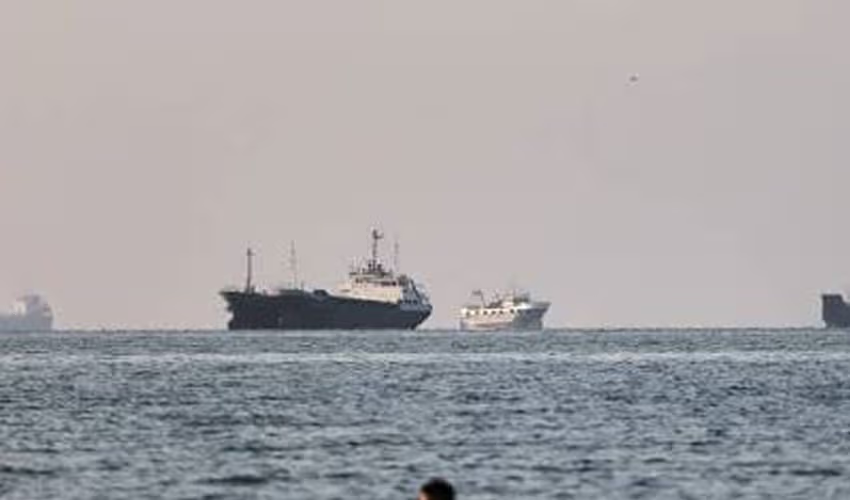
The Strait of Hormuz continued to pose serious risks to oil shipping. The British maritime security agency UKMTO said on Sunday that a vessel was struck by a projectile while transiting the strait, causing a fire and forcing its crew to evacuate.
Iran separately reported that one person was killed and four crew members were wounded after an Iranian commercial vessel was struck off the country’s coast.
The latest incidents have added to concerns over the security of one of the world’s most important oil transit routes.
Saudi oil exports face growing threat
Traders and Saudi oil buyers told Reuters that Riyadh has enough oil stored at its Red Sea port of Yanbu to maintain exports for only five to seven days if the damaged pipeline remains closed.
If the pipeline outage continues beyond that period, as much as 4% of global oil supply could be put at risk, on top of the millions of barrels of oil already affected by disruptions to shipping through the Strait of Hormuz.
Saudi Arabia has not disclosed the full extent of the pipeline damage or said how long it expects the facility to remain offline. Sources cited by Reuters have offered conflicting estimates for repairs, ranging from several days to several weeks.
Satellite images have meanwhile shown huge columns of smoke rising from locations along the pipeline.
Oil and diesel prices hit new highs
Oil prices surged above $100 a barrel last week for the first time since July. The disruption has also pushed fuel costs higher, with the politically sensitive US retail diesel price climbing on Sunday to a new record above $6.20 per gallon.
The renewed escalation follows a relatively quiet August, when Middle Eastern oil flows had gradually begun to recover.
The latest violence is linked to the war launched by the United States and Israel six months ago, adding fresh uncertainty to efforts to restore regional energy flows.
Iran links Hormuz reopening to US demands
Iranian Foreign Minister Abbas Araqchi said Iran would not reopen the Strait of Hormuz until the United States meets Tehran’s demands, even if an agreement is reached with Oman.
In an interview with the London-based pan-Arab outlet Al-Arabi Al-Jadeed, Araqchi made clear that any potential arrangement with Oman would not by itself lead to the reopening of the strategic waterway.
The United States has so far failed to achieve the objectives President Donald Trump announced when he launched “Operation Epic Fury” in February. Those objectives included ending Iran’s nuclear programme, preventing Iran from attacking its neighbours and creating conditions for the Iranian people to topple their rulers.
Trump says Iran war could end after US elections
During a weekend trip to Ireland that included attending the Irish Open golf tournament, Trump reiterated that he expected the conflict with Iran to end this year.
He suggested the war could end shortly after the US midterm elections in November and said gasoline prices would “drop like a rock” once the conflict was over.
Trump also said it made no difference to Washington if Gulf countries held talks with Iran about the Strait of Hormuz.
The US president said Iran was eager to reach a deal and had repeatedly been calling, but insisted that he would not accept an agreement he considered bad.
Trump also reiterated that Iran could not possess nuclear weapons under any circumstances and predicted that oil prices would fall sharply once the conflict ends.
Houthi attacks add to regional energy risks
The energy crisis is being compounded by continuing attacks linked to Yemen’s Iran-aligned Houthi rebels. Saudi state media released footage showing damage to homes and a mosque in Jazan province following the latest reported cross-border attack.
The Houthis separately claimed they had struck a Saudi military base in a neighbouring province after capturing Perim Island in the Bab El-Mandeb, the strategically important “Gate of Tears” strait controlling the entrance to the Red Sea.
The Houthi advance along Yemen’s Red Sea coast is part of the biggest escalation in fighting in the country in years.
Washington faces another difficult choice
The Houthi advance and attacks on Saudi Arabia have created a new dilemma for Washington, which wants to support its Saudi allies and protect international shipping while avoiding involvement in another regional front.
The attacks have also left Gulf states facing a difficult choice between accepting increasing economic pressure and engaging with Iran.
The United States bombed the Houthis for two months in 2025, but Trump halted the campaign after announcing that the group had lifted its threat to attack shipping in the Red Sea.
Three sources told Reuters that Saudi Arabia’s de facto leader, Crown Prince Mohammed bin Salman, called Trump on Thursday to request military assistance against the Houthis. According to the sources, Washington offered intelligence support for now rather than direct military aid.
Trump acknowledged on Saturday that he had spoken with the crown prince. He also said the Houthis had contacted the US administration and asked Washington to stay out of the Yemen war.
Oman urges alternative export routes
Oman’s Energy Minister said the Strait of Hormuz would eventually reopen and suggested that the current disruption could be short-lived.
He also stressed the need to identify alternative routes for energy exports, including possible routes through Oman or Yemen.
The minister said Oman remained capable of continuing its oil and gas production, while warning that rising oil and LNG prices were not in anyone’s interest.
For now, however, the postponed Oman meeting, continued attacks around the Strait of Hormuz and Bab El-Mandeb, and the shutdown of Saudi Arabia’s key pipeline have left global energy markets facing renewed uncertainty.