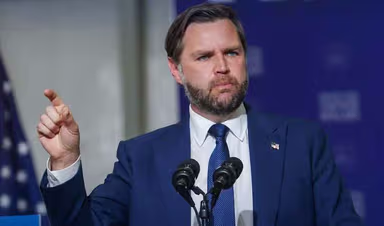
US Vice President JD Vance has ruled out talks with Iran until Tehran stops attacking commercial ships in the Strait of Hormuz, warning that continued disruption of maritime traffic could trigger a wider global energy crisis.
Vance said the United States was protecting commercial vessels and claimed that 15 million barrels of oil passed through the strategic waterway the previous night.
Speaking at a White House briefing on Thursday, Vance said there were currently no diplomatic talks between Washington and Tehran and that the United States would not negotiate while Iran continued targeting commercial shipping.
“There will be no talks” until the attacks on commercial ships stop, Vance said, stressing that Iran must halt what he described as attacks on maritime traffic. He urged Iran to “stop its madness” and end attacks on commercial vessels travelling through the Strait of Hormuz, a vital route for global oil shipments.
Vance also said the conflict was not currently being treated by the administration as a conventional war. He declined to give a timeline for when the hostilities would finally end.
“I wouldn’t call it a war,” Vance said, adding that the United States had ended major combat operations with Iran, although fighting had flared up again in some locations this week.
“Right now there’s no active shooting. I recognize there’s been places where this has flared up,” he said.
Strait of Hormuz remains at centre of crisis
Vance said Washington’s immediate priority was ensuring that Iran could no longer disrupt commercial oil shipments through the Strait of Hormuz.
The US vice president said American efforts to facilitate oil shipping through the strategic waterway had helped prevent a much broader global energy crisis. He claimed that 15 million barrels of oil passed through the Strait of Hormuz last night and attributed the continued movement of oil to US efforts to protect maritime traffic.
“The US is providing protection to a large number of commercial ships,” Vance said.
He warned that if maritime traffic could not remain safe, the disruption could have serious consequences for global energy supplies.
US military presence expanded in Middle East
The United States currently maintains more than 50,000 troops across the Middle East, while the Trump administration has increased its military presence in the region amid the continuing confrontation with Iran.
Nearly 20 US warships have been deployed as part of efforts focused on a blockade and securing maritime routes. Some American troops have also remained in the region longer than originally expected, while forces and military assets have been moved from Europe and the Indo-Pacific.
Asked repeatedly when the conflict would end, Vance said he could not provide a definite timeline. He said the end of the current confrontation would require Iran to stop firing at commercial shipping.
“When will the Iranians stop shooting at ships? I think the reality is I don’t know the answer to that question,” Vance said.
Oil prices rise as fighting disrupts shipping
The renewed exchanges of fire between the United States and Iran have kept global oil markets under pressure, with the continuing uncertainty surrounding the Strait of Hormuz raising fears over energy supplies.
The conflict has already contributed to higher petroleum prices, while Vance blamed Iran for the recent increase in oil prices.
Global oil prices surged after a fresh escalation this week, reaching levels not seen since July.
On Tuesday, the United States launched airstrikes against Iran, striking what Washington described as military targets along the Iranian coast. The attacks were carried out in retaliation for Iranian attacks on shipping in the Strait of Hormuz.
The sudden escalation followed a period of relative calm and has renewed concerns about the possibility of a wider regional and global energy crisis.
Vance says all options remain on table
Vance said the United States was keeping all options available in dealing with Iran. Those options include economic pressure, military action, diplomatic pressure and covert operations, according to the vice president.
He also reiterated that Washington had taken military action against Iran to prevent Tehran from obtaining nuclear weapons.
The comments underline the Trump administration’s broader strategy of maintaining pressure on Iran while refusing to resume negotiations as long as attacks on commercial shipping continue.
Conflict enters seventh month
Vance’s comments came as the confrontation between Washington and Tehran entered its seventh month, with the two sides exchanging attacks again this week after a period of relative calm.
The lack of diplomatic negotiations has added to uncertainty over when the conflict might end.
The prolonged confrontation has also created political difficulties for President Donald Trump. The war has contributed to a decline in Trump’s approval ratings and pushed up gasoline prices, increasing the political stakes for Republicans seeking to protect their narrow majorities in Congress ahead of the November midterm elections.
Vance declined to provide a timetable for the end of the fighting, highlighting the challenge facing the administration as it attempts to balance military pressure on Iran with concerns over energy prices and maritime security.
China could cooperate with US pressure on Iran
Vance also said China was prepared to cooperate with the United States in putting pressure on Iran.
The statement points to the possibility of broader international efforts to prevent further disruption of commercial shipping and maintain the flow of oil through the Strait of Hormuz.
For Washington, securing the waterway remains a central priority as the continued attacks and military escalation threaten to push energy prices higher and deepen concerns about a global energy crisis.