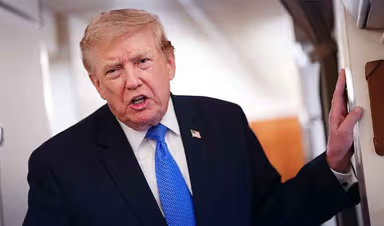
US President Donald Trump has again drawn a hard line over Iran’s nuclear ambitions, saying Tehran must never be allowed to obtain a nuclear weapon and warning that its possession of such a weapon could have devastating consequences across the Middle East and beyond.
In a Fox News interview, Trump defended US intervention in the conflict, saying Iran could have launched a nuclear attack against Israel or other countries if it had acquired such a weapon.
Speaking to Fox News’ Sunday Night in America, Trump said Iran was a leading state sponsor of terrorism and insisted that Tehran would not be permitted to develop nuclear weapons.
“You cannot let them have a nuclear weapon, and they won’t have a nuclear weapon,” Trump said.
The US president argued that a nuclear weapon would represent an unprecedented level of destruction, telling those who questioned US action against Iran to consider whether they believed Tehran should be allowed to possess one.
“A nuclear weapon is massive destruction,” Trump said, arguing that the consequences could be many times greater than the destruction already witnessed during the war.
Trump said he had repeatedly asked people who questioned the US campaign whether they considered it acceptable for Iran to possess a nuclear weapon.
He said most people he had spoken to, including some who had debated or challenged him on the issue, agreed that Iran should not have one.
Israel, Middle East may be destroyed
Trump said Iran would have used a nuclear weapon if it had obtained one. He argued that Israel would have been destroyed and that the wider Middle East could have faced catastrophic consequences.
“If I weren’t president, Israel would be gone. There would be no Israel, and there would probably be no Middle East,” Trump said.
He added that the United States or Europe could have become the next targets. Trump said the possibility of Iran acquiring a nuclear weapon was therefore not limited to Israel or the region.
“That means that if they would have had a nuclear weapon, they would have fired it,” he said, adding that the US, Europe or another location could potentially have been targeted afterward.
“But no, you cannot let them have a nuclear weapon,” Trump reiterated.
US pressure campaign against Iran
Trump also defended the broader US military and economic campaign against Tehran, saying Washington was inflicting significant damage on Iran.
“We are doing a great job,” Trump said, praising what he described as an effective blockade and severe financial pressure on Iran.
“The financial hits that we’re giving them, we’re hitting them very hard. Nobody’s ever been hit like this,” he added.
Trump described Iran as a “failing nation” and said the US would continue pursuing victory without necessarily requiring a formal agreement or signature on a document.
“And they’re a failing nation right now. And at the right point, we’ll either win, or they’ll do something,” he said.
Trump claims Iran’s military badly weakened
The US president also made sweeping claims about the damage inflicted on Iran’s military capabilities and leadership.
“Their navy is gone, their air force is gone, their leaders are gone,” Trump said, adding that Iran’s anti-aircraft systems had also been wiped out.
Trump described Iranians as “tough people” and “smart people” but also called them “very evil”. He further alleged that Iranian forces had killed tens of thousands of protesters.
“They killed 52,000 protesters as of three months ago, and sadly they’ve added very substantially to that list,” Trump said, while also claiming that people who were not participating in protests had been targeted.
Trump says Iran lost regional support
Trump said he was surprised when Iran began attacking Gulf countries after the war started. He said Iran targeted or threatened Saudi Arabia, Qatar, the United Arab Emirates, Bahrain and Kuwait.
“Everybody was shocked. I was surprised,” Trump said. He argued that Iran’s attacks against Gulf states ultimately weakened Tehran’s regional support.
“I thought it was a very good thing because they lost all of the support that they had,” he said.
According to Trump, countries that had previously remained largely neutral toward Iran were no longer willing to support Tehran after the attacks. He said this development reinforced his belief that Iran would have used a nuclear weapon if it had possessed one.
US strikes Iranian launchers on Larak Island
Trump’s interview came as US forces launched strikes on Iran’s Larak Island on Sunday, targeting two Iranian rocket launchers, according to an American official.
Larak Island is located near the northern edge of the Strait of Hormuz, a strategically vital maritime chokepoint at the centre of the latest tensions between Washington and Tehran.
The US official said Islamic Revolutionary Guard Corps forces had been observed preparing to launch rockets carrying sea mines into the Strait of Hormuz.
US Central Command described the operation as “limited, precise” action against Iranian minelaying forces that posed an “imminent threat” to the waterway.
The strikes were the first known US military attacks on Iran since late July.
Iran threatens retaliation after Larak strike
Iran’s Islamic Revolutionary Guard Corps condemned the US attack and warned that the strike would be met with retaliation. The IRGC Public Relations Department warned of direct “vengeance upon criminals” and promised punishment for the aggressor.
IRGC spokesman and public relations chief Hossein Mohebbi described the operation as a “grave blunder” that came alongside newly imposed US economic measures.
“This action was a strategic and fatal error by the Trump regime in the course of the economic war,” Mohebbi said, warning that the move would entail heavy costs for Washington.
“The enemy will pay the consequences of this miscalculation in both the economic and military arenas,” he added.
Iran attacks US bases in Jordan
Following the Larak Island strike, Iran launched ballistic missiles toward two US military bases in Jordan, according to Iranian media and the Revolutionary Guards.
Jordan’s armed forces said its air-defence systems intercepted eight missiles that entered the kingdom’s airspace.
A Fox News reporter, citing a US source, also reported that Iran had attacked US forces stationed in Jordan.
The reporter said nearly all incoming missiles had been intercepted at that point and indicated there had been no significant impact.
The latest military exchange has further raised tensions around the Strait of Hormuz, through which a significant share of the world’s oil and liquefied natural gas shipments traditionally passes.
The strategic waterway has become a central focus of the conflict between Iran and the United States, with threats to maritime traffic and concerns over mines creating additional pressure on global energy supplies.
Trump has repeatedly claimed that the Strait of Hormuz is effectively under US control and that mines placed in the waterway have been cleared.
He has also said the United States received only very limited assistance from other countries in removing the mines.
Iran’s Revolutionary Guards have disputed US claims about the waterway and continued to warn of consequences for what Tehran considers hostile actions.
Trump criticises allies over support
Trump also broadened his criticism to US allies, saying Washington spends billions of dollars supporting NATO and South Korea. He complained that when the United States asked allies for assistance, some refused to help.
Trump said the US could not continue supporting countries that did not stand with Washington when it needed them.
“We cannot continue to support those who do not stand with us,” Trump said.
His remarks reflect his wider criticism of allies over defence contributions and burden-sharing as the US continues military operations in the Middle East.
New US economic pressure on Iran
The military confrontation followed a new US economic campaign announced by Treasury Secretary Scott Bessent on August 24.
The initiative, described as “Operation Economic Outcast,” is aimed at cutting off Iran’s global financial networks and restricting sources of revenue for the Iranian regime.
The administration has increasingly relied on economic sanctions and financial pressure after previously shifting away from sustained military action.
The latest US approach includes secondary sanctions targeting financial institutions and businesses accused of facilitating Iran’s access to international funds.
Trump also rejected suggestions that the United States was losing its campaign against Iran or Venezuela. He accused Democrats of wanting the United States to lose its wars against both countries.
Trump said that would not happen because, in his assessment, the US was “absolutely winning easily.”
His comments come as Washington and Tehran have again exchanged fire following a period of relative de-escalation, with the six-month-old conflict now entering another dangerous phase.
US maintains hard line on Iran’s nuclear programme
Trump has repeatedly made Iran’s nuclear capabilities a central justification for US policy toward Tehran.
In his latest remarks, he presented preventing Iran from acquiring a nuclear weapon as a fundamental US objective and said allowing Tehran to obtain one would put Israel, the Middle East, the United States and Europe at risk.
The comments came as military tensions, economic sanctions and disputes over the Strait of Hormuz continue to converge, raising fears that the latest exchange could further complicate efforts to contain the conflict.