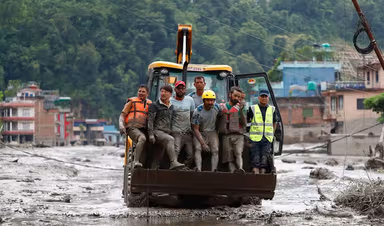
Nepal’s death toll from last week’s catastrophic floods and mudslides has risen to 903, while 4,247 people remain unaccounted for as rescue operations entered their sixth day.
The disaster devastated communities along the Nepal-Tibet border, with floodwaters carrying ice, rocks, mud and debris through towns and villages before crossing into China and sending victims and debris hundreds of kilometres downstream.
The National Disaster Risk Reduction and Management Authority (NDRRMA) said in its 9am Monday search, rescue and relief update that 903 bodies, including human remains, had been recovered across several flood-affected districts.
Chitwan recorded the highest number of recoveries with 272 bodies, followed by Nawalparasi East with 207 and Nawalparasi West with 151.
Nuwakot reported 95 deaths, while 62 bodies were recovered in Gorkha, 55 in Dhading, 37 in Tanahun and 24 in Rasuwa.
Many victims continue to be recovered far downstream after powerful floodwaters swept people and debris along the river channels.
The latest figures follow earlier reports that 788 people had died as of Sunday night. Chinese state media has separately reported 16 deaths in Tibet, taking the combined death toll in Nepal and China to at least 919.
More than 4,200 people remain missing
The number of people missing in Nepal has climbed to 4,247, according to the latest disaster management figures.
The NDRRMA listed 3,655 missing Nepali citizens in an earlier Monday update, while its later 9am breakdown reported 1,558 people unaccounted for in Nuwakot and 865 in Rasuwa.
The Nuwakot figure had earlier been reported at 1,158, up sharply from 115 recorded on Sunday, highlighting the rapidly changing scale of the disaster as authorities collect information from affected communities.
The missing also include 933 people associated with hydropower projects, 592 foreign nationals and 127 Nepalis accompanying foreign tourists.
Disaster management records list another 65 missing in Makawanpur, three in Langtang National Park, three at an immigration office, three at a quarantine office and 15 at a customs office.
Security personnel also among missing
At least 83 security personnel remain unaccounted for, according to government records.
The missing include 45 members of the Nepali Army, 25 Nepal Police personnel and 13 members of the Armed Police Force.
Earlier figures had also identified 38 police and armed police officers and 19 customs and immigration officers among those missing as authorities continued reconciling reports from different locations.
Hundreds feared trapped inside hydropower tunnels
Rescue teams are working around the clock to reach hundreds of people believed to be trapped inside blocked hydropower project tunnels.
Nepal’s disaster authority said 933 people associated with hydropower projects were missing, with rescuers focusing on about half a dozen tunnel sites, including the Trishuli-3A project.
The tunnels were blocked by enormous quantities of mud, rocks and debris carried by the floodwaters.
Nepali Army spokesperson Raja Ram Basnet said the amount of debris deposited inside and around the tunnels was creating a major challenge for rescue teams.
“Our main focus is on opening the tunnels,” Basnet told Reuters.
Earth-moving machinery has been working through the night to remove mud and rocks, while soldiers used torchlights to search for possible access points inside the blocked structures.
Indian and Chinese experts assist Nepal
Although Nepal has said it does not generally require foreign assistance for search and rescue operations, it has relied on neighbouring India and China for specialised tunnel-rescue expertise.
An Indian tunnel rescue team has been working alongside the Nepali Army at hydropower sites in Chilime and Langtang.
Chinese and Indian experts have also supported efforts to reach people believed to be trapped inside the damaged hydropower infrastructure.
The Nepali Army has used heavy equipment and personnel through the night as rescuers attempt to clear the routes into the tunnels.
More than 10,000 people rescued
Authorities said 10,451 people have been rescued so far as search, rescue and relief operations continue across the affected districts.
A total of 20,819 security personnel have been deployed for the response. The force includes 8,722 Nepali Army personnel, 7,894 Nepal Police personnel and 4,203 members of the Armed Police Force.
Aerial operations have played a major role in reaching isolated communities, with 411 helicopter flights conducted so far, including 17 flights on Monday.
Nepali Army helicopter operations have evacuated 3,344 Nepali citizens and 252 foreign nationals.
Those foreign nationals included 15 Chinese and seven Indian citizens who were rescued from a hydropower site on Sunday.
Hundreds of bodies remain unidentified
Identifying victims remains one of the biggest challenges facing authorities.
Unidentified bodies are currently being held at 21 hospitals across different districts as officials work to establish their identities and reunite victims with their families.
Information about unidentified bodies is being published through the official NDRRMA Facebook page and the Nepal Police disaster portal.
The government also reported 267 injuries, with 156 injured people discharged from hospitals after treatment.
Six specialised surgical medical teams have been deployed to some of the worst-affected areas.
Floods triggered by massive ice-rock avalanche
A preliminary study by Nepali scientists found that the disaster was triggered by a massive ice-rock avalanche at an altitude of around 5,200 metres in the Langtang-Lirung area of Rasuwa.
The debris entered the Lhende River before surging into the Bhotekoshi and Trishuli rivers. Scientists said the findings ruled out a conventional glacial lake outburst flood, or GLOF, as the immediate trigger.
The unprecedented torrent of ice, rock, mud and debris then swept through settlements on both sides of the Nepal-China border.
Dramatic surveillance footage showed floodwaters and debris engulfing buildings as residents attempted to escape.
China reports deaths and hundreds missing in Tibet
The disaster has also caused severe damage in Tibet. Chinese state media reported 16 deaths and 546 missing people in Gyirong County following Wednesday’s flooding.
Beijing has also said that 261 foreign nationals from 23 countries were unaccounted for in Tibet near a key border crossing with Nepal.
Chinese President Xi Jinping directed authorities to make every possible effort to find missing people and strengthen rescue and relief operations.
China has mobilised thousands of rescue workers and deployed equipment to the affected areas, while its personnel have used life-detection equipment to search for survivors.
India recovers 17 bodies from rivers
The impact of the floods has extended downstream into India. Authorities in Uttar Pradesh said they had recovered 17 bodies from rivers flowing from Nepal. The victims are believed to have been swept away by the floods.
Indian authorities are working to identify the bodies, which have not been included in Nepal’s official death toll.
Nepalese Prime Minister Balendra Shah described the flooding as an “unprecedented and devastating natural disaster”. He said nearly 21,000 security personnel were involved in rescue operations, alongside civilian workers and volunteers.
Shah said difficult terrain, adverse weather and continuing risks were complicating efforts to assess the full extent of the destruction, but authorities were continuing rescue operations with the aim of saving lives.
The Red Cross estimates that more than 90,000 people have been affected by the disaster.
Bad weather repeatedly disrupts rescue efforts
Rescue operations have been suspended several times since Friday because of poor weather and concerns about a lake that formed across the Nepal-China border.
The lake began overflowing into Nepal’s rivers, raising fears that a sudden surge could trigger additional flooding.
Conditions improved on Monday, allowing rescue teams to increase the pace of their operations.
Narendra Pariyar, the district administrator of Rasuwa, one of the two hardest-hit districts, said rescue work was picking up as the weather improved.
Survivors search through destroyed homes
In the holy town of Devighat, residents returned to the banks of the Trishuli River to search through what remained of their homes. People walked among collapsed structures and piles of debris, trying to recover belongings that survived the flood.
The destruction has left communities facing not only the loss of family members but also the daunting task of rebuilding homes and livelihoods.
Chinese state broadcaster CCTV said the flooding was caused by glacier instability linked to the long-term effects of global warming.
CCTV described the event as a “new and prominent feature of cryosphere disasters” on the Tibetan Plateau.
Two Nepali officials told Reuters that China had shared limited information about glacier risks and water levels after a meeting earlier this year aimed at strengthening cooperation.
The officials expressed concern that insufficient data sharing could make it harder for Nepal to prepare for future disasters.
China’s Foreign Ministry did not respond to a Reuters request for comment about the meeting.
Flood reached border crossing within minutes
Chinese state broadcaster CCTV, citing Chinese scientists, reported that the mudslide from the Nepalese side reached the Gyirong border crossing within six to seven minutes.
The speed and scale of the torrent left residents with little time to escape as water, ice, rocks and mud swept through the valleys.
The disaster has become one of the most severe recent flood emergencies in the Himalayan region, with its effects stretching from Nepal into Tibet and downstream parts of India.
With thousands still missing, rescuers are racing against time to clear blocked hydropower tunnels and search areas buried beneath massive debris deposits.
Authorities continue to recover bodies downstream while deploying helicopters, heavy machinery, security personnel and specialised medical teams across the disaster zone.
The scale of the destruction remains difficult to assess fully, but officials say the immediate priority is clear: locate survivors, recover the missing and provide relief to communities devastated by the floods.