India’s education minister said that Prime Minister Narendra Modi’s administration was committed to addressing the concerns of protesting youth and exam reforms, in the latest sign that the government was beginning to respond to growing protests.
The comments by Dharmendra Pradhan are his first since the youth-led “cockroach” movement launched a protest in New Delhi last month seeking his resignation over the leak of medical school test papers that affected some 2 million students and was linked to several student suicides.
The protests by the self-named Cockroach Janta Party (CJP) – which began as an online satire – involved a few hundred young people when they were first launched.
This week, the movement has grown into the biggest youth challenge to Modi since he came to power in 2014 as tens of thousands of protesters took to the streets of Delhi on Monday, clashing with police who used tear gas and batons to push them back.
The protests gained further momentum on Tuesday when the main opposition Congress party, led by Rahul Gandhi, launched a sit-in outside the gates leading to Modi’s residence.
Thousands of supporters of India’s youth-led “cockroach” movement protested in Delhi on Tuesday, a day after violent clashes with police, and in spite of Prime Minister Narendra Modi’s vow to punish those behind damaging exam leaks.
“Our government remains 100% committed to discussing NEET and addressing every genuine concern of our youth on the floor of the house,” Pradhan said in a post on X late on Tuesday, referring to the medical school entrance test.
“The students of India deserve far better than being treated as props in a political campaign,” he said, referring to Gandhi’s protest.
“We owe our students more than outrage. We owe them answers, reforms and accountability. That is exactly what our government remains committed to delivering,” he added.
Pradhan’s comments follow those by Modi on Tuesday – his first on the issue – who vowed to punish those behind the exam leaks and also called on his lawmakers to help create a foolproof exam system.
Separately, Health Minister J.P. Nadda held talks with CJP leaders on Monday for the first time and assured them the government would consider their demands.
GANDHI DEMANDS DEBATE IN PARLIAMENT
Youth anger and protests over the exams have become the biggest challenge for the prime minister in his third term.
The CJP’s surge in popularity reflects frustrations among young Indians over issues such as job shortages, as well as exam leaks, which they say happen frequently.
It has also given opposition parties a rare opening to pressure Modi and his Bharatiya Janata Party, who count young voters as a core base and have won a series of state elections since a shock result in the 2024 election, when Modi did not win an outright parliamentary majority.
“Why is the Indian education system collapsing? Why are papers leaking? Why is education so expensive in India? Why do families have to destroy themselves financially to educate their children?” Gandhi said in a video message recorded while he was in detention at a Delhi stadium on Tuesday night.
“These are legitimate questions. And there’s absolutely nothing wrong with asking these questions,” he said.
Gandhi said the students’ issues should be debated in Parliament on Wednesday and Modi should apologise to the students for the police action on Monday and begin reforms to the examination and education systems as soon as possible.
The CJP movement gained momentum from the support of activist Sonam Wangchuk, who began a hunger strike on June 28, but was forcibly moved to a hospital by police on Saturday.
PROTESTS CONTINUE
Earlier, more than 5,000 protesters gathered at Delhi’s Jantar Mantar protest site, after their march on parliament to demand the resignation of Education Minister Dharmendra Pradhan ended in violent clashes with police on Monday.
Modi’s comments, reported by a cabinet minister, were his first on the subject since the leaking of question papers for a national entrance test to medical school in May.
Youth anger and protests over the exams have become the biggest challenge for the prime minister in his third term.
Delhi Police said nearly 180 people, including 118 security and police personnel and 60 protesters, were injured when they clashed in central Delhi.
The founder of the Cockroach Janta Party (CJP), a movement that began as an online satire, said more than 150 protesters were undergoing treatment in hospital.
Reuters could not independently verify the numbers of injured, after police beat protesters with batons and fired tear gas rounds to push them back.
OPPOSITION LEADER GANDHI DETAINED
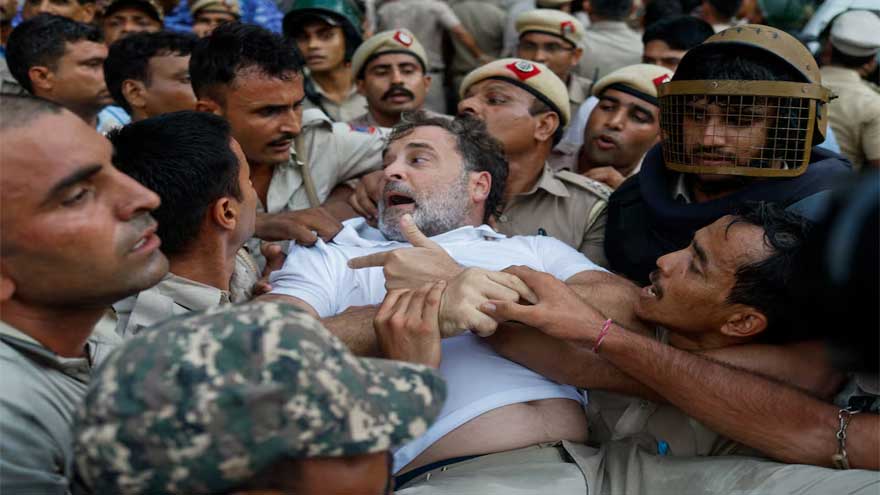
A few dozen members of India’s main opposition Congress party, including Rahul Gandhi and his sister Priyanka Vadra, also briefly protested against the crackdown outside Modi’s house on Tuesday, before they were detained by police, news agency ANI said.
They were later released.
ANI visuals showed Gandhi, dressed in his signature white T-shirt and khaki trousers, lying on the road, resisting attempts to remove him, as police officers tried to lift him.
They then showed him being taken away in a police bus along with other members of his party.
One protester held a poster that read, “Democracy bleeds when voices are beaten”, and some Congress members were detained by police, television footage showed.
Modi told lawmakers of his ruling alliance that the government acted immediately on receiving reports of exam irregularities and 13 people were arrested and jailed, Parliamentary Affairs Minister Kiren Rijiju said.
Modi also said a re-examination had been successfully conducted.
“The prime minister said… that to ensure the future of youth is not jeopardised… everyone should unite to ensure strict steps are taken, those guilty punished, and a foolproof system is created,” Rijiju said.
PROTESTERS SAY THEY WON’T MARCH AGAIN
The CJP movement has said it will continue its anti-government protest but will not march on parliament as it fears its supporters will be beaten by police again.
The months-old movement has drawn the support of millions of young, Gen Z Indians who are demanding the resignation of Pradhan. CJP says the leaking of the papers in May was a sign of deep-seated corruption in education.
CJP founder Abhijeet Dipke apologised to supporters, especially women, who he said were beaten by male police officers.
Delhi Police said protesters had “displayed unruly, aggressive and violent behaviour” and “deliberately violated the prohibitory orders in force”.
The movement was galvanized after the support of activist Sonam Wangchuk, who began a hunger strike on June 28, but was forcibly moved to a hospital by police on Saturday.
COURT ALLOWS ACTIVIST TO BE MOVED TO PRIVATE HOSPITAL
On Tuesday, the Delhi High Court allowed the Magsaysay award winner to be shifted to a private hospital following a petition from his wife that alleged he had been illegally detained.
The court order fulfils one of the three demands of the protesters.
CJP said Health Minister J.P. Nadda sought time to discuss their demands within the government after a meeting with two leaders on Monday.
The demands include the release of Wangchuk, Pradhan’s resignation and compensation of 10 million rupees ($104,000) each for about a dozen students who died by suicide following the leak.
The CJP’s surge in popularity reflects frustrations among young Indians including job shortages as well as exam leaks, which they say happen frequently.