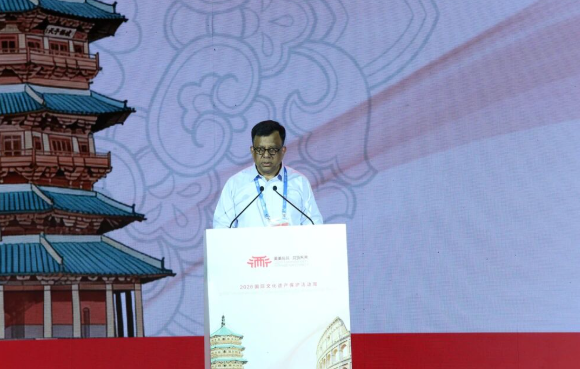
International Heritage Protection Week opened in Yuci Ancient City in Jinzhong, Shanxi Province, last week, bringing together Chinese and international officials, diplomats, scholars and cultural experts to discuss stronger global cooperation in safeguarding cultural heritage.
Held under the theme “Unity for Prosperity, Heritage for Eternity,” the week-long event focuses on addressing growing challenges to cultural heritage, including climate change, rapid urbanization, armed conflicts and illicit trafficking of cultural property.
The opening ceremony was guided by the Publicity Department of the Communist Party of China (CPC) Shanxi Provincial Committee and China International Communications Group (CICG), jointly hosted by Shanxi Daily and the CICG Center for Americas, and organized by the Shanxi International Communications Center.
Zhang Biyong, head of the Publicity Department of the CPC Shanxi Provincial Committee, officially declared the event open.
Among the speakers were CICG Vice President Yu Yunquan, Jinzhong CPC Secretary Liu Xing, CICG Center for Americas President Xin Feng, Shanxi Daily President Zhang Yu, Bangladesh Ambassador to China Md. Nazmul Islam, Brazilian scholar Evandro Menezes de Carvalho, and Shanxi Museum Director Wang Xiaoyi.
In his remarks, Yu said China has consistently prioritized cultural heritage preservation and reaffirmed the country’s commitment to promoting international cultural exchange through the Global Civilizations Initiative. He added that CICG would continue strengthening international partnerships to advance intercultural dialogue.
Liu highlighted Jinzhong’s rich historical legacy, noting the city is home to more than 5,500 immovable cultural heritage sites and 69 nationally protected cultural relic sites. He said the event would serve as a bridge for dialogue among civilizations and help present Shanxi’s cultural heritage to the world.
Bangladesh Ambassador Md. Nazmul Islam described cultural heritage as a living source of identity and inspiration, praising Shanxi’s achievements in heritage conservation, digitalization and archaeological research. He called for expanded China-Bangladesh cooperation in restoration, archaeology, digital heritage and professional exchanges.
Brazilian international law scholar Evandro Menezes de Carvalho said cultural heritage worldwide faces increasing threats from climate change, urban expansion, mass tourism and technological change. Marking the China-Brazil Year of Culture, he urged deeper institutional cooperation in heritage governance between the two countries.
Wang Xiaoyi said China’s approach to cultural heritage protection combines preserving its own cultural identity with openness to the achievements of other civilizations.
During the ceremony, scholars and professionals were appointed to the Shanxi International Communications Center Think Tank. Participants also viewed The Light of Yungang, a large-scale projection mapping show inspired by the fifth-century Yungang Grottoes, a UNESCO World Heritage site.
The week-long program includes roundtable discussions, academic lectures, field visits and themed exhibitions aimed at promoting international cooperation and exploring new approaches to preserving humanity’s shared cultural heritage.