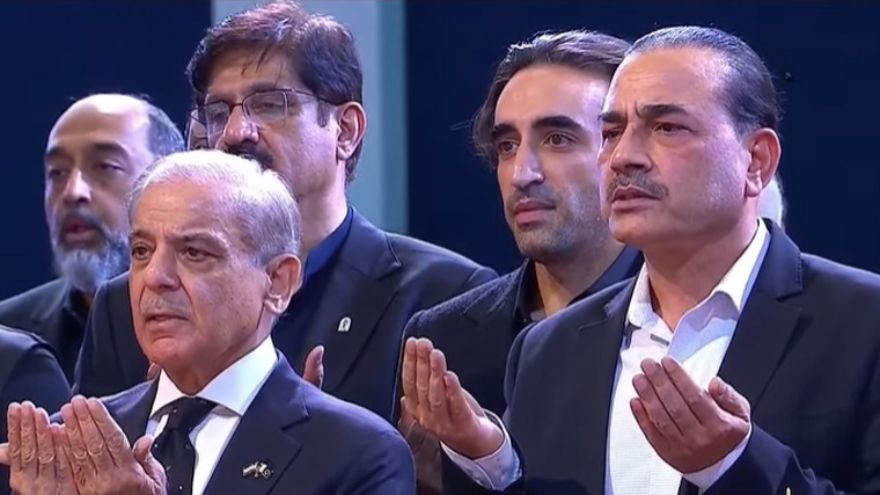
Prime Minister Shehbaz Sharif and Chief of Defence Forces and Chief of Army Staff Field Marshal Asim Munir arrived in Tehran on Friday to attend the funeral of Iran’s late supreme leader, Ayatollah Ali Khamenei, who was assassinated in a US-Israeli strike on February 28.
Pakistan’s leadership, which also includes PPP chairman Bilawal Bhutto Zardari, is taking part in the funeral ceremonies alongside delegations from around 30 countries as Iran begins several days of commemorations for one of its most influential figures.
Field Marshal Asim Munir was received by Iranian officials and Pakistan’s Interior Minister Mohsin Naqvi, who had already arrived in Tehran. PM Shehbaz was welcomed at Mehrabad Airport by Iran’s interior minister, Pakistan’s ambassador to Tehran and senior diplomatic officials from both countries.
According to the Prime Minister’s Office, Shehbaz is on a one-day visit to Iran to participate in the funeral rites and convey Pakistan’s condolences to the Iranian leadership. The prime minister is also expected to reaffirm Pakistan’s solidarity with the Iranian people during what the government described as a time of national grief. Following the funeral events, Prime Minister Shehbaz is scheduled to travel onwards to Turkiye for a bilateral visit.
Ayatollah Ali Khamenei’s funeral
Iran’s state media reported that Khamenei’s body arrived at Tehran’s Grand Mosalla, where mourners, clerics, government officials and foreign dignitaries gathered to pay their respects. Images from the ceremony showed his coffin, draped in the Iranian tricolour, being carried into the vast ceremonial complex before being placed against a backdrop decorated with red flowers and white butterflies.
The Grand Mosalla has been prepared to host mourning ceremonies over three days, with banners displaying Khamenei’s images and quotations throughout the venue. Millions of mourners are expected to attend Saturday’s official funeral ceremony, while representatives from around 30 countries have travelled to Tehran. Visitors have also arrived from neighbouring Iraq and Afghanistan to participate in the commemorations.
Among those seen at the ceremony was Ahmad Wahidi, head of the Revolutionary Guards, making his first public appearance since the outbreak of the conflict in February. The bodies of Khamenei’s slain relatives are also expected to be present during the official funeral events.
The funeral programme will continue beyond Tehran, with ceremonies planned in the holy cities of Qom, Najaf and Karbala before Khamenei is laid to rest on July 9 at the shrine of Imam Reza in Mashhad, his birthplace.
The funeral had initially been delayed during the Middle East conflict and is now taking place as Iran and the United States observe a fragile ceasefire following the Islamabad Memorandum of Understanding aimed at ending hostilities.
Iranian officials say Khamenei was killed alongside several members of his family, including his daughter, grandchild, son-in-law and daughter-in-law, during the opening strikes of the conflict. Other senior Iranian figures, including Ali Shamkhani, an adviser to the supreme leader, were also killed.
Iranian President Masoud Pezeshkian said a large public turnout at the funeral would send a decisive message against terrorism, violence and bullying while reflecting national unity.
Pakistan’s delegation accompanying Prime Minister Shehbaz includes National Assembly Speaker Sardar Ayaz Sadiq, Deputy Prime Minister and Foreign Minister Ishaq Dar, Information Minister Attaullah Tarar, Pakistan Peoples Party Chairman Bilawal Bhutto Zardari, PPP Secretary General Nayyer Bukhari and Sindh Chief Minister Syed Murad Ali Shah.
Earlier in the day, Senate Chairman Yousaf Raza Gilani also reached Tehran with a separate high-level delegation to attend the funeral prayers and burial ceremonies, where he was received by Iranian officials.