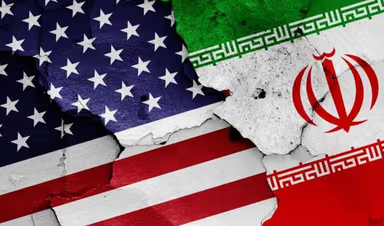
Iran said on Friday that it had not reached a final decision on a possible agreement with Washington after US President Donald Trump announced a “great settlement” to end the war.
Iranian Foreign Ministry spokesman Esmaeil Baqaei said Tehran had yet to reach a final conclusion on any agreement, despite Trump’s assertion that a deal could be signed in Europe within days.
The Tasnim news agency noted that Trump had declared an agreement imminent 38 times during the previous two months.
It added that until Iran formally announces any potential understanding, statements by Trump on the matter should be viewed in the same light as his previous remarks.
In a separate statement, Iran’s Foreign Ministry strongly condemned a ‘serious violation’ of the ceasefire by the United States, saying Washington bears responsibility for the dangerous consequences arising from the alleged provocation.
The ministry said recent US attacks constituted a clear breach of the United Nations Charter and international law relating to national sovereignty and territorial integrity, and had effectively rendered the April 8 ceasefire meaningless.
It stated that the use of territory and facilities in certain regional countries by US forces for operations against Iran placed those countries alongside the parties carrying out the attacks.
Iran reiterated that regional states have a legal and moral obligation to prevent their territory, facilities and resources from being used for actions against Iran. It also reaffirmed its intention to exercise its right of legitimate self-defence against military aggression.
The statement called on all United Nations member states to oppose alleged violations of the principles and objectives of the UN Charter by the United States and Israel.
Iran said silence and inaction in response to such actions would contribute to greater instability and insecurity around the world.
Tehran also urged the UN Security Council and the UN Secretary-General to fulfil their responsibilities regarding international peace and security, stating that vague responses to acts of aggression would only encourage more breaches of international law.