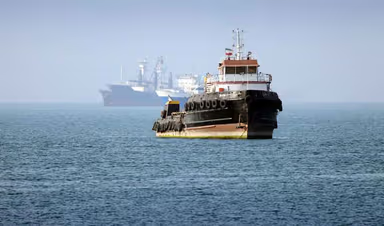
Iran has announced the complete closure of the Strait of Hormuz, warning that any vessel attempting to pass through the strategic waterway will be targeted, as tensions between Tehran and Washington escalated sharply following a new round of US military strikes.
The move marks one of the most significant developments in the ongoing conflict, raising concerns over global energy supplies and regional security as both sides exchange fresh military attacks.
Iran’s top joint military command, Khatam al-Anbiya Central Headquarters, announced early Thursday that the Strait of Hormuz had been fully closed to all traffic, including oil tankers and commercial ships.
In a statement broadcast by Iranian state television, the headquarters said the decision was taken due to growing insecurity in the region and what it described as continued American aggression.
“From this moment, due to insecurity in the region, the Strait of Hormuz is declared closed to the passage of all vessels, including oil tankers and commercial ships, and any traffic will be targeted,” the statement said.
The military command warned that any movement through the waterway would be considered a target and rejected US claims that ships were continuing to transit through the strait.
Iranian officials said the closure followed recent US attacks on several areas in the southern province of Hormozgan.
The Islamic Revolutionary Guard Corps (IRGC) separately confirmed that the Strait of Hormuz would remain closed until further notice.
US launches new strikes inside Iran
The announcement came shortly after US Central Command (CENTCOM) confirmed a new wave of military operations against targets inside Iran.
According to the US military, American forces launched additional “self-defense” strikes at the direction of President Donald Trump in response to what Washington described as Iran’s continued and unwarranted aggression.
CENTCOM said the operation targeted military surveillance capabilities, communication systems, and air defense sites across Iran.
The US military stated that the strikes began at 22:15 GMT on Wednesday and concluded approximately four hours later.
Explosions reported across southern Iran
Following the US attacks, Iranian media reported explosions, air defense activity and airstrikes in several southern regions of the country.
Reports cited incidents in Bandar Abbas, Minab, Jask, Qeshm and Sirik, while other accounts also mentioned activity in Kargan and areas near the Strait of Hormuz.
The attacks were among the latest military exchanges between the two countries since the conflict intensified earlier this year.
IRGC claims attacks on bases and vessels
In response to the American strikes, the IRGC claimed it launched coordinated attacks on multiple US military facilities across the region.
According to the Iranian military force, drone strikes targeted Bahrain’s Sheikh Isa Air Base as well as Kuwait’s Ali Al Salem and Ahmad Al-Jaber airbases.
The IRGC also said it fired 12 ballistic missiles at the Al-Azraq airbase in Jordan.
Iran further claimed that two oil tankers attempting to “illegally pass through” the Strait of Hormuz were struck.
The group described the attacks as retaliation for what it called repeated US violations of an April ceasefire agreement.
Bahrain, Kuwait activate air defenses
Regional governments reported defensive measures following the Iranian attacks. Bahrain activated air raid sirens twice, while Bahraini authorities said their air defense systems intercepted and destroyed incoming aerial threats.
Kuwait’s military announced that its air defense systems were actively engaging hostile aerial targets.
Iran has repeatedly claimed attacks on US military facilities in Bahrain, Kuwait and Jordan during the latest escalation.
Diplomacy further out of reach
Iranian officials said the renewed US attacks have pushed prospects for diplomacy further away.
Tehran maintains that the closure of the Strait of Hormuz and its military response are direct consequences of continued American military actions.
The strategic waterway remains one of the world’s most important energy transit routes, making the latest developments a major concern for international shipping markets and global oil supplies.
With both Washington and Tehran continuing to exchange military strikes, fears are growing that the conflict could expand further across the region.