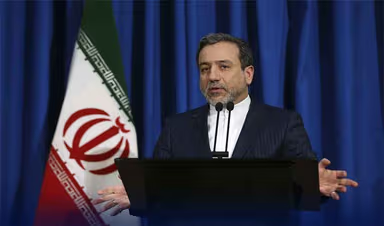
Iran’s Foreign Minister Abbas Araghchi has told foreign military forces operating near Iran to leave for the sake of their own safety.
In a post on X, Araghchi said troops stationed close to Iran were exposed to risks arising from operational mistakes, unforeseen incidents, or the possibility of becoming involved in military exchanges.
He said the safest way to avoid such dangers would be for foreign forces to withdraw from what he described as an environment that would not welcome a hostile military presence.
He added that his country’s armed forces remain on high alert against any violation of its territory.
While stressing that Tehran remains committed to diplomatic engagement, Araghchi said Iran was capable of responding through other means if necessary.
The remarks came as Iran renewed its position on the Strait of Hormuz, one of the world’s most strategically important shipping routes and a key corridor for global energy supplies.
Araghchi said the waterway was not international waters, maintaining Tehran’s long-standing view that the strait falls under the shared sovereignty of Iran and Oman.
“The Strait of Hormuz is not international waters but shared between Iran and Oman,” Araghchi wrote, adding that maritime boundaries in the region were clearly defined and located far from US territory.
At its narrowest point, the strait measures about 21 nautical miles (39km) across, placing the channel within the territorial waters of Iran and Oman.
Iranian authorities argue that this legal status grants the two countries authority to regulate movement through the passage, although international shipping has historically moved through the route without major restrictions.
The United States rejects Iran’s interpretation, arguing that the Strait of Hormuz serves as an international transit corridor essential to global commerce and energy markets. Washington maintains that freedom of navigation through the waterway must be preserved.