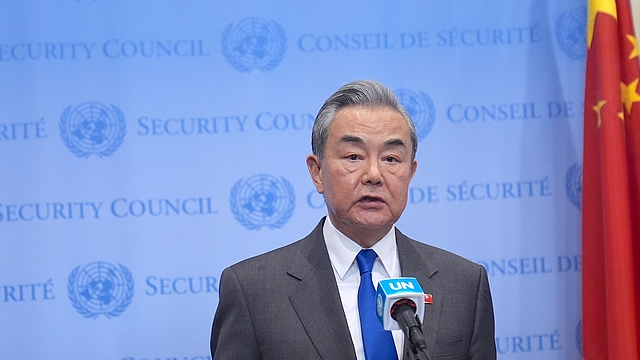
Chinese Foreign Minister Wang Yi on Wednesday called for efforts to practice multilateralism and safeguard the authority of the United Nations during separate meetings with his global counterparts on the sidelines of a UN Security Council high-level meeting in New York.
Chinese, Serbian FMs vow to boost bilateral ties
During a meeting with Serbian Foreign Minister Marko Djuric, Wang, who is also a member of the Political Bureau of the Communist Party of China Central Committee, said Serbian President Aleksandar Vucic is in China for a visit that marks a milestone in bilateral relations.
Serbia has become the first country to issue a joint statement with China on promoting the implementation of the Global Development Initiative, the Global Security Initiative, the Global Civilization Initiative and the Global Governance Initiative, demonstrating the uniqueness and high level of the China-Serbia relationship, he said.
Wang said the two sides should prioritize the implementation of the important consensus of the two heads of state, enhance exchanges at different levels, advance the Hungary-Serbia railway project, expand cooperation in areas such as artificial intelligence and new energy, strengthen coordination and cooperation in the United Nations and other platforms, and carry forward the building of a China-Serbia community with a shared future in the new era.
Djuric said that Serbia appreciates China’s consistent support for Serbia’s sovereignty and territorial integrity and will firmly adhere to the one-China principle. “No matter how the external situation may evolve, Serbia will remain China’s most reliable ironclad friend in Europe.”
Serbia is ready to work with China to implement the outcomes of President Vucic’s state visit, enhance strategic mutual trust, expand mutually beneficial cooperation, strengthen multilateral coordination, and elevate the Serbia-China community with a shared future to a new level, he said.
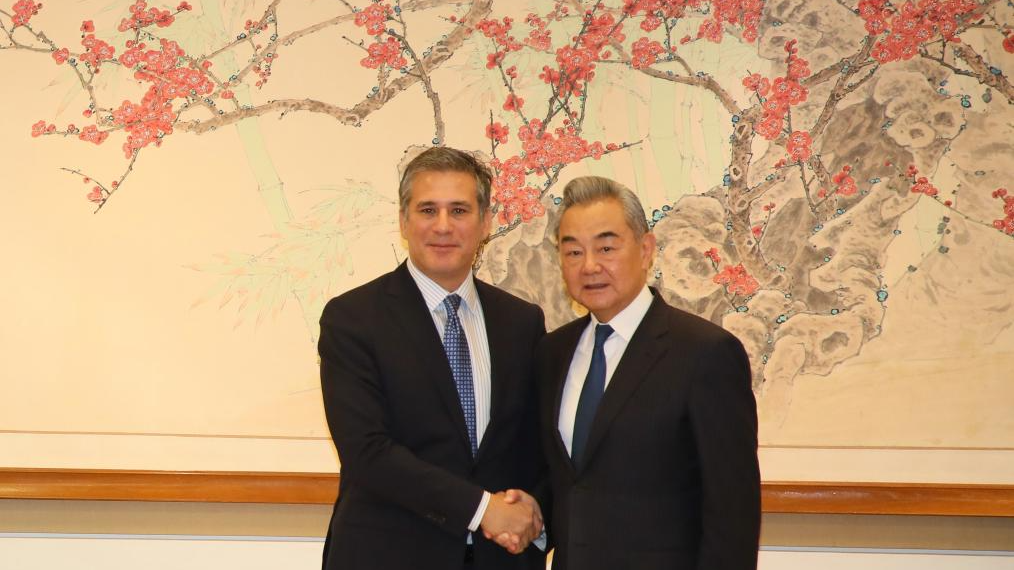
Chinese Foreign Minister Wang Yi (R), also a member of the Political Bureau of the Communist Party of China Central Committee, meets with Costa Rican Foreign Minister Manuel Tovar Rivera in New York, the United States, May 27, 2026. /Xinhua
China-Costa Rica relations serve interests of both
During a meeting with Costa Rican Foreign Minister Manuel Tovar Rivera, Wang said facts have fully demonstrated that China-Costa Rica relations serve the long-term strategic interests of both countries and bring benefits to the two peoples.
Noting that Costa Rica was the first country in Central America to establish diplomatic relations with China in the new century, as well as the first to forge a strategic partnership and sign a free trade agreement with China, Wang said Costa Rica stands at the forefront among Central American nations in developing relations with China.
Emphasizing that the Taiwan question lies at the very center of China’s core interests, Wang expressed confidence that the new Costa Rican government will continue to firmly uphold the one-China principle. He added that China will always be a friend and partner Costa Rica can rely on, and China will strengthen its cooperation with Costa Rica from the perspective of South-South cooperation to help accelerate its modernization process.
Tovar congratulated China on the success of the UN Security Council high-level meeting on upholding the purposes and principles of the UN Charter and strengthening the UN-centered international system, which China initiated.
He said Costa Rica firmly adheres to the one-China policy and thanked China for its support and assistance for Costa Rica’s economic and social development.
Costa Rica deeply recognizes the importance of the United Nations and is ready to work alongside China to uphold multilateralism and safeguard global peace and development, he said.
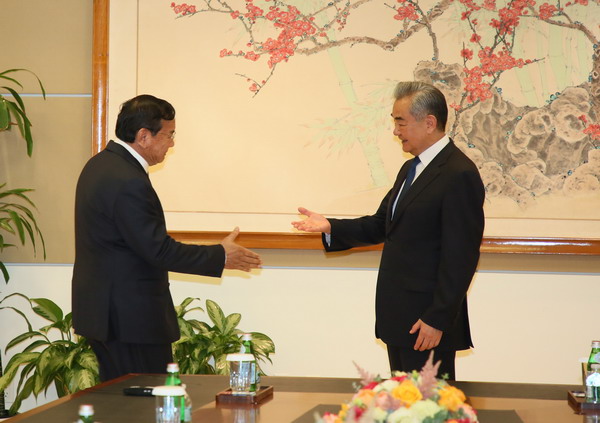
Chinese Foreign Minister Wang Yi (R), also a member of the Political Bureau of the Communist Party of China Central Committee, meets with Cambodian Deputy Prime Minister and Foreign Minister Prak Sokhonn in New York, the United States, May 27, 2026. /Chinese Foreign Ministry
Chinese, Cambodian FMs agree to advance bilateral ties
Wang and Cambodian Deputy Prime Minister and Foreign Minister Prak Sokhonn on Wednesday agreed to advance bilateral relations.
The upgrade of the “2+2” strategic dialogue mechanism involving the two countries’ foreign and defense ministers to a “3+3” mechanism that will also include the public security authorities is a demonstration of high-level mutual trust between the two countries and will usher in greater development, Wang said.
China is ready to deepen comprehensive strategic cooperation with Cambodia; conduct closer high-level exchanges; promote pragmatic cooperation in economics and trade, energy, law enforcement and connectivity; and enhance multilateral coordination to advance the building of an all-weather China-Cambodia community with a shared future in the new era, said Wang.
Sokhonn said Cambodia adheres to the one-China principle, supports China’s reunification and opposes any form of “Taiwan independence,” stressing that Cambodia remains unwavering in its position.
Wang and Sokhonn also exchanged views on the border conflict between Cambodia and Thailand.
Wang said as a common friend of both countries, China supports the two sides in sticking to the direction of dialogue and is ready to play a positive role in helping them promote mutual trust and improve relations.
Sokhonn briefed Wang on his country’s position on the issue and thanked China for its constructive efforts in mediating the Cambodia-Thailand dispute. He said his country is ready to reduce differences through dialogue with Thailand and work toward the normalization of bilateral relations, adding that he looks forward to China’s continued support.
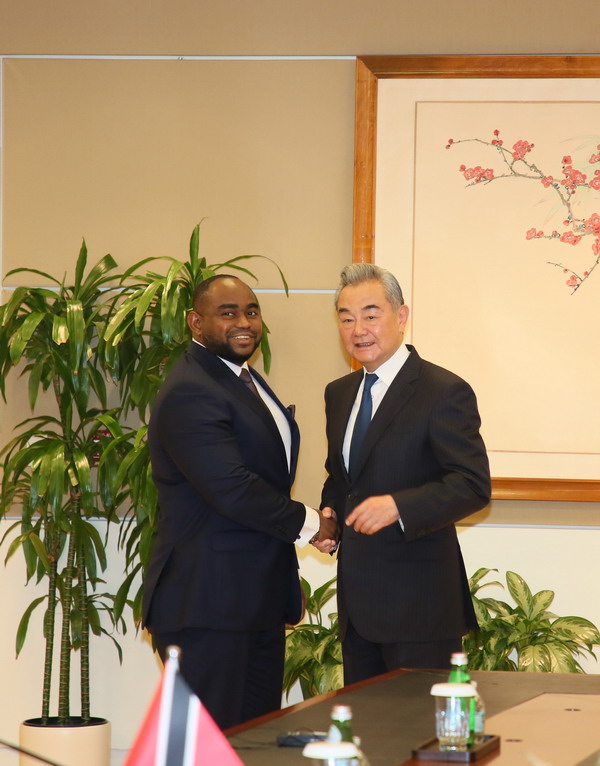
Chinese Foreign Minister Wang Yi (R), also a member of the Political Bureau of the Communist Party of China Central Committee, meets with Sean Sobers, foreign minister of Trinidad and Tobago, in New York, the United States, May 27, 2026. /Chinese Foreign Ministry
China, Trinidad and Tobago enjoy ‘profound’ friendship
When meeting with Sean Sobers, foreign minister of Trinidad and Tobago, Wang said that China and Trinidad and Tobago enjoy a profound friendship and that China is ready to strengthen contacts, enhance mutual trust, deepen practical cooperation in trade and other areas, and greatly promote people-to-people and cultural exchanges with Trinidad and Tobago.
China appreciates Trinidad and Tobago’s adherence to the one-China principle and will support Trinidad and Tobago’s choice of its development path, Wang added.
He said Latin American and Caribbean states have the right to independently choose their development partners.
For his part, Sobers said that most Latin American and Caribbean countries are in favor of exchanges and cooperation with China, noting that the relations between Trinidad and Tobago and China, as well as those between Latin America and China, will not be affected by any third party.
Trinidad and Tobago is firmly committed to developing relations with China and always regards China as a good friend, said Sobers, adding that the country steadfastly adheres to the one-China policy and appreciates China’s support for safeguarding Trinidad and Tobago’s own sovereignty and security.
Sobers said that the current bilateral relations are developing vigorously, with smooth progress in practical cooperation, and that he looked forward to further strengthening communication and coordination between the two sides on the United Nations platform.
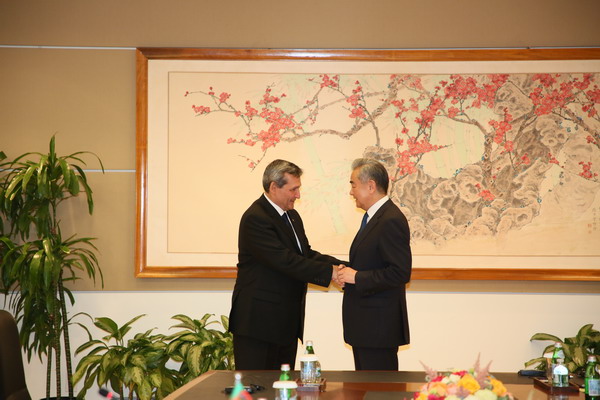
Chinese Foreign Minister Wang Yi (R), also a member of the Political Bureau of the Communist Party of China Central Committee, meets with Turkmenistan’s Deputy Prime Minister and Foreign Minister Rashid Meredov in New York, the United States, May 27, 2026. /Chinese Foreign Ministry
China to work with Turkmenistan to invigorate ties
During a meeting with Turkmenistan’s Deputy Prime Minister and Foreign Minister Rashid Meredov, Wang said that China stands ready to work with Turkmenistan to act on the consensus reached by the leaders of the two countries, advance cooperation on major projects and inject fresh vitality into bilateral relations.
The more complex and volatile the international situation becomes, the more imperative it is to uphold multilateralism and safeguard the authority of the United Nations; otherwise, countries of the Global South would bear the brunt of the impact, said Wang.
Noting that the United Nations serves as a vital platform for cooperation between China and Turkmenistan, he said both sides should further enhance coordination, support each other’s major initiatives and demonstrate the high level of the China-Turkmenistan comprehensive strategic partnership.
For his part, Meredov said that under the current international circumstances, it is of particular importance to uphold the UN Charter and reform and improve global governance.
He said Turkmenistan highly values its comprehensive strategic partnership with China, and the two countries share deep political mutual trust, engage in frequent high-level exchanges and enjoy strong momentum in their pragmatic cooperation.
Turkmenistan stands ready to work with China to advance cooperation on major projects such as natural gas development, expand collaboration in fields such as trade and connectivity, and elevate bilateral relations to a new level, Meredov added.