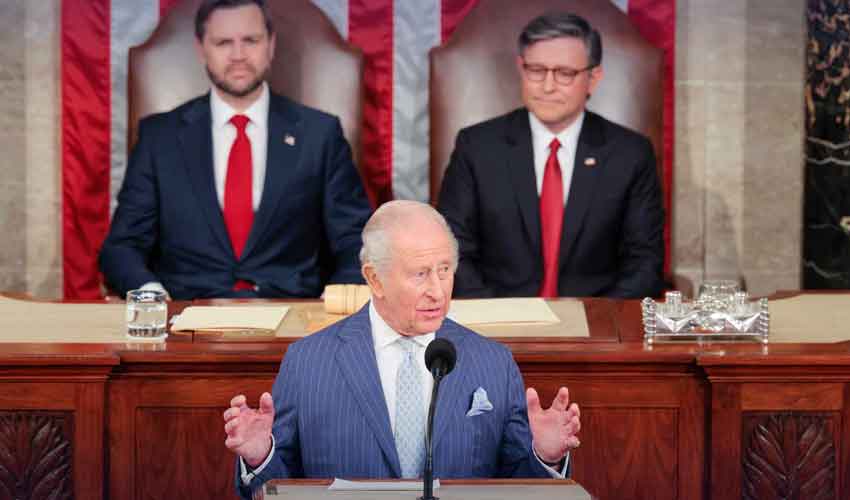
Britain’s King Charles told the US Congress on Tuesday that the United Kingdom and the United States must remain “staunch allies” in a more uncertain and dangerous world, even as deep divisions over the war with Iran have strained relations between the two longtime partners.
Speaking during a rare joint meeting of the Senate and House of Representatives, Charles called for unity in defending democracy, supporting Ukraine, strengthening NATO and resisting isolationism.
King Charles entered the chamber alongside Queen Camilla to a prolonged standing ovation before delivering one of the most significant diplomatic speeches of his reign.
“Whatever our differences, whatever disagreements we may have, we stand united in our commitment to uphold democracy, to protect all our people from harm, and to salute the courage of those who daily risk their lives in the service of our countries,” he told US lawmakers.
The speech was repeatedly interrupted by applause, with around 12 standing ovations during the address.
Charles is only the second British sovereign to address the US Congress. His mother, Queen Elizabeth II, spoke to both houses in 1991, at a time when the Cold War had ended and liberal democracy was widely seen as ascendant.
Avoids direct politics, sends clear messages
Buckingham Palace had said ahead of the address that the speech would not be political. Still, Charles made several pointed references to issues at the heart of tensions between Washington and London.
He highlighted the importance of NATO, the need for continued support for Ukraine in its war with Russia, the dangers of countries becoming inward-looking and the responsibility to protect nature.
The remarks came at a time when US President Donald Trump has repeatedly criticized NATO and European allies, most recently over their reluctance to provide military help in the US-Israeli war against Iran.
Trump has also been ambivalent about prolonged US financial and military support for Ukraine.
Charles referred to the September 11, 2001 attacks and the long history of US-UK cooperation, saying the two countries had stood “shoulder to shoulder” through two world wars, the Cold War, Afghanistan and other defining moments.
“That same unyielding resolve is needed for the defense of Ukraine, and her most courageous people,” he said.
King warns against isolationism
In what appeared to be a subtle reference to Trump’s “America First” agenda, Charles urged the US and UK not to turn inward.
“I pray with all my heart that our lands will continue to defend our shared values with our partners in Europe and the Commonwealth, and across the world, and that we ignore the clarion calls to become ever more inward-looking,” he said.
The king also praised NATO’s role in keeping North Americans and Europeans safe from common adversaries.
He noted that Britain had committed to the biggest sustained increase in defense spending since the Cold War, a message likely aimed at concerns in Washington that European allies must contribute more to their own security.
Charles also used the address to emphasize the shared legal and democratic traditions of the US and UK. He spoke of the rule of law, stable and accessible rules, an independent judiciary and impartial justice as common ideals of both countries.
Drawing a line from the Magna Carta to modern constitutional government, he said the principle that executive power is subject to checks and balances remained central to democratic life.
The message came as critics in the US have accused Trump of using presidential authority and the Department of Justice for political retribution.
Trump says Charles agrees on Iran nuclear stance
Later, at a state banquet at the White House, Trump said Charles agreed with him that Iran should never be allowed to possess a nuclear weapon.
“We’re doing a little Middle East work right now and we’re doing very well,” Trump said at the dinner. “We have militarily defeated that particular opponent, and we’re never going to let that opponent ever — Charles agrees with me even more than I do — we’re never going to let that opponent have a nuclear weapon.”
Charles did not mention Iran or the Iran war in his own remarks at the dinner.
The British monarch is not a spokesman for the UK government, and Downing Street and Buckingham Palace did not immediately respond to questions about Trump’s comments.
Iran war strains US-UK relations
Charles’ speech came on the second day of a four-day state visit to the US, during a tense period in relations between Washington and London.
Trump has repeatedly criticized UK Prime Minister Sir Keir Starmer, saying he has not done enough to help prosecute the Iran war.
As tensions have grown over the US-Israeli offensive against Iran, an internal Pentagon email suggested Washington could review its support for Britain’s claim to the Falkland Islands.
The war in Iran and the wider conflict in the Middle East formed a constant backdrop to the visit, even though Charles largely avoided naming those disputes directly in his congressional speech.
Shared history and humour
Charles opened his address with a lighter tone, praising the shared history and values of the two countries. He joked that Washington, DC, was “a tale of two Georges,” referring to first US President George Washington and his ancestor King George.
He also assured lawmakers, to laughter, that he had not come to the US “as part of some cunning rearguard action” linked to the Revolutionary War.
Marking America’s upcoming 250th anniversary, Charles joked: “That’s 250 years, or as we say in the United Kingdom, just the other day.”
At the state dinner, he teased Trump about a previous comment that without the US, Europeans would be speaking German.
“Dare I say that, if it wasn’t for us, you’d be speaking French,” the king said.
Trump praises Charles after White House meeting
During a ceremonial reception at the White House, Trump stressed the friendship that had developed between Britons and Americans after their history as adversaries during the War of Independence.
After escorting the king and queen to their limousine, Trump told reporters: “It was a really good meeting. He’s a fantastic person. They’re incredible people and it’s a real honor.”
The White House also shared a photo of Trump and Charles on social media with the caption “TWO KINGS.”
The post came after Trump and his allies had repeatedly objected to “No Kings” protests against his administration, insisting he is not a king.
This week, Trump’s allies also accused critics of fanning anger that has led to attempts on his life.
The visit took place under tight security, especially after a gun attack in Washington, DC, over the weekend. A man has been charged with attempting to assassinate Trump, further raising security concerns in the US capital.
Charles appeared to refer to the attack during his speech, saying: “Let me say with unshakeable resolve: such acts of violence will never succeed.”
The first two days of the state visit were held largely inside a security bubble, with no public access.
There were no walk-outs or protests during the congressional speech or state dinner.
Nature, climate message receives muted Republican applause
Charles also spoke about the need to safeguard nature, a cause he has championed for most of his life.
“As we look toward the next 250 years, we must also reflect on our shared responsibility to safeguard nature, our most precious and irreplaceable asset,” he said.
The applause was more muted on the Republican side of the aisle, where many lawmakers are skeptical of climate change action.
Charles warned that natural systems provide the foundation for prosperity and national security.
Trump has called climate change a “con job,” withdrew from the Paris climate agreement during his first and second terms, and has pursued policies focused on fossil fuel deregulation and a retreat from green energy.
Trade and technology also on agenda
Charles also highlighted the scale of the US-UK economic relationship, citing $430 billion in annual trade and $1.7 trillion in mutual investment.
His remarks came after Trump recently threatened to impose a “big tariff” on the UK if it did not drop a digital services tax on US technology companies.
Later, Charles met US tech leaders to discuss the challenges facing early-stage startups as Britain promotes itself as a leading destination for technology firms.
Among those he met were Amazon founder Jeff Bezos, Apple CEO Tim Cook, Nvidia CEO Jensen Huang, AMD CEO Lisa Su, Salesforce CEO Marc Benioff and Alphabet President Ruth Porat.
State dinner focuses on NATO and wartime ties
At the White House state dinner, Charles again emphasized the historic strength of the US-UK relationship. He recalled how American leadership helped rebuild a shattered Europe after World War II and played a decisive role as a defender of freedom.
Charles said both countries supported each other in their “darkest days,” leading to the establishment of NATO in 1949.
He also said both nations must remain committed to Ukraine as Russia’s invasion continues beyond four years.
He referred to deepening technological and military cooperation through NATO and other partnerships, saying the allies must work together to confront an increasingly complex and contested world.
The state dinner also included a lighter moment when Charles gave Trump an original bell from a wartime submarine called HMS Trump.
“And should you ever need to get hold of us… well, just give us a ring,” the king joked. The exchange added to the warmer tone of the evening, which UK officials appeared to view as a positive shift after months of diplomatic strain.
British officials, including Foreign Secretary Yvette Cooper, were said to be encouraged by the speeches and the mood of the visit.
Epstein scandal looms over royal visit
One subject Charles has tried to avoid during the visit is the Jeffrey Epstein scandal.
His brother, Andrew Mountbatten-Windsor, the former Prince Andrew, has seen his reputation and royal standing destroyed over his links to the late US sex offender.
Andrew is currently facing police inquiries over his connections, though he has denied wrongdoing.
Royal sources said it was not possible for Charles and Camilla to meet Epstein survivors during the tour, despite requests, because of concerns about affecting potential criminal cases.
Representative Ro Khanna, co-author of the Epstein Files Transparency Act, held a roundtable with survivors, advocacy groups and others on Tuesday.
Khanna said the king had declined his invitation to meet survivors.
“I thought the king owed that to the survivors, given his brother’s serious allegations of abuse,” Khanna said. “He unfortunately declined that request.”
Charles’ speech appeared to include a coded reference to such abuse, calling for support for “victims of some of the ills that so tragically exist in our societies today,” though he did not mention Epstein by name.
The king and queen are expected to continue their US visit with stops in New York and Virginia before an official farewell ceremony at the White House on Thursday.
For Charles, the trip has become a high-stakes diplomatic effort to repair some of the recent damage in the US-UK relationship.
By using his personal prestige and Trump’s fascination with monarchy, the king sought to rebuild transatlantic trust while gently pressing Washington on NATO, Ukraine, democracy, climate and international cooperation.
In Charles’ own words, the relationship remains a “story of reconciliation, renewal and remarkable partnership.”