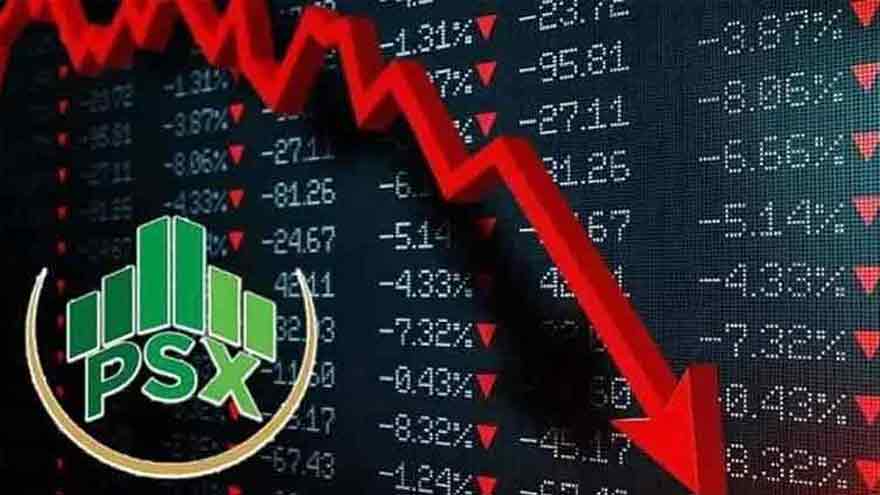
Selling pressure returned to the Pakistan Stock Exchange (PSX) on Thursday after President Donald Trump said the United States would continue to attack Iran, with the benchmark KSE-100 Index shedding over 5,300 points during the opening minutes of trading.
At 9:35am, the benchmark index was hovering at 150,167.12, down by 5,344.44 points or 3.44%.
Selling was observed in key sectors, including automobile assemblers, cement, commercial banks, oil and gas exploration companies, OMCs and power generation. Index-heavy stocks, including MARI, OGDC, POL, PPL, MCB, MEBL, NBP and UBL, traded in the red.
On Wednesday, PSX staged a powerful rally with the benchmark KSE-100 Index surging past the key psychological barrier of 150,000 points as improving investor sentiment, driven by optimism over geopolitical de-escalation in the Middle East, sparked broad-based buying and enabled the market to regain its bullish momentum.
The KSE-100 Index closed at 155,511.57 points, registering a sharp gain of 6,768.25 points or 4.55%.
Internationally, stocks fell, the dollar firmed, and oil rose on Thursday after US President Donald Trump said Washington’s “core strategic objectives” in the Iran war were nearing completion but stopped short of providing a clear outline of when the conflict would end.
The prospect of the end to the month-long U.S.-Israeli war with Iran has lifted global stocks and knocked the dollar off its recent highs in the past two sessions after a brutal March, where soaring oil prices sent risk assets into a tailspin.
But Trump, in his prime-time speech, said the US will strike Iran “extremely hard” over the next two to three weeks and hit the country into the “Stone Ages.”
That sent stocks retreating, with U.S. stock futures down 0.67% while European futures were 0.1% lower.
MSCI’s broadest index of Asia-Pacific shares outside Japan slid 0.75%. Japan’s Nikkei reversed course to trade down 0.79% in volatile trading.
Analysts and investors were focusing on when and how the Strait of Hormuz, a major fuel shipment route, would reopen and ease the bottleneck in supply that has hit Asian economies hard.
Iran has repeatedly fired on Gulf countries, some home to US bases, and is using the Strait of Hormuz, which carries a fifth of global oil and liquefied natural gas, as leverage.