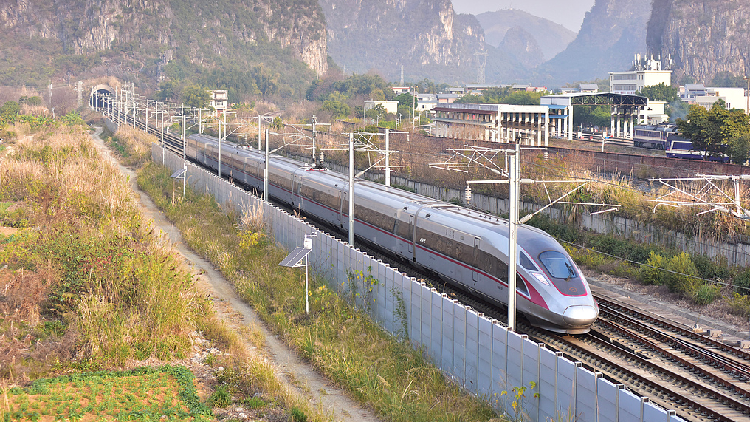
ISLAMABAD (PEN) : The annual Spring Festival travel rush is underway, with China’s high-speed trains serving as the main transportation force. During the 14th Five-Year Plan (2021-2025) period, the network achieved a systematic technological leap in speed, intelligence and engineering capability.
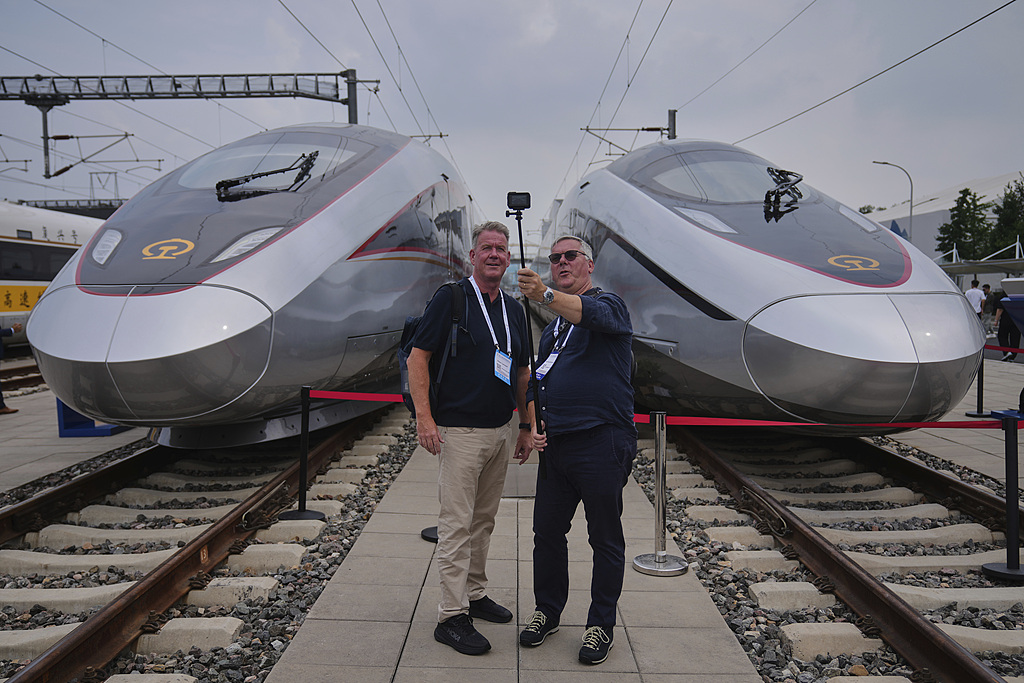
Delegates to the World Congress on High-Speed Rail take a selfie with the Fuxing CR400 high-speed train, left, and the new generation of Fuxing CR450 high-speed EMU, right, as they tour the National Railway Test Center in Beijing, July 9, 2025. /VCG
Speed remains a core indicator. By the end of 2025, China’s high-speed rail network exceeded 45,000 kilometers, with the 350 km/h network continuously expanding. In the past five years, the CR450 electric multiple unit (EMU) prototype achieved a single-train speed of 453 km/h and a relative passing speed of 891 km/h in tests, laying the groundwork for next-generation high-speed rail.
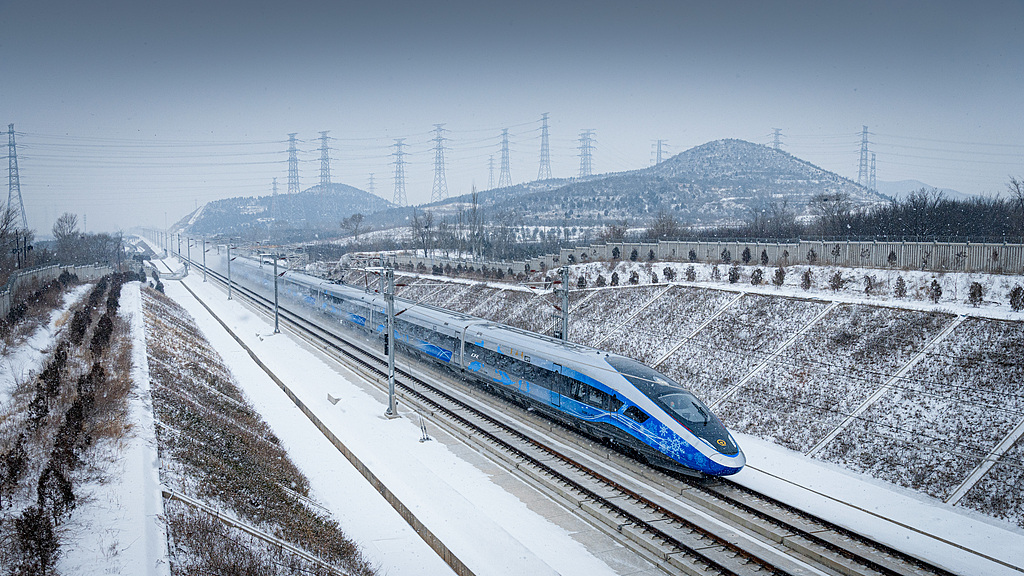
A smart high-speed train for the Beijing Winter Olympics speeds along the Beijing-Zhangjiakou High-Speed Railway in Beijing, January 22, 2022. /VCG
Intelligent systems became a defining feature. Projects like the smart Beijing-Zhangjiakou line integrated technologies, including intelligent dispatch, environmental sensing and maintenance. The application of big data and BeiDou navigation significantly enhanced operational safety and efficiency.
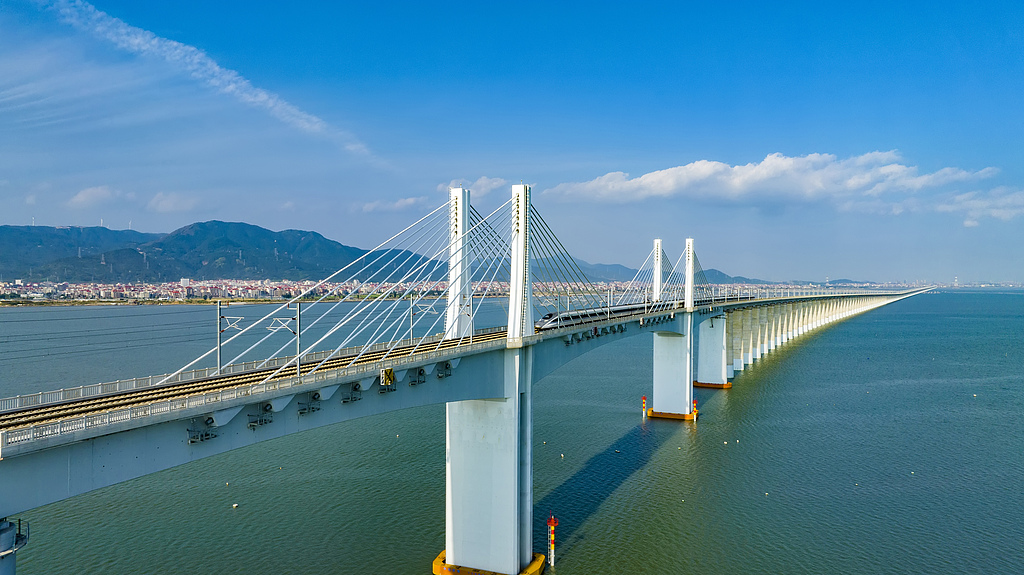
A high-speed train races across the Meizhou Bay Sea-Crossing Bridge on the Fuzhou-Xiamen High-Speed Railway in Quanzhou, southeast China’s Fujian Province, November 3, 2023. /VCG
Engineering capabilities reached new heights in complex environments. The Fuzhou-Xiamen High-Speed Railway, opened in September 2023, features the world’s first ballastless-track cross-sea bridge over Meizhou Bay, enabling 350 km/h operations in marine conditions.
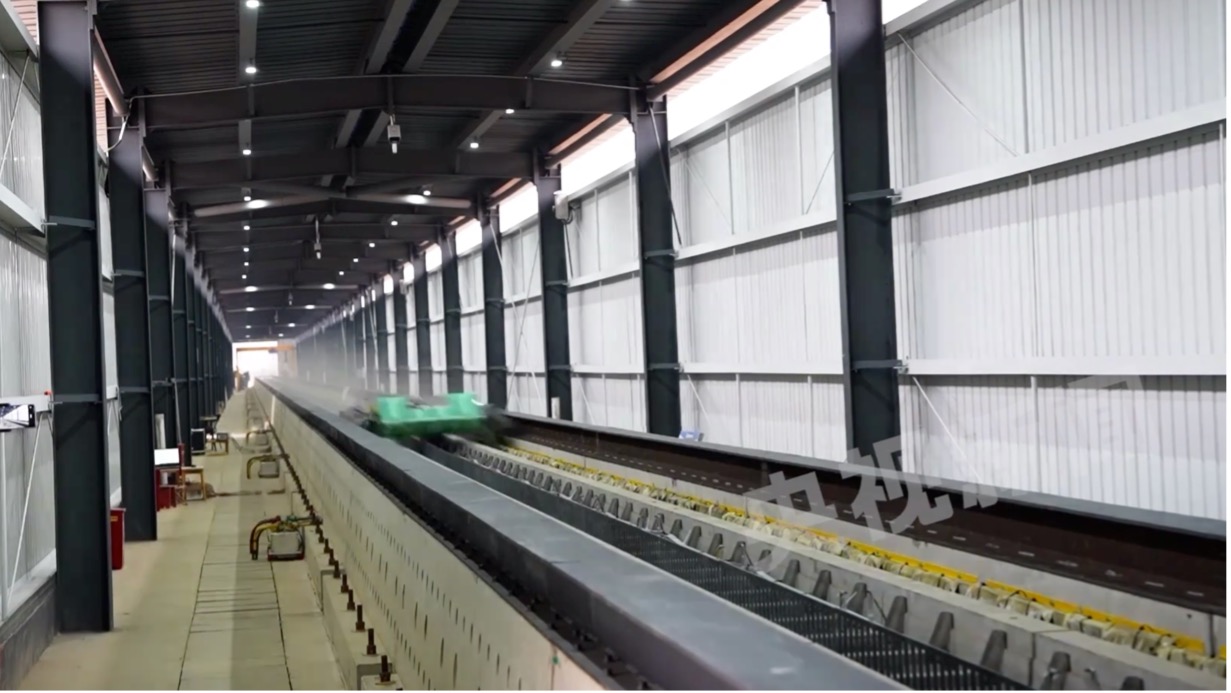
A test vehicle runs at ultra-high speed during an experiment. /CMG
Cutting-edge research has also progressed. In December 2025, a domestic superconducting maglev test system achieved 700 meters of acceleration within 2 seconds, accumulating valuable data for future ultra-high-speed transit.
These technological advances during the 14th Five-Year Plan have solidified the reliability of China’s high-speed rail network for mass transportation and contributed Chinese solutions to global rail development.