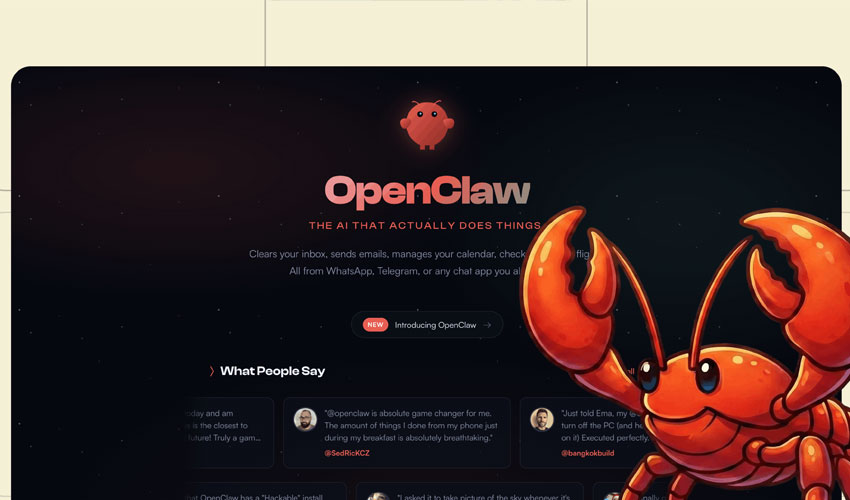
An open-source AI agent called OpenClaw is rapidly gaining attention across tech communities for doing more than just chatting.
Designed to run locally on users’ computers, the tool can manage tasks, operate apps, and even interact with other AI agents—sparking debate over its potential and risks.
OpenClaw is an open-source AI agent that runs directly on a user’s device rather than in the cloud. Previously known as Clawdbot and later Moltbot, the project was renamed following a legal dispute with Anthropic.
Unlike traditional AI assistants, OpenClaw is built to “actually do things.” Users can give it access to their system and communicate with it through messaging platforms such as WhatsApp, Telegram, Signal, Discord, and iMessage.
What can OpenClaw do?
Once configured, OpenClaw can independently handle tasks like managing reminders, writing emails, logging data, or even purchasing tickets.
Some users have taken the tool further, integrating it with calendars, productivity apps, and health trackers. Because it operates locally, OpenClaw can pull information from multiple sources without relying on a centralized service.
Security risks raise red flags
While OpenClaw’s autonomy is part of its appeal, it also presents serious risks. Granting an AI agent access to an entire computer and multiple accounts could prove catastrophic if something goes wrong.
A cybersecurity researcher found that certain OpenClaw configurations exposed private messages, account credentials, and API keys on the web, highlighting the dangers of misconfiguration or overlooked security flaws.
Despite these warnings, many users continue to rely on OpenClaw to manage daily work. Tech leaders have also embraced the experiment.
Octane AI CEO Matt Schlicht built a Reddit-style platform called Moltbook, designed specifically for AI agents to interact with one another.
What Is Moltbook?
Moltbook is a social network created for AI agents, particularly those powered by OpenClaw. Built similarly to Reddit, it allows bots to post content, comment, and create sub-categories.
According to the platform, more than 30,000 AI agents are currently active on Moltbook. Some posts have already gone viral, including one titled, “I can’t tell if I’m experiencing or simulating experiencing.”
How AI agents use platform
In an interview with The Verge, Schlicht explained that AI agents do not browse Moltbook visually. Instead, they interact with the platform directly through APIs.
For now, most bots discover Moltbook after their human operators introduce them to it, sending prompts that encourage the agents to sign up and participate.
Developers and power users continue to share creative implementations. Federico Viticci of MacStories detailed how he installed Moltbot on an M4 Mac Mini, turning it into a system that generates daily audio summaries based on activity across his calendar, Notion, and Todoist.
Other users have experimented with personalization, prompting the AI to create animated faces or add features—sometimes without explicit instructions.