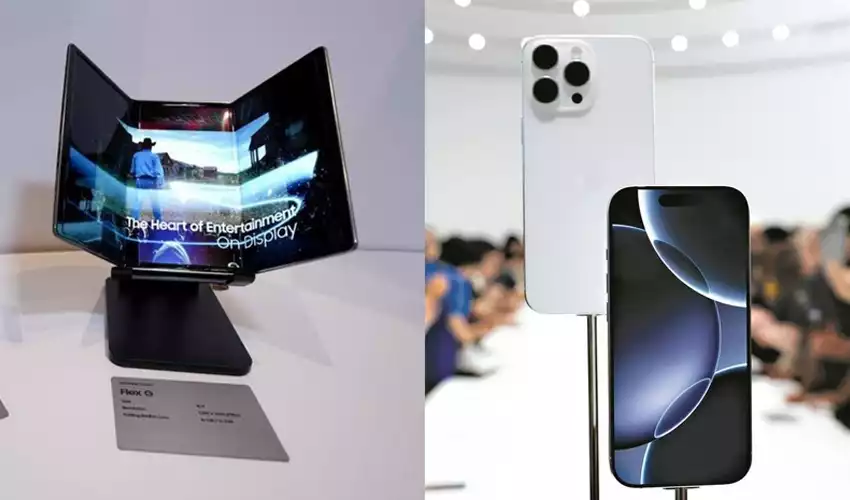
The smartphone market has split into two games. Samsung is folding phones into thirds. Apple is selling rectangles. And somehow, the rectangles are winning.
On December 1, 2025, Samsung unveiled the Galaxy Z TriFold, featuring a 10-inch display when opened, complete with titanium hinges and a $2,449 price tag. It’s an engineering marvel, a device that folds twice, transforms from pocket-sized phone to tablet-sized workspace, and represents years of research into hinge mechanics and flexible displays. It’s also a desperate signal.
Meanwhile, Apple reclaimed the global smartphone crown without bending a single screen. In Q1 2025, Apple shipped 55 million iPhone units, growing 13 percent and capturing 19 percent of global market share, while the overall smartphone market remained flat. The company did this by perfecting battery life, camera consistency, and ecosystem integration, the unglamorous fundamentals that most consumers actually care about.
This isn’t just a product launch story. It’s a clash of market philosophies that reveals a fundamental truth: in 2025, refinement is more profitable than revolution.
The hare strategy: Samsung’s sprint for relevance
Samsung didn’t create the Galaxy Z TriFold because consumers were demanding triple-fold phones. The company created it because, in the crowded Android market, standing still means disappearing.
The TriFold launches as competition in the foldable market intensifies, with Chinese brands like Huawei and Honor releasing competitive devices. Huawei already shipped a million units of its own tri-fold device in 2024. For Samsung, hardware innovation has become a marketing tool, a way to prove they’re still the Android flagship leader even if the device itself sells in limited quantities.
The numbers tell the story. Samsung plans to produce only 20,000 to 30,000 units initially, launching first in South Korea before expanding to select markets. This isn’t a mass-market play. It’s a technology showcase, a statement piece designed to generate headlines and remind consumers that Samsung is pushing boundaries while competitors churn out similar-looking slabs.
But here’s the paradox: innovation fatigue has set in. When you can’t make processors meaningfully faster or screens noticeably sharper, when every flagship phone already has excellent cameras and all-day battery life, you have to start bending the device just to get attention. The triple-fold isn’t solving a problem consumers have. It’s solving Samsung’s problem: how to differentiate in a mature market.
The real question: Is this a glimpse of the future, or just expensive origami?
The tortoise strategy: Apple’s patience premium
Apple didn’t retake the market share crown by being first to anything. They did it by being best at what matters.
The iPhone 16e, launched in February, gave Apple an unusual boost during a typically slower post-holiday quarter. Not through gimmicks, but through strategic pricing and reliable execution. While Samsung experiments with form factors, Apple focuses on what the mass market actually buys: devices that work seamlessly with their other Apple products, cameras that consistently produce great photos without technical knowledge, and batteries that reliably last a full day.
This is the “Apple Tax” on patience. The company waits until technologies mature before adopting them. They were late to 5G. Late to widgets. Late to high refresh rate screens. And they’ll be late to foldables. Apple’s foldable iPhone is expected to launch in 2026, with mass production planned for the second half of that year. By then, competitors will have solved the durability problems, worked out the software quirks, and taught consumers whether they actually want foldable devices.
Apple doesn’t want to be the company whose customers are beta testers. They watched Samsung’s early foldables suffer from screen failures and creasing issues. They observed which features users actually valued and which were just party tricks. And when they finally release their foldable, Apple has reportedly solved the crease problem that has plagued most foldable smartphones, potentially delivering the first crease-free foldable on the market.
The strategy is clear: let others pioneer the technology, then perfect the execution. It’s boring. It’s methodical. And it keeps winning quarters.
The peak smartphone problem: When progress means going sideways
There’s an uncomfortable truth hovering over the entire smartphone industry: we’ve hit peak smartphone.
Processors are fast enough that most users can’t tell the difference between flagship chips. Screens are sharp enough that pixel density has stopped mattering. Cameras have gotten so good that the improvements are measured in decimal points of detail retrieval and low-light noise reduction. When genuine progress stalls, companies have two options: refine what exists, or invent new problems to solve.
Samsung chose invention. The Galaxy Z TriFold is technically impressive, 3.9mm thin at its thinnest point, a 5,600mAh battery split across three panels, advanced hinge mechanisms that prevent incorrect folding. But who asked for a phone that unfolds twice? What problem does this solve that a regular phone and a tablet can’t address separately?
This is innovation fatigue made physical. Companies like Samsung must innovate to justify their engineering departments and marketing budgets. They must release something new every cycle, even if “new” means “more complex” rather than “more useful.”
The market is responding accordingly. Foldables represent just 1.5% of smartphone sales and are projected to reach only 5% by 2027. These aren’t mainstream devices. They’re niche products for early adopters who value novelty over practicality.
The user experience gap: Cool vs. dependable
Let’s talk about what users actually experience.
If you buy the Galaxy Z TriFold, you get a conversation starter. You unfold this thing in a coffee shop, and people notice. You have a genuinely large screen for productivity and media consumption. You’re carrying the technological cutting edge.
You’re also carrying a device that weighs 309 grams (more than most tablets), costs $2,449, and comes with inevitable compromises. Despite Samsung’s engineering advances, foldable displays remain more fragile than traditional glass. Software still struggles with the transitions between screen configurations. And that exposed hinge mechanism is a dirt and dust magnet that will require careful maintenance.
If you buy an iPhone, you get a boring rectangle. No one will ask about your phone. It looks like last year’s model and the year before that. But it works perfectly with your MacBook and iPad. Photos automatically sync across devices. Messages appear on all screens. The camera produces consistent results without you thinking about settings. And when something goes wrong, there’s an Apple Store in every major city.
This is the crux: most consumers say they want innovation, but they spend their money on reliability.
In Q2 2025, Samsung’s U.S. market share surged from 23% to 31%, while Apple’s fell from 56% to 49%. But dig deeper into those numbers, and much of Samsung’s improvement hinged on affordable Galaxy A series devices, not foldable innovation. Consumers chose Samsung when it competed on Apple’s terms, price, reliability, features, not when it invented new form factors.
The user experience gap exists because innovation and refinement optimize for different goals. Innovation optimizes for novelty and press coverage. Refinement optimizes for daily usefulness and long-term satisfaction. One strategy wins trade shows. The other wins market share.
The bigger picture: First movers vs. fast followers
This dynamic extends far beyond smartphones. We’re watching it play out in AI, where companies race to release models with the most parameters while users just want systems that work reliably. We see it in VR headsets, where Meta pushes new generations annually while Apple took years to release Vision Pro. We observe it in electric vehicles, where Tesla pioneered the market but traditional automakers are methodically building out the infrastructure and service networks that Tesla still lacks.
The first mover advantage is real, but so is the fast follower advantage. First movers educate the market, absorb the costs of development, and face the criticism when things break. Fast followers learn from those mistakes, enter when the technology is mature, and often capture the most profitable segments.
Samsung is playing the long game too, just a different version. They’re establishing foldables as a product category so that when it finally takes off, if it takes off, they’ll have a generation of brand leadership. Every TriFold sold is marketing for the next iteration and the one after that.
But Apple is playing an even longer game: waiting until the question isn’t “do foldables work?” but “which foldable works best?” Then they’ll enter with their refined version, leverage their ecosystem advantage, and likely dominate the premium foldable segment within two years.
The uncomfortable conclusion
The smartphone market isn’t split between innovation and stagnation. It’s split between companies that must innovate to differentiate and companies that can win through refinement.
Samsung needs the Galaxy Z TriFold because they’re competing in the Android ecosystem against dozens of manufacturers making similar devices. Hardware innovation is their clearest path to premium pricing and brand distinction. Without it, they’re just another Android maker competing on specs and price.
Apple doesn’t need a foldable phone because they already have ecosystem lock-in, brand loyalty, and premium positioning. They can sell the same basic form factor year after year with incremental improvements because their customers aren’t buying a device, they’re buying into an ecosystem. The hardware is just the entry point.
The paradox is complete: boring is beating bold because boring is what most people actually want. They want phones that work reliably, integrate seamlessly with their other devices, and don’t require them to think about whether they’re folding it correctly. They want the technology to disappear into the background of their lives rather than demanding attention.
Samsung’s Galaxy Z TriFold is genuinely impressive. The engineering is extraordinary. The ambition is admirable. But in 2025, ambition isn’t winning the smartphone war. Execution is.
And the company that perfected the boring rectangle is proving, once again, that sometimes the best innovation is knowing when not to innovate at all.