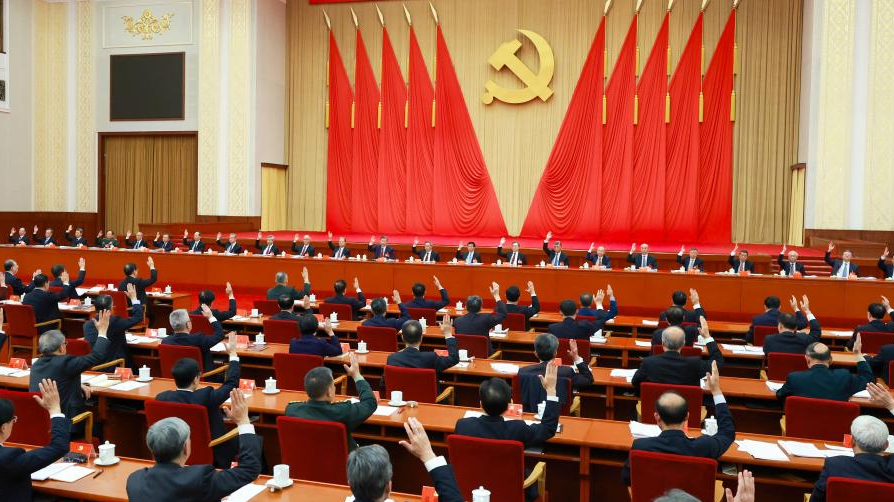
Major international media outlets have provided extensive coverage of the Fourth Plenary Session of the 20th Central Committee of the Communist Party of China, along with the communique issued at the conclusion of the session on Thursday.
The reports of foreign media focused on several key aspects of the communique, emphasizing the continuity and stability of the policies, the prioritization of technological self-reliance, and the drive to boost domestic consumption as key components in advancing socialist modernization.
Policy continuity and stability
Citing Xin Sun, a senior lecturer at King’s College London, the Associated Press (AP) noted that the communique reflected more continuity than change in the policy direction.
Similarly, the Financial Times (FT) also recognized the policy consistency, quoting Bert Hofman, a professor at the National University of Singapore, who said that there were “small nuanced changes” but little major shift in direction.
Hofman told the FT that such an emphasis on continuity had a “tactical” element. Noting that there’s a lot of upheaval in the world, Hoffman said that China is “continuing to implement their plan towards socialist modernization.”
Emphasis on technological self-reliance
Foreign media outlets also highlighted China’s deepened commitment to technological self-sufficiency, income redistribution, and clean energy transition in the new blueprint.
Reuters reported that the communique emphasized the creation of a “modern industrial system” with advanced manufacturing as its backbone, while accelerating “high-level scientific and technological self-reliance.”
The FT echoed this, noting that China aims to substantially improve its technological independence in response to external challenges, particularly the technological restrictions imposed by the United States.
The Business Standard added that China’s key objectives include fostering new productive forces and achieving technological self-reliance.
Boosting domestic demand and consumption
Another key focus in foreign media reports was China’s efforts to boost domestic demand and consumption.
Noting that China has rolled out various policies to help increase consumption, such as subsidies for consumer loans and child care packages and trade-in programs for electric vehicles and appliances, AP reported that the communique showed China would continue to boost domestic demand and spending, an objective that economists said is important for the country’s economic growth.
Reuters also noticed China’s promise of more efforts to expand domestic demand and improve people’s livelihoods.
The Business Standard also noticed the communique’s emphasis on expanding domestic demand and improving people’s livelihoods while cautioned that rebalancing the economy may be slow, given the Chinese economy’s dependence on exports.
Citing expert Yue Su from the Economist Intelligence Unit, AFP stressed the importance of boosting consumption as a driver for domestic demand.
“We can expect investment to focus more on consumption-related sectors and activities, such as improved urban planning, public services, and elderly care,” Yue told AFP.