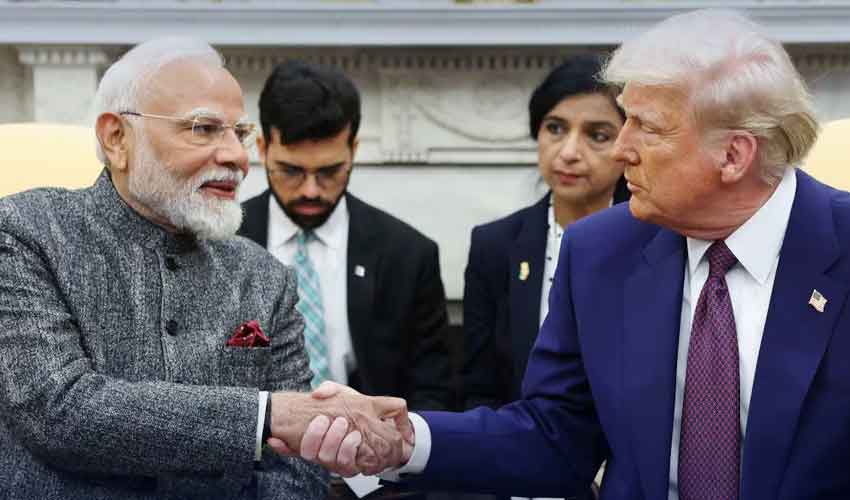
US President Donald Trump announced on Wednesday that Indian Prime Minister Narendra Modi has pledged to stop purchasing oil from Russia, marking a major development in Washington’s global push to curb Moscow’s energy income amid the ongoing Ukraine war.
Speaking at a White House press conference, Trump said he would next turn his focus toward persuading China to halt similar purchases, signaling a new phase in his administration’s strategy to economically isolate the Kremlin.
“So I was not happy that India was buying oil, and he (Modi) assured me today that they will not be buying oil from Russia. That’s a big step. Now we’re going to get China to do the same thing.”
India and China: Russia’s top oil customers
India and China remain the two biggest buyers of Russian seaborne crude exports, capitalizing on the discounted prices Moscow has offered since European buyers began avoiding its oil following sanctions from the US and the European Union over the 2022 invasion of Ukraine.
India alone imported about 1.62 million barrels per day from Russia in September — nearly one-third of its total crude needs — making Moscow its top oil supplier.
Until now, Indian officials had defended the purchases as essential to national energy security, resisting US pressure and emphasizing affordability for a developing economy.
However, analysts caution that such a shift will take time. Trump himself acknowledged that India could not stop shipments “immediately,” describing the process as “a little bit of a process, but that process will be over soon.”
US tariffs and diplomatic push
Trump has increasingly targeted India over its Russian oil imports, imposing tariffs totaling 50% on Indian exports to the United States this year — 25% initially after trade talks failed, and another 25% explicitly linked to its continued crude purchases from Moscow.
India reportedly viewed the move as unfair since other major Russian oil buyers like China and Turkey were not subjected to similar penalties.
The announcement of Modi’s pledge came just days after Trump’s nominee for US Ambassador to India, Sergio Gor, met with Modi in New Delhi to discuss defense, trade, and technology cooperation. Gor, a close Trump ally, is seen as central to advancing the administration’s India strategy.
Japan also urged to end Russian energy imports
In a related development, US Treasury Secretary Scott Bessent said he had urged Japanese Finance Minister Katsunobu Kato during a meeting in Washington to stop importing Russian energy.
“Minister Kato and I also discussed important issues pertaining to the U.S.-Japan economic relationship and the administration’s expectation that Japan stop importing Russian energy,” Bessent wrote on X (formerly Twitter).
The Japanese government has not yet issued a response, similar to the Indian embassy in Washington, which has remained silent on whether Modi made such a commitment.
Trump highlights broader achievements
During the same press briefing, Trump also reflected on a range of domestic and international issues, touting his record in reducing global conflicts and tackling crime within the US.
“I stopped eight wars, also met the prime minister of Pakistan,” he said, and once again mentioned that seven planes had been shot down in the Indo-Pak war in May. He also remarked that the prime minister of Pakistan had some time back credited him with helping “save millions of lives”.
Trump further claimed that peace has been established in the Middle East after 3,000 years, and said Russia had lost thousands of soldiers in the Ukraine conflict.
Operation Summer Heat and crime in US cities
Shifting to domestic affairs, Trump highlighted the success of Operation Summer Heat, an initiative aimed at crime prevention and the arrest of violent offenders.
“Important successes were achieved in Operation Summer Heat,” Trump stated. “We’ve made Washington the safest city in America.”
He contrasted this with other cities, citing Chicago as an example where 11 people were killed last week, and vowed to “clean all cities in America from crime.”
“The law and order situation in some cities is worse than war zones,” Trump warned, emphasizing that his administration had launched a “war against criminals” based on the mandate given by the people.